Learn how to manage Snowflake budget alerts across multiple accounts with centralized visibility. Improve FinOps control, reduce cost surprises, and streamline monitoring.
Centralizing Snowflake Budget Alerts: A Smarter Approach to FinOps Control
Managing costs in Snowflake becomes increasingly complex as organizations scale across multiple accounts, teams, and environments. What starts as a straightforward cost monitoring setup quickly turns into fragmented tracking, duplicated configurations, and delayed visibility into spend patterns.
One of the most common challenges faced by FinOps and data teams is the limitation of budget alerts. While Snowflake provides native mechanisms to track and control costs, these capabilities are primarily designed at the individual account level. As organizations expand, this model introduces inefficiencies that make it harder to maintain consistent cost governance.
This article explores the limitations of Snowflake’s native budget alerting system, the operational challenges it creates, and how centralized budget monitoring helps teams regain control over cost visibility and accountability.
The Problem with Snowflake Budget Alerts Today
Budget alerts in Snowflake are useful in principle, but their current structure creates friction for organizations operating at scale. Each Snowflake account requires its own independent budget configuration, meaning teams must replicate the same setup across environments such as development, staging, and production.
This becomes particularly challenging in multi-account architectures, where different teams or business units operate separate Snowflake instances. Instead of having a unified view of spend, teams are forced to monitor each account in isolation.
Another limitation comes from the types of alerts available. Snowflake currently supports two alerting modes: a standard option that is relatively low cost and a low-latency option that provides faster detection but comes at a significantly higher cost. This trade-off forces teams to choose between delayed visibility and increased monitoring expenses, neither of which is ideal in a FinOps-driven environment.
Over time, these constraints lead to inconsistent budget policies, gaps in monitoring, and delayed detection of cost overruns.
Why This Becomes a FinOps Bottleneck
From a FinOps perspective, the goal is not just to monitor costs but to ensure accountability and proactive control. When budget alerts are fragmented across accounts, it becomes difficult to answer fundamental questions such as:
- How much is the organization spending across all Snowflake environments?
- Which accounts are exceeding budgets consistently?
- Where should optimization efforts be prioritized?
Without centralized visibility, teams often rely on manual aggregation of cost data, which slows down decision-making and increases the risk of missing anomalies.
In fast-growing data environments, this delay can translate into significant unnecessary spend before corrective action is taken.
What We Built: Centralized Budget Alerts Across Snowflake Accounts
To address these challenges, Anavsan introduced a centralized approach to budget monitoring that extends beyond the limitations of native Snowflake alerts.
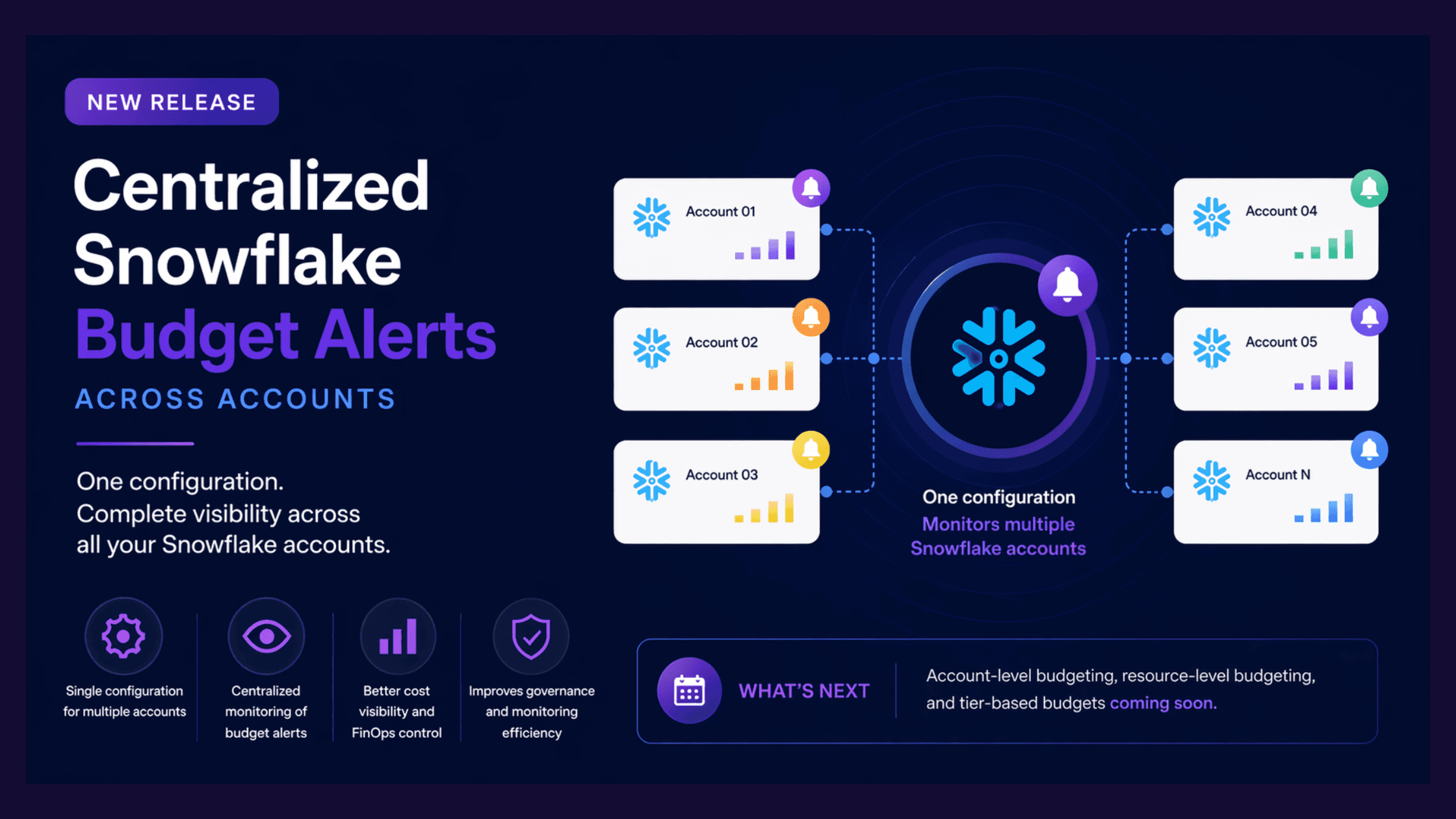
Instead of configuring alerts separately for each account, teams can now define a single monitoring configuration to track budgets across multiple Snowflake accounts. This fundamentally changes how cost monitoring works by shifting from a siloed model to a unified FinOps control layer.
With centralized budget alerts, organizations can track spend across their entire Snowflake footprint without duplicating effort or losing visibility across environments.
How Centralized Budget Alerts Improve Cost Visibility
Centralization simplifies one of the most complex aspects of Snowflake cost management: visibility. Instead of navigating multiple dashboards or switching between accounts, teams gain a consolidated view of budget consumption across all monitored environments.
This unified perspective makes it easier to detect anomalies early, understand spending patterns, and correlate cost increases with specific workloads or teams. More importantly, it enables faster decision-making because all relevant information is available in one place.
As a result, organizations can move from reactive cost monitoring to proactive cost management.
Reducing Operational Overhead for FinOps Teams
One of the hidden costs of managing Snowflake at scale is the operational overhead associated with maintaining monitoring systems. When budget alerts must be configured individually for each account, even small changes require repeated updates across environments.
This creates unnecessary complexity and increases the likelihood of configuration drift, where some accounts are monitored differently than others.
By centralizing budget alerts, teams eliminate the need for repetitive setup and maintenance. A single configuration can be updated once and applied universally, ensuring consistency across all accounts.
This not only saves time but also reduces the risk of human error.
Enabling Better Cost Governance Across Teams
Cost governance is most effective when it is consistent and transparent. In decentralized setups, different teams may follow different budget thresholds, alerting mechanisms, or monitoring practices, leading to uneven cost control.
A centralized model standardizes how budgets are monitored and interpreted across the organization. This ensures that all teams operate under the same FinOps policies, making it easier to align cost optimization efforts with business goals.
It also improves accountability by providing a clear view of how each account contributes to overall spend.
The Practical Benefits of Centralized Budget Alerts
Organizations adopting centralized budget monitoring typically see improvements in several key areas:
- Reduced time spent managing and updating budget configurations
- Faster detection of cost anomalies across accounts
- Improved visibility into organization-wide spend
- More consistent enforcement of FinOps policies
- Better alignment between engineering and finance teams
These benefits compound over time as Snowflake usage continues to grow.
Where Native Snowflake Alerts Still Fall Short
While Snowflake provides a solid foundation for cost monitoring, its native capabilities are not designed for multi-account orchestration. As organizations scale, the gap between basic monitoring and advanced FinOps requirements becomes more apparent.
Specifically, native alerts do not provide:
- cross-account aggregation of budgets
- centralized policy enforcement
- unified visibility into cost consumption
- efficient scaling of monitoring configurations
This is where external orchestration layers become essential.
What’s Coming Next: Expanding Budgeting Capabilities
Centralized budget alerts are just the first step toward a more comprehensive FinOps framework.
Upcoming enhancements will focus on enabling more granular control over how budgets are defined and enforced. This includes support for account-level customization, resource-level budgeting, and tier-based budget structures that align more closely with real-world usage patterns.
As these capabilities evolve, organizations will gain even greater flexibility in managing costs across complex Snowflake environments.
Why This Matters for Modern Data Teams
As data platforms become central to business operations, cost management is no longer a secondary concern. It is a core operational responsibility that directly impacts efficiency, scalability, and profitability.
Teams that rely solely on fragmented monitoring systems often struggle to keep pace with growing workloads. In contrast, those that adopt centralized visibility and control mechanisms are better positioned to scale efficiently without losing track of costs.
Centralized budget alerts represent a shift toward more mature FinOps practices, where cost management is integrated into the broader data workflow rather than treated as an afterthought.
Final Takeaway
Snowflake cost management becomes exponentially harder as organizations scale across accounts and teams. Native budget alerts, while useful, are limited in their ability to provide unified visibility and control.
By centralizing budget monitoring, teams can eliminate operational inefficiencies, improve visibility, and enforce consistent cost governance across their entire Snowflake environment.
As FinOps continues to evolve, centralized approaches like this will play a critical role in helping organizations maintain control over their data platform costs.
See how Anavsan governs your Snowflake costs
APEX detects cost anomalies, assigns them to the owning engineer, and documents savings with proof — automatically.