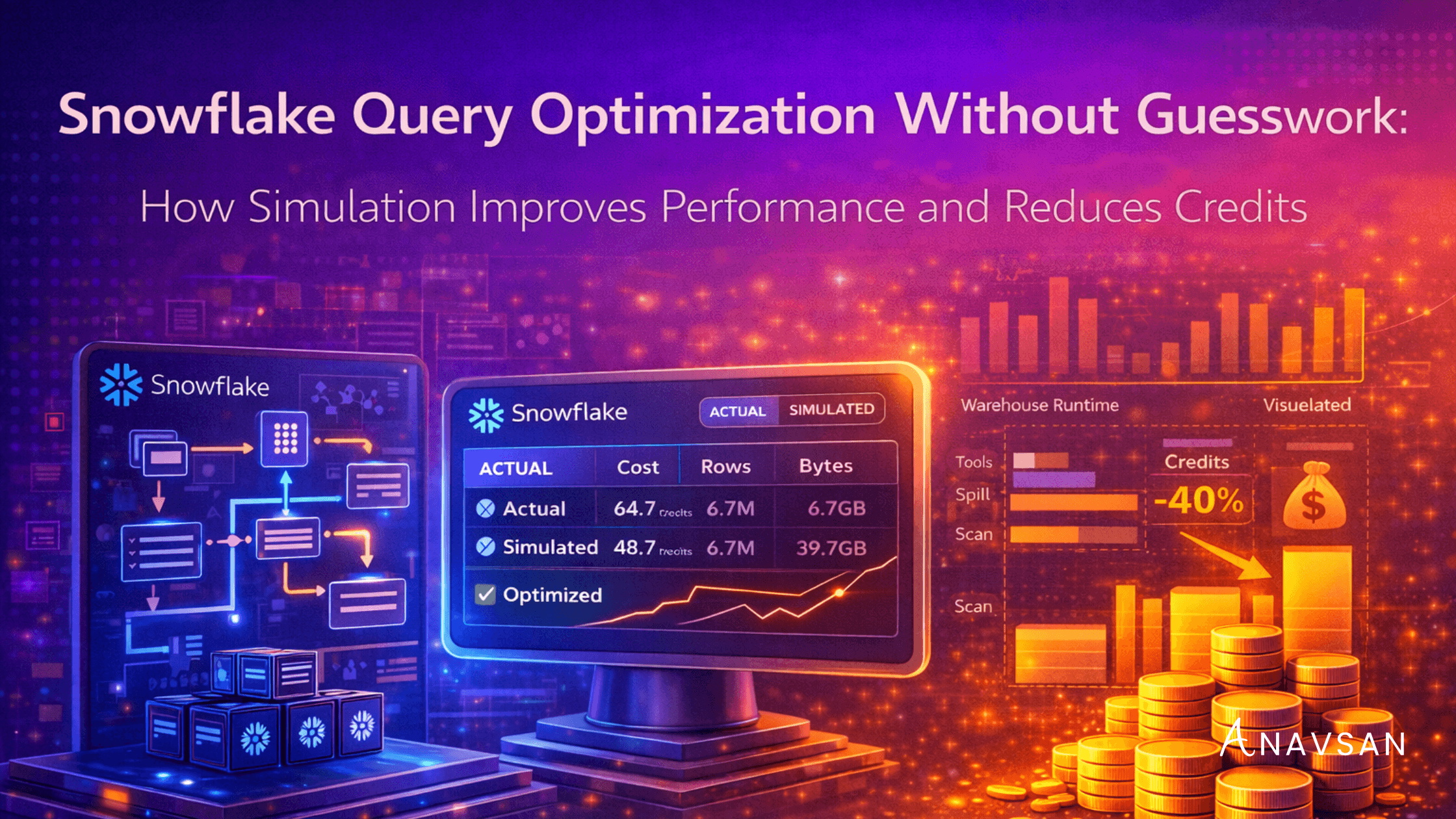
Learn how simulation-driven Snowflake query optimization helps data engineering teams reduce warehouse credits, prioritize high-impact rewrites, and improve performance without trial-and-error testing in production environments.
Snowflake Query Optimization Without Guesswork: How Simulation Changes Data Engineering Workflows
Snowflake query optimization has traditionally depended on experimentation. Engineers identify a slow or expensive query, rewrite parts of it based on experience, test the change in production-scale environments, and compare execution metrics afterward. While this workflow works at small scale, it becomes increasingly unreliable as query complexity and platform usage expand.
Modern Snowflake environments require a different approach. Instead of optimizing queries through trial and error, teams are beginning to simulate performance improvements before deploying changes. This shift is redefining how engineering teams prioritize optimization work and how organizations manage compute efficiency across workloads.
Simulation-driven optimization represents one of the most important changes in Snowflake platform engineering over the past few years.
Why Traditional Query Optimization Workflows Break at Scale
In early Snowflake deployments, engineers can manually inspect execution behavior and iterate quickly. Query plans remain interpretable, warehouse usage patterns remain predictable, and schema dependencies are relatively limited.
As organizations scale, however, query optimization becomes a coordination challenge rather than a tuning exercise.
A transformation rewritten to reduce scan volume may affect downstream dashboards. A join strategy change may alter clustering behavior. A warehouse resizing decision may improve latency while increasing credit consumption elsewhere. Without structured validation workflows, optimization introduces uncertainty rather than confidence.
Because of this risk, many engineering teams postpone improvements even after identifying inefficient queries. The cost of testing changes becomes too high relative to the expected benefit.
The Hidden Cost of Trial-and-Error Optimization
Trial-and-error optimization appears inexpensive on the surface because rewriting SQL is fast. The real cost emerges during validation.
Every production-scale test consumes warehouse credits. Every regression introduces downstream instability. Every rewrite attempt requires engineers to manually compare execution behavior across environments. Over time, these costs accumulate into a structural barrier that prevents optimization from happening consistently.
As Snowflake usage expands across analytics and operational pipelines, organizations cannot rely on intuition-driven optimization cycles anymore. They need workflows that allow them to estimate impact before committing changes.
Why Query History Alone Cannot Prioritize Optimization Work
Snowflake’s metadata views provide essential visibility into execution behavior, but they do not answer the most important optimization question: which changes will produce measurable improvement before they are implemented.
Engineers can identify expensive queries using execution statistics, yet deciding whether a rewrite is worthwhile still requires experimentation. Even when execution frequency and credit usage are known, the expected impact of structural SQL changes remains uncertain.
Without simulation capabilities, prioritization becomes subjective. Teams often optimize queries that are easy to modify rather than those with the highest potential savings.
Simulation replaces this guesswork with evidence.
What Simulation Changes in Query Optimization Workflows
Simulation introduces a forward-looking evaluation step into the optimization lifecycle. Instead of testing changes directly in production-scale environments, engineers can estimate how a rewrite will affect runtime, scan volume, and warehouse credits before deployment.
This allows teams to treat optimization as a measurable engineering process rather than a sequence of exploratory experiments.
Simulation also improves coordination between engineering and FinOps stakeholders. When the expected savings of a rewrite can be estimated in advance, prioritization decisions become transparent and defensible. Optimization work shifts from opportunistic improvements to structured platform investment.
Why Context Matters More Than Individual Query Performance
Most inefficient queries are not isolated mistakes. They are artifacts of schema evolution, orchestration constraints, or historical workload assumptions.
A join strategy that was efficient when a table contained millions of rows may become inefficient when it contains billions. A transformation optimized for nightly batch execution may perform poorly under near-real-time refresh schedules. A clustering decision that once improved pruning may become obsolete after schema expansion.
Effective optimization therefore requires understanding how queries interact with their surrounding environment rather than evaluating them independently.
Platforms that preserve relationships between queries, warehouses, and schemas allow optimization decisions to improve continuously over time instead of being rediscovered repeatedly.
How AI Is Changing Snowflake Query Optimization
AI-assisted optimization does not replace engineering judgment. Instead, it accelerates the identification of structural improvements that would otherwise require manual experimentation.
Modern optimization systems analyze execution behavior across workloads, detect inefficient scan patterns, and generate rewrite recommendations tailored to schema structure and usage patterns. Because these recommendations can be evaluated through simulation before deployment, they reduce the risk traditionally associated with query tuning.
This combination of automated detection and predictive validation is what enables optimization workflows to scale across large Snowflake environments.
Where Anavsan Fits in Simulation-Driven Optimization Workflows
Anavsan introduces simulation and workflow structure directly into Snowflake query optimization processes so engineering teams can evaluate improvements before modifying production workloads.
Its optimization engine analyzes execution behavior and generates rewrite recommendations informed by relationships between queries, warehouses, and datasets. Instead of requiring engineers to experiment manually, these recommendations can be evaluated using credit simulation to estimate their expected impact before rollout.
Because optimization decisions are tracked over time within a persistent knowledge graph, improvements compound rather than restarting with each investigation cycle. This allows engineering teams to maintain continuity across optimization initiatives even as workloads evolve.
The platform’s workspace layer further introduces accountability into optimization programs by enabling teams to assign rewrites, track validation progress, and preserve optimization history across environments. As Snowflake usage expands beyond individual teams, this workflow structure becomes essential for maintaining consistency and confidence in performance improvements.
Why Simulation Improves Engineering Confidence in Optimization Decisions
Engineering teams often recognize inefficient workloads but hesitate to modify them because the downstream consequences are difficult to predict. Simulation reduces this uncertainty by providing measurable estimates of expected improvement before implementation.
This allows optimization to move earlier in the delivery lifecycle. Instead of reacting to regressions after deployment, teams can validate performance improvements proactively. Over time, this changes optimization from an occasional maintenance activity into a continuous engineering discipline.
How Simulation Connects Query Optimization With Platform-Level Efficiency
Query optimization is most effective when it aligns with warehouse sizing strategies, workload scheduling patterns, and storage lifecycle decisions. Simulation helps teams evaluate these relationships explicitly.
When optimization decisions are evaluated in isolation, they improve individual queries. When they are evaluated in context, they improve entire platforms.
This distinction becomes increasingly important as Snowflake environments support analytics, machine learning pipelines, and operational workloads simultaneously.
Simulation allows engineering teams to optimize confidently across these layers without introducing unintended regressions.
The Future of Snowflake Query Optimization Is Predictive, Not Reactive
As Snowflake environments grow in complexity, optimization workflows must evolve from experimentation toward prediction. Simulation-driven platforms allow teams to estimate the impact of structural improvements before implementing them, reducing both compute waste and delivery risk.
This transition represents a shift from reactive tuning toward predictive platform engineering, where optimization decisions become measurable investments rather than exploratory interventions.
See how Anavsan governs your Snowflake costs
APEX detects cost anomalies, assigns them to the owning engineer, and documents savings with proof — automatically.