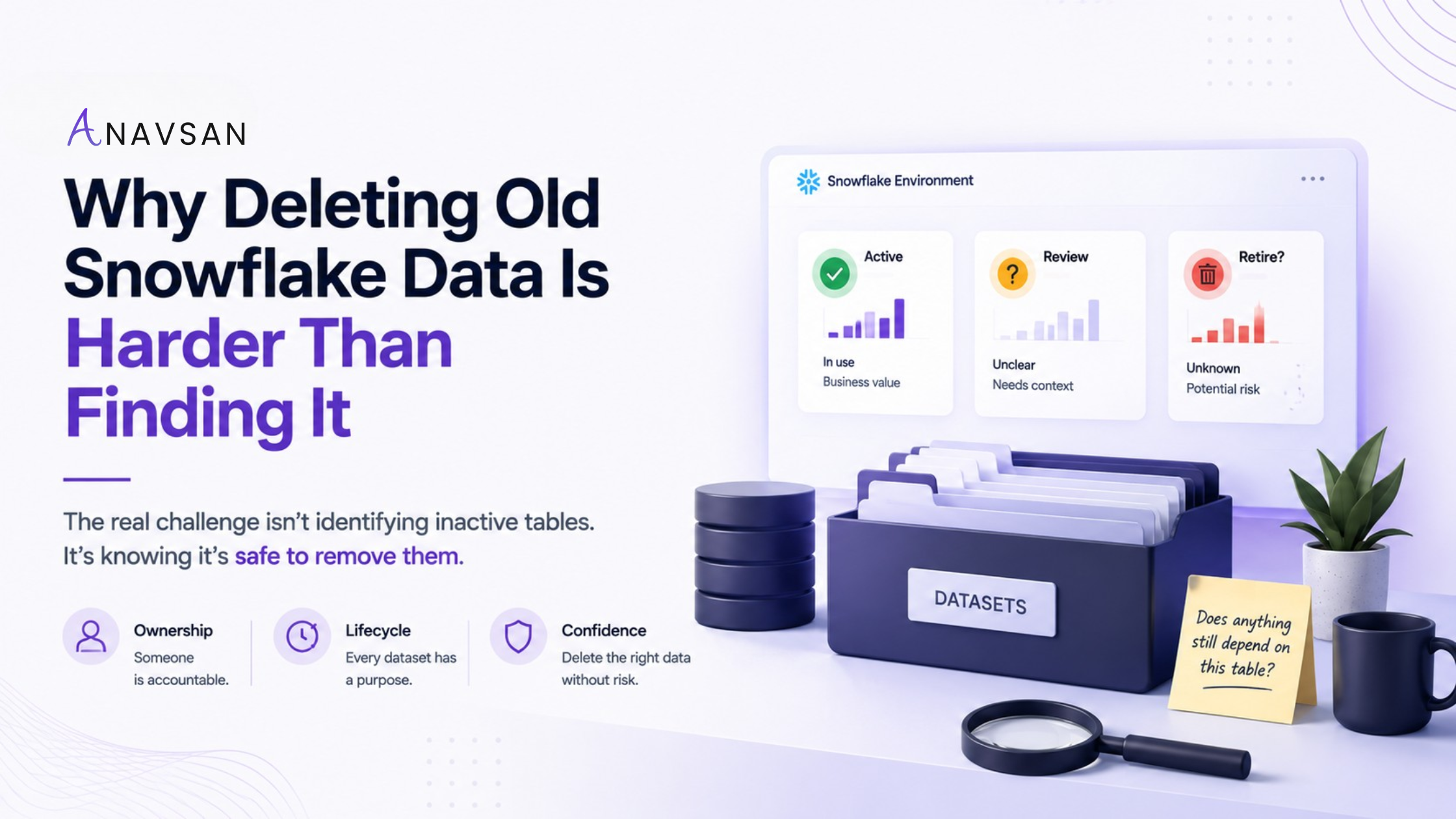
Most Snowflake storage optimization initiatives don't fail because teams can't identify inactive tables. They fail because nobody can confidently answer a much more important question: "Is it safe to delete?" Modern Snowflake environments accumulate data faster than organizations establish ownership and lifecycle policies. Sustainable storage optimization begins long before cleanup — it begins by ensuring every dataset has an owner, a purpose, and an expected lifecycle.
The Hardest Question in Storage Optimization Isn't "What Can We Delete?"
Every Snowflake environment reaches a point where storage becomes part of the FinOps conversation.
The initial review usually feels encouraging. Engineers pull object usage statistics, identify tables that haven't been queried for months, and discover databases that appear untouched since an old migration project. The list of obvious cleanup candidates grows surprisingly quickly, and it becomes tempting to believe that reducing storage costs will simply require deleting what nobody uses anymore.
Then someone asks a single question.
"Are we absolutely sure nothing still depends on these tables?"
The conversation changes immediately.
Suddenly, the problem is no longer identifying inactive data. It becomes understanding whether that data still has value somewhere else in the organization. A forgotten dashboard, an annual compliance report, a rarely executed machine learning pipeline, or an undocumented downstream integration could still rely on a table that appears completely inactive.
That hesitation explains why storage optimization projects often stall. The technical work is straightforward. The governance work is not.
Every Mature Snowflake Environment Slowly Builds a Data Archive Nobody Planned
Unlike compute costs, storage rarely creates urgency overnight.
Warehouses can suddenly consume more credits because of a poorly optimized query or an unexpected workload spike. Storage behaves differently. It grows gradually through hundreds of perfectly reasonable engineering decisions made over months or years.
A migration project creates temporary staging tables. A data science team duplicates production data for experimentation. Analysts preserve intermediate datasets while validating reports. New feature development introduces additional schemas, and completed proof-of-concept projects leave behind databases that nobody remembers revisiting.
None of these activities are mistakes. In fact, most of them are signs of a healthy engineering organization experimenting, iterating, and delivering new capabilities.
The challenge is that projects end much faster than infrastructure disappears.
Temporary data quietly becomes permanent. Test environments become part of the production landscape. Intermediate datasets outlive the transformations they were built to support. Storage grows not because organizations intentionally retain unnecessary information, but because deleting data always feels riskier than leaving it alone.
Over time, many Snowflake environments develop what could best be described as a data archive that nobody consciously designed.
Visibility Is No Longer the Limiting Factor
Modern Snowflake environments provide excellent visibility into storage.
Engineering teams can review object sizes, monitor growth trends, analyze query history, and identify tables that haven't been accessed in months. Compared to only a few years ago, finding inactive datasets has become significantly easier.
Yet visibility rarely solves the problem by itself.
A table that hasn't been queried for six months may genuinely be obsolete. It may also support a regulatory report that runs once every year. A schema created for an old application might appear abandoned while quietly supplying historical reference data to another system. Storage metrics alone cannot distinguish between forgotten data and intentionally retained data.
This is where many storage optimization initiatives lose momentum.
Organizations already know where storage is being consumed. What they often lack is the business context required to decide whether removing that storage introduces unnecessary risk.
The limiting factor is no longer observability. It is confidence.
Why Engineers Naturally Avoid Deleting Data
Engineers rarely hesitate because they enjoy keeping unnecessary infrastructure.
They hesitate because experience has taught them that deleting the wrong object can create far more work than retaining it for another few months.
Every experienced platform team has encountered a situation where removing what appeared to be an unused table unexpectedly broke a dashboard, interrupted an executive report, or disrupted a downstream process that nobody realized still existed. Those experiences shape future behavior.
Once trust is lost, deletion becomes the last option rather than the first.
The safest decision is often to postpone cleanup until someone can confidently prove that nothing depends on the dataset anymore. Unfortunately, that proof becomes increasingly difficult as engineering teams grow, projects change ownership, and institutional knowledge gradually disappears.
Without documented ownership, every inactive table becomes somebody else's responsibility.
Eventually, it becomes nobody's responsibility at all.
Identify inactive storage before it becomes permanent
Anavsan Storage Intelligence surfaces unused tables, migration artifacts, and excessive Time Travel — with ownership context to act confidently.
Storage Governance Begins When Data Is Created, Not When Storage Bills Increase
Organizations often think about storage optimization as an occasional cleanup initiative.
A team spends several days reviewing inactive objects, deletes what appears unnecessary, archives a few datasets, and considers the project complete until storage costs become noticeable again.
The healthiest Snowflake environments operate very differently.
Instead of relying on periodic cleanup exercises, they treat every new dataset as something with an expected lifecycle. Engineers know why it exists, which workloads depend on it, who owns it, and under what circumstances it should eventually be archived or retired.
That shift changes the nature of storage optimization completely.
Rather than asking whether a table should be deleted years after it was created, teams establish expectations at the beginning of its lifecycle. Temporary datasets remain temporary because everyone understands they were never intended to become permanent infrastructure. Experimental environments are reviewed before they quietly become long-term storage. Migration artifacts disappear as part of the migration process rather than months later during a storage audit.
Lifecycle governance reduces uncertainty because ownership never becomes ambiguous.
The cleanup becomes a natural consequence of good engineering practices instead of a risky maintenance exercise.
From Storage Cleanup to Lifecycle Governance
As Snowflake environments continue expanding, organizations will need to think differently about storage.
The conversation should gradually move away from finding large tables or deleting inactive objects and toward understanding how data evolves throughout its lifetime. Every dataset should have a clear purpose, a responsible owner, and an expected review cycle. Those three pieces of information provide significantly more value than another dashboard showing which database consumes the most storage.
This is also where storage governance begins to overlap with broader workload governance.
Data is created because workloads require it. When workloads change, the data supporting those workloads should evolve as well. If ownership disappears, if applications are retired, or if engineering priorities shift, the associated datasets should be reviewed as part of that same lifecycle. Storage optimization becomes an ongoing governance process rather than an isolated cost-reduction project.
The organizations that manage this well rarely perform dramatic storage cleanup exercises because they never allow forgotten infrastructure to accumulate in the first place.
Conclusion
The hardest part of storage optimization has never been finding inactive data.
Modern platforms already make that relatively easy.
The real challenge is understanding whether inactive data has reached the end of its useful life and whether someone has enough context to make that decision confidently.
That is why ownership, lifecycle management, and governance matter far more than cleanup scripts or storage reports. They provide the confidence engineering teams need to archive or retire data without introducing unnecessary operational risk.
As Snowflake environments continue growing, the most valuable question organizations can ask is no longer, "Which tables haven't been used?"
It is, "Who can confidently tell us why this table still exists?"
When teams can consistently answer that question, storage optimization becomes significantly easier — not because they delete more data, but because every dataset has a lifecycle that is understood long before it becomes forgotten.
Stop paying for data nobody uses
Anavsan helps teams identify inactive tables, assign ownership, and govern storage lifecycle — before forgotten datasets become permanent costs.