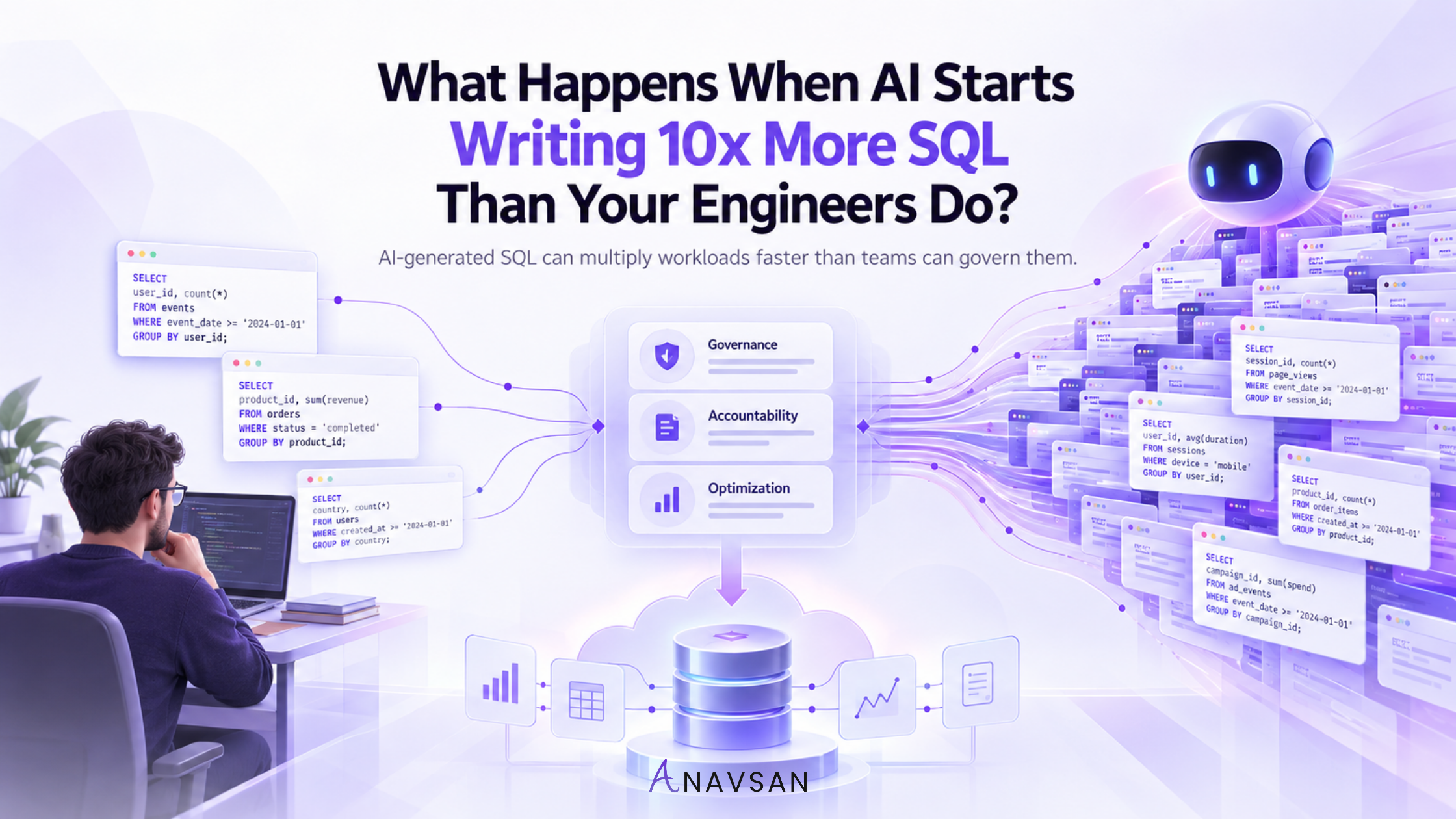
- AI-assisted development can increase the speed at which teams create SQL, but SQL generation and query execution are not the same thing.
- The biggest risks are unnecessary repeated executions, inefficient queries, unexpected concurrency, unclear ownership, and workloads that continue consuming resources after their original purpose has disappeared.
- Snowflake and BigQuery provide native visibility and cost-management mechanisms, but engineering teams still need a repeatable process for prioritizing changes, assigning owners, validating improvements, and preventing recurring waste.
- Anavsan’s APEX workload governance approach connects workload intelligence, optimization, ownership, and evidence of resolution across Snowflake and BigQuery.
- The next challenge for data teams is not simply generating better SQL. It is ensuring that growing workload volume remains economically and operationally accountable.
Imagine your data engineering team produces 500 SQL queries in a typical working day.
Now imagine AI coding assistants, analytical copilots, and autonomous agents begin generating 5,000.
Your engineers have not grown the team. Your data platform has not necessarily become ten times more efficient. And your Snowflake or BigQuery budget has not increased to accommodate the additional activity.
Yet thousands of additional SQL statements may now enter development workflows, analytics applications, and production environments.
The tenfold figure is a hypothetical scenario. It is a way to examine how a data platform would respond if query creation and execution grew much faster than the ability to govern them. It is not an observed industry statistic, an Anavsan customer result, or a forecast of a real deployment.
Not every generated query will execute. Not every executed query will be expensive. Some may never reach production, and others may benefit from caching or existing capacity.
The fundamental question remains: what happens when the ability to generate workloads grows much faster than the ability to govern them?
This is where AI-generated SQL stops being only a developer productivity story and becomes a data platform economics problem.
AI is accelerating SQL creation. Governance is not keeping pace.
For years, writing SQL required a reasonable understanding of databases, schemas, joins, aggregations, and performance considerations.
Natural-language interfaces and coding assistants are changing that workflow.
A business analyst can ask an assistant to compare quarterly revenue across regions. An engineer can use an AI tool to generate a transformation. A support agent can retrieve customer activity through an application that translates requests into SQL.
Each interaction can produce SQL without someone manually writing every statement.
The adoption trend is already visible. According to the 2026 State of Analytics Engineering Report from dbt Labs, 72% of surveyed respondents prioritize AI-assisted coding. Only 24% prioritize AI-assisted pipeline management, including testing, observability, and quality controls.
These percentages measure reported priorities, not the number of queries generated or executed. They still expose an important imbalance. Organizations are investing heavily in generating analytical work faster, while operational safeguards are not receiving the same attention.
The bottleneck is moving from writing SQL to understanding and governing its consequences.
That creates a new challenge for data engineering leaders. How do you maintain visibility, accountability, and cost control when SQL can be generated by people, applications, and agents at a much higher rate?
The real risk is more uncontrolled execution
AI-generated SQL is not inherently inefficient.
A well-generated query can be as effective as one written by an experienced engineer. AI can also help identify optimization opportunities and reduce the time required to implement them.
The problem begins when generated workloads are executed without sufficient context or controls. Five situations show how that happens.
Scenario A: One question becomes twenty queries
An analytics agent receives a request: “Why did customer retention fall last month?”
Instead of issuing one carefully scoped query, it may break the request into multiple steps. It could retrieve historical cohorts, compare customer segments, investigate cancellation patterns, query support activity, and run follow-up analysis.
Some of those operations may be necessary. Others may repeat work already completed. If several agents investigate similar questions simultaneously, overlapping queries may repeatedly scan the same tables.
The business sees one analytical request. The data platform sees many execution events.
Scenario B: A harmless query becomes expensive through repetition
Consider a query that consumes only a small amount of compute. Executed once, it may not deserve attention. Executed hundreds of times each day, its cumulative resource consumption can become meaningful.
An AI assistant might regenerate similar SQL with different filters, parameter values, or formatting. Depending on the database engine and query structure, those variations can affect the ability to reuse cached results.
The problem is not necessarily that one query is expensive. It is that no one is evaluating what the same query pattern costs over time.
This is why repeated-query detection is especially important in AI-assisted environments. Cumulative consumption, not a single execution, is what turns a small statement into a material workload.
Scenario C: Agents compete with business-critical workloads
Imagine several AI agents exploring operational data during business hours. At the same time, finance dashboards, customer-facing applications, and scheduled transformations are using the same underlying compute resources.
Additional queries can increase concurrency and create queueing or capacity pressure.
In Snowflake, the actual impact depends on warehouse configuration, workload isolation, and scaling behavior. In BigQuery, the impact depends in part on whether the project uses on-demand pricing or capacity-based reservations, and on how workloads share available slots.
More query requests do not automatically mean proportionally higher cost. They can instead appear as greater capacity pressure, slower execution, or higher resource consumption. Teams need to recognize which workloads justify those tradeoffs.
Scenario D: Generated SQL creates downstream consequences
An AI-generated transformation may produce another intermediate table, scheduled model, or data copy. Initially, that output may appear harmless. Over time, similar processes can create overlapping datasets, redundant transformations, additional refresh workloads, and storage growth.
Some outputs are required and valuable. Others may duplicate information that already exists. Without dependency and lineage context, teams can struggle to understand what relies on these objects before making changes.
AI-assisted SQL generation can therefore create more than compute overhead. It can increase the amount of data infrastructure that engineers must maintain and govern.
Scenario E: Nobody knows who owns the workload
A production query runs under a service account. Its technical identity is visible, but that identity may represent several applications or agents.
Who requested the analysis? Which team authorized the workload? Who decides whether it should be optimized, rescheduled, or discontinued? And who is accountable if the same issue returns?
A query’s execution identity is not always the same as its business owner. That distinction becomes increasingly important as automated systems create and trigger more workloads.
What does 10x SQL growth actually do to costs?
The most misleading assumption is that ten times more SQL automatically means ten times more data cloud spend. It does not.
Generation volume, execution volume, compute consumption, and billed cost are different measurements. A more useful starting point is:
Workload compute impact = execution frequency × average compute consumed per execution
The relationship is more complex under shared capacity, concurrency, caching, and different pricing models. It still provides a useful way to analyze repeated work.
Consider this hypothetical workload. The tenfold increase in statements generated is a scenario, not a measured industry average.
| Metric | Before AI-assisted expansion | After expansion |
|---|---|---|
| SQL statements generated per day | 500 | 5,000 |
| Share executed | 40% | 30% |
| Query executions per day | 200 | 1,500 |
| Average compute consumed per execution | 0.02 credits | 0.015 credits |
| Total illustrative daily compute | 4 credits | 22.5 credits |
In this example, the average compute consumed per execution has decreased by 25%. Cumulative query-level compute has still increased by more than five times.
At an illustrative compute rate of $3 per credit, the difference would be $55.50 per day, or approximately $1,665 across a 30-day period.
These are not Anavsan customer results or a forecast of a real deployment. The model also excludes idle compute, other platform charges, and pricing-model differences.
Individual queries can become more efficient while total workload consumption still grows considerably.
For data platform leaders, the relevant metrics are therefore not limited to query latency or the cost of individual executions. They also include execution frequency, cumulative resource consumption, workload ownership, concurrency, and growth relative to business value. Choosing which workload to optimize first starts from that cumulative picture, not from the single most expensive statement.
Why traditional cost dashboards are not enough
Both Snowflake and BigQuery provide mechanisms for understanding resource consumption.
Snowflake exposes information such as query history, warehouse metering, cost attribution, and execution patterns. BigQuery provides job history, billing data, slot-consumption information, and query execution details. These capabilities are essential.
Having cost data does not automatically resolve a workload problem. Suppose a cost dashboard identifies a recurring group of expensive queries. The team still needs answers to several questions:
- Are these queries necessary?
- Are they repeating the same underlying work?
- Which application, agent, or business process is responsible?
- What change could reduce resource consumption without breaking the outcome?
- Who has authority to approve and implement that change?
- How will the team confirm that the improvement held?
These are engineering and governance decisions, not simply reporting questions. Native platform information helps establish what happened. A practical governance process connects that information to decisions, owners, and verified outcomes.
This distinction matters more as workload creation accelerates. When engineers are responsible for a relatively small number of pipelines, they can often investigate manually. As automated workloads grow, relying entirely on human investigation becomes increasingly difficult.
The operational objective should be to make the process repeatable, not to remove engineers from important decisions.
Six controls every AI-enabled data platform should establish
Control 1: Identify the source of automated workloads
Teams should distinguish among human-authored workflows, AI-assisted development, BI-generated queries, application queries, and autonomous agents wherever reliable attribution is available.
Useful context includes application identifiers, workload names, service accounts, team ownership, execution environment, and query or job metadata.
For Snowflake, query tags can help associate queries with logical applications and cost centers. For BigQuery, job labels and project information can support workload attribution.
These identifiers need to be deliberately implemented. Query history alone cannot always prove whether a human or an AI model originally wrote the SQL.
Control 2: Measure cumulative workload behavior
A single execution rarely tells the full story. Track recurring query families, execution frequency, compute consumption, changes in performance, and the overall contribution of a workload to resource utilization.
Look beyond the ten most expensive individual queries. A moderately expensive query executed thousands of times may deserve attention before an expensive query that runs once a month.
Control 3: Evaluate potential optimizations before rollout
Optimization is not just rewriting SQL to make it shorter. A proposed change must preserve the business result and meet performance requirements.
Teams should consider query structure, data scanned, repeated computation, pruning, available capacity, and resource configuration. Where suitable, use pre-execution estimation, historical analysis, or simulation to assess likely impact before deploying a change. On Snowflake, simulating a query change before you deploy it is one way to reduce that uncertainty.
Estimates are not guarantees of future consumption. Their value is in reducing uncertainty and helping teams prioritize sensible experiments.
Control 4: Assign a responsible owner
Every material optimization opportunity needs a person or team responsible for deciding what happens next. The owner should understand the application’s purpose and the consequences of changing its workload.
An engineering task without a responsible owner can remain open indefinitely. A workload tied to a business outcome, an optimization decision, and a named owner is much more likely to reach resolution.
Control 5: Add safeguards around automated execution
For workloads that may be executed by autonomous agents, consider preventive controls such as appropriate permissions, query timeouts, resource limits, job budgets, workload isolation, and review requirements.
These mechanisms are platform- and architecture-dependent. They should be designed with security and platform teams rather than assuming that a downstream cost-management tool can intercept every query.
Cost governance and access security are complementary. They are not interchangeable.
Control 6: Prove that the change worked
After an engineer optimizes a repeated query or adjusts a resource configuration, measure the result under comparable conditions.
- Did the repeated execution frequency fall?
- Did the query consume less compute?
- Did performance stay within acceptable limits?
- Was the workload removed, consolidated, or rescheduled?
- Did the improvement continue after the next deployment?
Optimization without follow-through often becomes another recurring maintenance task.
Where Anavsan fits: from AI workload visibility to accountable optimization
This is the problem Anavsan’s APEX approach is designed to address.
Anavsan is not a SQL generation engine. Its role is to help teams understand the economic and operational behavior of workloads running across Snowflake and BigQuery.
As more SQL enters the environment, the need shifts toward identifying which patterns matter, connecting them to responsible teams, evaluating possible improvements, and documenting outcomes.
The core workflow is Trace → Assign → Enforce → Prove.
Trace: Understand what is consuming resources
Anavsan analyzes workload behavior to surface inefficiencies and optimization opportunities.
For Snowflake, capabilities include repeated-query and repeated-expensive-query intelligence, query analysis, warehouse insights, and related cost signals. For BigQuery, workload governance applies to jobs, scan behavior, slots, reservations, and available cost and storage metadata.
This provides a basis for distinguishing meaningful optimization opportunities from background activity that does not warrant intervention.
Assign: Connect findings to ownership
Finding an inefficient query does not automatically establish who should change it. Anavsan’s Private Knowledge Graph supports context-aware recommendations and ownership workflows based on the organization’s available workload knowledge.
The objective is to connect the technical finding to an actionable decision. In an AI-enabled environment, that context becomes especially valuable because workload execution may be separated from the original human request.
Enforce: Make optimization an operational decision
Here, enforcement means carrying an optimization through an accountable review and resolution workflow.
Anavsan’s query analysis and optimization capabilities help teams investigate expensive patterns and evaluate changes. Simulation capabilities can support pre-deployment assessment of potential query optimizations where available. Its shared workflow helps engineering and FinOps teams move a finding toward an approved action.
APEX is human-gated. It should not be confused with a universal inline query admission controller that automatically blocks or reroutes every SQL statement.
Prove: Verify outcomes instead of assuming savings
Once a change is implemented, the team needs evidence. Did the expected improvement materialize? Was the workload behavior actually changed? Does it remain within acceptable performance and cost boundaries?
Anavsan’s governance approach emphasizes measurable outcomes and documented closure, giving teams a way to distinguish open recommendations from completed optimization work.
The benefit is not simply another list of expensive queries. It is a repeatable process for turning workload intelligence into operational accountability.
Should every AI-generated query be allowed to run?
As autonomous systems become more deeply integrated into analytics operations, a larger architectural question emerges.
Should every generated query be executed immediately, simply because an application or AI agent requested it?
In some environments, the right answer will be yes. For others, the decision may depend on resource budgets, workload priority, execution time, data sensitivity, or expected business value.
A future-oriented workload-control architecture could evaluate a request before execution:
Who generated it → What does it need → What might it consume → Does it comply with policy → Where and when should it run?
Depending on the platform and the organization’s safeguards, appropriate actions could include allowing the request, requesting approval, choosing a different execution window, adjusting resource allocation, or rejecting an unsuitable workload.
That is the broader direction of data cloud workload control. It is not a claim that Anavsan currently implements all of those admission decisions inline across Snowflake and BigQuery. It points toward the problem that organizations will increasingly need to address as AI-generated workloads move from assisted development into autonomous execution.
The near-term foundation is clear: identify workloads, understand their consequences, establish ownership, and enforce decisions through reliable governance.
A practical readiness test for your data team
Before scaling AI-generated SQL across production data platforms, ask:
- Can we distinguish the applications and agents responsible for material workloads?
- Can we identify repeated query patterns rather than investigating one execution at a time?
- Do we understand the cumulative resource impact of automated workloads?
- Can we estimate the likely impact of significant optimization changes before rollout?
- Does every material workload issue have an accountable owner?
- Can we validate whether optimization actions achieved their expected outcomes?
- Do we have appropriate platform-level safeguards for autonomous query execution?
An organization does not need perfect answers to begin. If most of these questions are unanswered, accelerating SQL generation may also accelerate the volume of unmanaged engineering work.
AI may write the SQL. Your data platform still pays to execute it.
The promise of AI-assisted analytics is straightforward: engineers and business teams can build, investigate, and deliver faster. That is worth pursuing.
Better productivity at the code-generation layer does not automatically create better efficiency at the infrastructure layer. An AI system may produce a useful query in seconds. Snowflake or BigQuery still has to execute it.
Someone still needs to understand whether the workload is necessary, whether it can run more efficiently, and who is responsible for its ongoing resource consumption.
The organizations that benefit most from AI-assisted analytics will not necessarily be those generating the greatest number of queries. They will be those that can scale useful work without scaling uncontrolled resource consumption alongside it.
AI can write more SQL. The real competitive advantage is knowing which workloads are worth running, what they cost, and who owns the outcome.
See what your Snowflake and BigQuery workloads are really doing
Anavsan helps data engineering and FinOps teams identify recurring inefficiencies, evaluate optimization opportunities, assign accountability, and verify outcomes. APEX brings structured workload governance to Snowflake and BigQuery.
Frequently asked questions
Continue reading
- Repeated Queries in Snowflake: The Hidden Cost Driver — why cumulative query consumption matters more than a single expensive execution
- Snowflake Query Optimization: Simulate Before You Deploy — how to assess a query change before it reaches production
- The Missing Layer in Cloud FinOps: Why Data Workloads Need a Governance Agent — how APEX connects visibility to owned, evidenced outcomes
- Which Cloud Data Workload Should You Optimize First? — how to choose the next fix once opportunities are visible
- Anavsan APEX: Workload Governance Agent
References
- dbt Labs, 2026 State of Analytics Engineering Report
- Snowflake, Attributing cost — query tags and query-level cost attribution
- Google Cloud, Add labels to BigQuery resources
- Google Cloud, Estimate and control costs — dry runs and on-demand query estimates
- Anavsan, Repeated Queries in Snowflake
- Anavsan, Simulate Before You Deploy
- Anavsan, The Missing Layer in Cloud FinOps
- Anavsan APEX