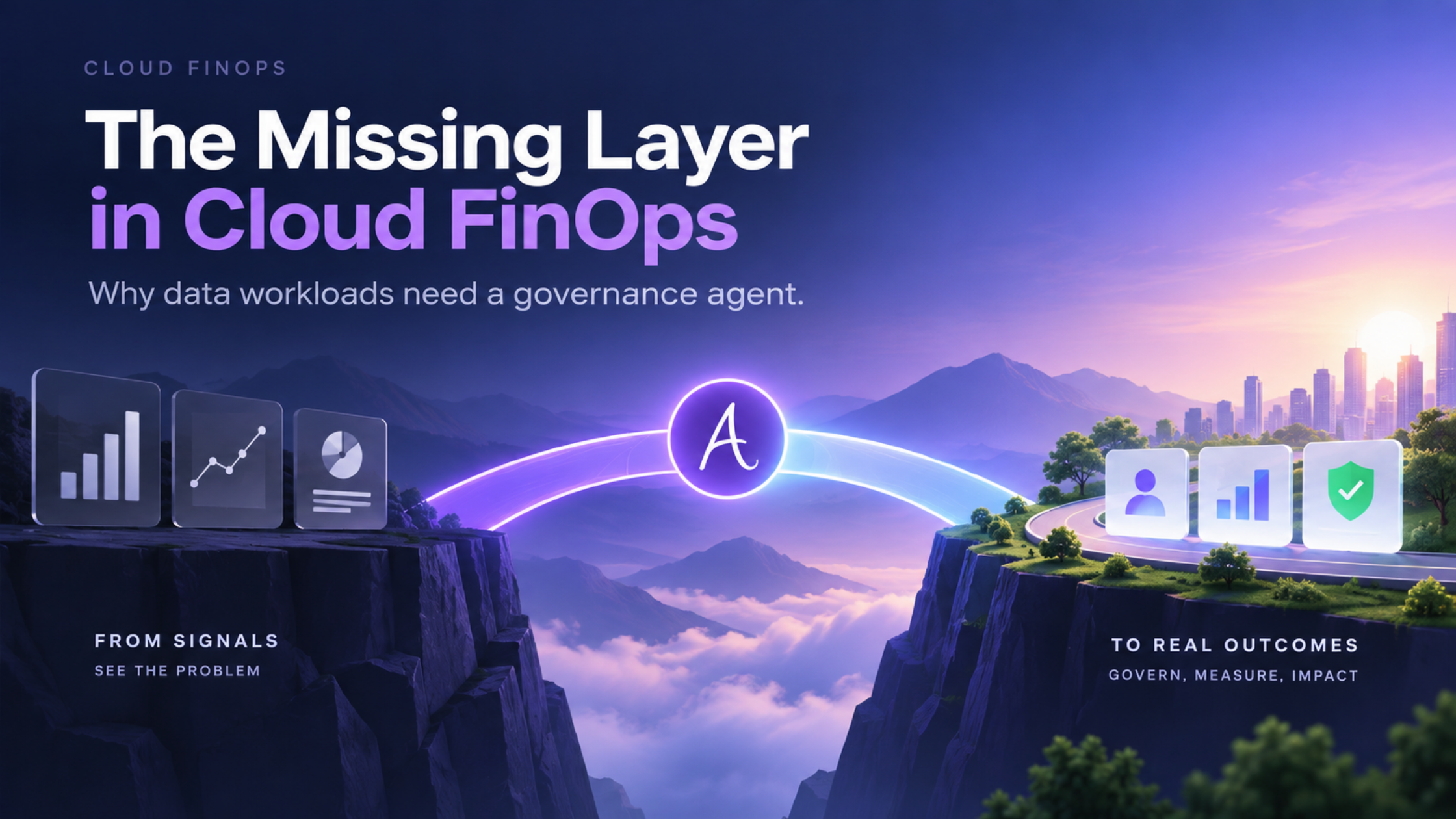
Cloud FinOps has become highly effective at surfacing cost and optimization signals, but detection does not guarantee action. A Workload Governance Agent connects those signals to workload context, ownership, validated outcomes, and continuous enforcement. Anavsan APEX applies this model through Trace → Assign → Enforce → Prove across Snowflake and BigQuery.
Cloud FinOps has become remarkably good at telling organizations where their money is going. Modern cloud data platforms expose detailed consumption information, FinOps platforms consolidate costs across services and teams, and native tooling provides budgets, alerts, usage histories, query statistics, capacity monitoring, and increasingly sophisticated optimization recommendations. Engineering teams can inspect individual workloads in considerable detail, and yet many organizations still experience the same frustrating pattern.
An expensive workload is identified. An optimization opportunity is surfaced. Someone reviews it, perhaps it becomes a ticket, appears in a Slack conversation, or gets added to an engineering backlog. Then priorities change, ownership becomes unclear, the workload evolves, and the opportunity remains unresolved. Or the team fixes it once, only to discover months later that the same workload has become inefficient again.
The problem is increasingly not whether organizations can see cloud inefficiency. It is whether they have an operating system for doing something about it. This is particularly visible in modern data platforms such as Snowflake and BigQuery, where cost is generated by thousands of individual queries, jobs, pipelines, datasets, compute decisions, applications, and user behaviors that continuously change. FinOps visibility helps organizations understand the bill, and optimization helps identify what could change. Between an optimization opportunity and a measurable outcome sits another problem entirely: workload governance. As data environments become larger and more autonomous, that governance layer increasingly needs to behave like an agent.
Cloud FinOps has become very good at seeing the problem
The first generation of cloud cost management was largely about visibility. Organizations needed to understand what they were spending, which services were responsible, how costs were changing, and which teams or business units were driving consumption. That visibility remains fundamental to FinOps, and the discipline has since moved considerably further.
The FinOps Foundation describes usage optimization as an ongoing practice of ensuring resources are appropriately selected, sized, configured, utilized, and aligned with business value. It also emphasizes evaluating optimization opportunities against expected savings, effort, risk, and disruption rather than simply treating every possible saving equally. Cloud data platforms themselves now provide increasingly detailed information for doing this work.
In BigQuery, for example, teams can examine bytes processed, slot consumption, query execution stages, shuffle behavior, capacity, concurrency, and query patterns. BigQuery’s execution graph can expose stages that dominate resource utilization, while INFORMATION_SCHEMA.JOBS and other administrative capabilities provide workload-level information for analysis, as described in Google Cloud’s query performance guidance. BigQuery also provides mechanisms for controlling cost and capacity through on-demand pricing, reservations, autoscaling, commitments, quotas, and workload isolation. Reservations can separate production and test workloads, allocate capacity according to workload requirements, and help organizations attribute compute consumption across projects, which Google documents in its reservations and workload management guidance.
Snowflake teams operate with their own combination of query histories, warehouse monitoring, budgets, resource controls, account usage data, optimization practices, and third-party FinOps tooling. In other words, the industry does not suffer from a complete absence of signals. In many environments, the opposite is true: there are more signals than humans can reasonably act upon, and that changes the nature of the problem. Visibility without an operating loop is how FinOps programs stall after the dashboard.
The governance gap begins after detection
Consider a simple example. A platform identifies a workload whose consumption increased significantly over the previous month. Finding the increase is useful, but it immediately creates another set of questions that monitoring tools are not designed to close:
- What changed, and is the increase caused by legitimate business growth or by inefficiency?
- Is it a one-time event or a recurring pattern, and which query, job, pipeline, application, or compute configuration is responsible?
- Who owns it, what change should be made, and could that change affect performance or downstream systems?
- Who should approve it, was the recommendation implemented, and did consumption actually decline afterward?
- What happens if the workload gradually becomes inefficient again?
These are not primarily monitoring questions. They are governance questions. Traditional observability tends to end around the point where the problem becomes visible, and optimization systems can go further by suggesting a technically appropriate intervention. Neither automatically guarantees that the intervention becomes an accountable, validated, durable outcome.
This distinction matters because a recommendation has no financial value merely because it exists. A dashboard showing $50,000 in potential savings does not mean the organization saved $50,000. The saving exists only after the relevant change is understood, prioritized, implemented, validated, and sustained. That distance between identified opportunity and realized outcome is where workload governance belongs, and it is the same gap we documented in Snowflake cost governance beyond detection.
Cloud costs are generated by workloads, not bills
FinOps naturally works with financial abstractions: accounts, projects, cost centers, services, budgets, commitments, forecasts, and invoices. Engineering works with a different abstraction: the workload. A workload might be a customer-facing analytics application, a transformation pipeline, a scheduled reporting job, an ML process, an AI application, an ELT workflow, or a collection of related queries supporting a business process. This distinction becomes particularly important in data platforms, because the bill is a lagging summary of thousands of engineering decisions.
In Snowflake, consumption can be influenced by query behavior, warehouse configuration, concurrency, data architecture, storage patterns, pipelines, serverless features, AI services, and numerous other engineering decisions. BigQuery has a different architecture and economic model. Its primary costs include query compute and storage, with compute operating under either on-demand or capacity-based models. Under on-demand pricing, query cost is tied to data processed; under capacity-based pricing, organizations manage compute through slots and reservations, as Google explains in BigQuery pricing.
The engineering characteristics are different, but the governance problem is remarkably similar. Suppose BigQuery consumption increases by 25%. That percentage alone tells us very little. Perhaps data volume increased because the business acquired more customers. Perhaps an analyst introduced an inefficient recurring query. Perhaps a scheduled transformation began scanning unnecessary partitions, concurrency changed, or reservation assignments no longer reflect actual workload requirements. Google’s own performance guidance highlights how workload behavior can involve I/O, shuffle, computation, materialization, capacity, concurrency, and query patterns.
Each situation could produce a cost or performance signal, but each requires a different response. This is why effective governance has to move beneath the bill and toward the workload responsible for generating it. The question changes from “Why did BigQuery cost increase?” to “Which workloads changed, why did they change, and does that change represent expected business growth or an optimization problem?” That is a far more useful starting point for both Snowflake cost governance and BigQuery cost governance.
Why optimization recommendations get lost
Once a workload has been identified, another deceptively difficult problem appears: ownership. Modern data environments rarely map cleanly to organizational structures. A central platform team may operate the infrastructure, a data engineering team may own the pipeline, an analytics team may own the SQL, a finance team may care about the budget, and a product team may depend on the output. A workload created by one engineer two years ago may now support five applications across three departments.
Shared infrastructure makes this even harder. BigQuery reservations, for example, can pool compute capacity and isolate workloads across projects or departments, while idle capacity may be shared across reservations depending on configuration, as described in Google’s workload-management documentation. The infrastructure owner is therefore not necessarily the workload owner. FinOps itself recognizes this broader accountability problem. A core principle of the discipline is that people should take ownership of their cloud usage, while shared costs and insufficient allocation can make that accountability difficult to establish, as the FinOps Foundation notes on managing shared cost.
This is where many optimization workflows become surprisingly manual. Someone investigates the issue, tries to determine which team owns it, sends a message, creates a ticket, and waits. The engineering team investigates when priorities allow, someone eventually implements a change, and then somebody else has to determine whether the saving actually materialized. Every handoff creates friction. At small scale, humans can coordinate this reasonably well. At hundreds or thousands of continuously changing workloads, the model begins to break, which is why optimization fails without clear workload ownership and why cost alerts stall after detection. The bottleneck moves from finding optimization opportunities to governing what happens after they are found.
What a Workload Governance Agent actually does
This is where we believe a new operational layer is emerging. A Workload Governance Agent sits between workload intelligence and engineering execution. Its purpose is not simply to produce another list of recommendations. It continuously carries context forward so that a finding can progress toward an accountable outcome. We think about that responsibility through four connected functions that match how Anavsan APEX operates:
Trace → Assign → Enforce → Prove. Find the workload behind the signal, name an owner, drive a decision through a review process, and close the finding from the data.
Trace: understand the workload behind the signal
A cost anomaly is only a starting point. The first responsibility is tracing the signal back to the workload responsible for it and understanding enough context to determine what actually changed. Was consumption caused by a repeated query, a growing pipeline, a capacity decision, a workload running more frequently, or a legitimate increase in business activity?
The objective is to move from “Spend increased.” to “This workload changed, and this is why.” That distinction prevents teams from treating every increase as waste, and it is the same move from bill-level detection to workload-level diagnosis that workload drift makes unavoidable.
Assign: connect the issue to accountability
Once the workload and its context are understood, someone needs to own the next action. Ownership should not begin every time with an engineer manually searching repositories, messaging teams, examining tags, and trying to reconstruct organizational knowledge. A governance agent should help connect workload context to the appropriate owner or team and maintain that accountability as the issue progresses.
The output is not another recommendation sitting in a dashboard. It is an accountable action, even when the honest answer is that the workload still needs an owner rather than a guessed assignee.
Enforce: turn the finding into a governed decision
Potential savings remain theoretical until a decision is made. Enforcement is the step that carries a finding through an accountable workflow until it is applied, deferred, or dismissed. Humans still define policy, approve consequential changes, and decide which trade-offs are acceptable. The agent handles operational continuity: tracking the exact change, keeping the issue visible, escalating exceptions, and preventing the finding from disappearing into Slack threads and backlogs.
Even a successful optimization is not permanent. Data volumes grow, query patterns change, pipelines evolve, applications gain users, teams modify configurations, new AI workloads appear, and capacity requirements shift. The environment continuously moves away from the assumptions under which the original optimization was made. That is governance drift, and continuous enforcement means maintaining the governance state after an intervention so the same class of waste does not quietly return.
Prove: establish whether the intervention worked
Potential savings and realized savings are different things. Before a change, teams need confidence that the intervention is technically appropriate. After implementation, they need evidence that it actually produced the intended result, whether that is lower consumption, better execution behavior, reduced resource contention, improved utilization, or another measurable workload outcome.
This closes an important gap in traditional optimization reporting. Instead of reporting “We identified $50,000 of potential savings,” governance should ultimately be able to answer “What changed, what happened afterward, and what value was actually realized?” A finding is closed when the metric recovers, not when a ticket is marked done.
Why the agent matters
None of these activities is entirely new. Organizations already perform them, and that is precisely the point. Today, much of the governance layer exists implicitly across engineers, FinOps teams, ticketing systems, Slack conversations, spreadsheets, dashboards, repositories, tribal knowledge, and periodic cost reviews. The opportunity for an agent is not to invent a new organizational responsibility. It is to make an existing responsibility continuous.
An agent can maintain context across a workflow in ways that disconnected alerts and dashboards cannot. It can repeatedly observe workload behavior, connect findings with historical context, maintain accountability, follow an issue through its lifecycle, and determine whether the expected outcome occurred. Humans still define policy, approve consequential decisions, understand business context, and decide what trade-offs are acceptable. The agent handles the operational continuity between those decisions.
That difference matters. A monitoring tool asks “What happened?” An optimization system asks “What could we improve?” A Workload Governance Agent needs to keep asking “What happened next?”
From periodic optimization to continuous workload governance
For years, cloud optimization has often been organized around events: a cost review, a FinOps initiative, a renewal, a migration, a performance incident, or an optimization sprint. These exercises can produce significant results, but the environment begins changing again almost immediately after they finish. That makes optimization temporary by default, which is why cost optimizations often fail to last.
Continuous workload governance approaches the problem differently. Instead of periodically rediscovering inefficiency, it preserves the relationship between workload behavior, ownership, intervention, and outcome over time. This also changes what successful FinOps can measure. The objective is no longer simply to identify more savings opportunities. A more mature question is: how much of the opportunity we identified actually became a measurable, sustained outcome? That requires visibility, but it also requires accountability, engineering context, evidence, and continuity.
APEX: Anavsan’s Workload Governance Agent
This is the operating model behind Anavsan APEX. APEX is Anavsan’s Workload Governance Agent, designed to connect cost and performance signals with workload context, accountability, validation, and continuous enforcement across Snowflake and BigQuery. Rather than treating cloud cost governance as a sequence of disconnected alerts and optimization recommendations, APEX is built around the lifecycle Trace → Assign → Enforce → Prove.
The goal is not to replace the native capabilities of the underlying data platform. Snowflake and BigQuery already provide extensive telemetry, controls, workload-management mechanisms, and optimization capabilities. The missing problem sits above those capabilities: ensuring that the right signal becomes the right action, reaches the right owner, produces a measurable outcome, and remains governed as the workload evolves. That is the layer APEX is intended to address.
In practice, APEX traces waste to a workload and owner, assigns accountability from evidence, enforces a decision through your review process, and proves closure from the data. The Private Knowledge Graph is the agent’s ownership memory, not a graph built so an agent can silently change production. The Enforcement Desk is the ranked worklist of addressable waste. Ask APEX is how FinOps and engineering talk to the agent over the same definitions. APEX is human-gated. It does not AutoApply.
On Snowflake, that loop includes warehouse, query, storage, and Cortex signals. On BigQuery, the same loop runs in platform vocabulary: jobs, slots, reservations, and scan waste, with nested coverage for cost governance, storage intelligence, and dataset lineage. Native monitoring can show that spend moved. APEX is built to close the finding. For a closer look at how detection still leaves the loop open, see Snowflake native anomaly detection vs APEX and how Anavsan works.
The next phase of FinOps is about closing the loop
Cloud cost management started with a visibility problem, and the industry has made enormous progress solving it. The next challenge is operational. As cloud data environments become larger, more dynamic, and increasingly influenced by AI-driven workloads, organizations will generate more optimization signals than engineering teams can manually govern. Finding another opportunity will not necessarily be the difficult part. Closing it will be.
The organizations that mature beyond periodic optimization will therefore need to connect financial visibility with workload-level context, engineering accountability, measurable outcomes, and continuous enforcement. That is what turns optimization from a recommendation into an operating discipline, and it is why we believe the next important layer of Cloud FinOps will not simply be another dashboard. It will be a Workload Governance Agent.
See how APEX governs Snowflake and BigQuery workloads
APEX traces waste to a workload and owner, assigns accountability, enforces a decision through your review process, and proves closure from the data. Human-gated. APEX does not AutoApply.
Frequently asked questions
Continue reading
- Anavsan APEX: Workload Governance Agent — Trace, Assign, Enforce, Prove across Snowflake and BigQuery
- BigQuery Slot Optimization: Do You Really Need More Slots? — contention vs inefficiency on capacity
- BigQuery Cost Optimization: How Workload Drift Brings Costs Back — the first BigQuery article in this series
- Snowflake Cost Governance: Beyond Detection
- Why Snowflake Cost Optimization Fails Without Clear Workload Ownership
- Why Snowflake Cost Optimizations Don’t Last
- Snowflake Native Anomaly Detection vs APEX