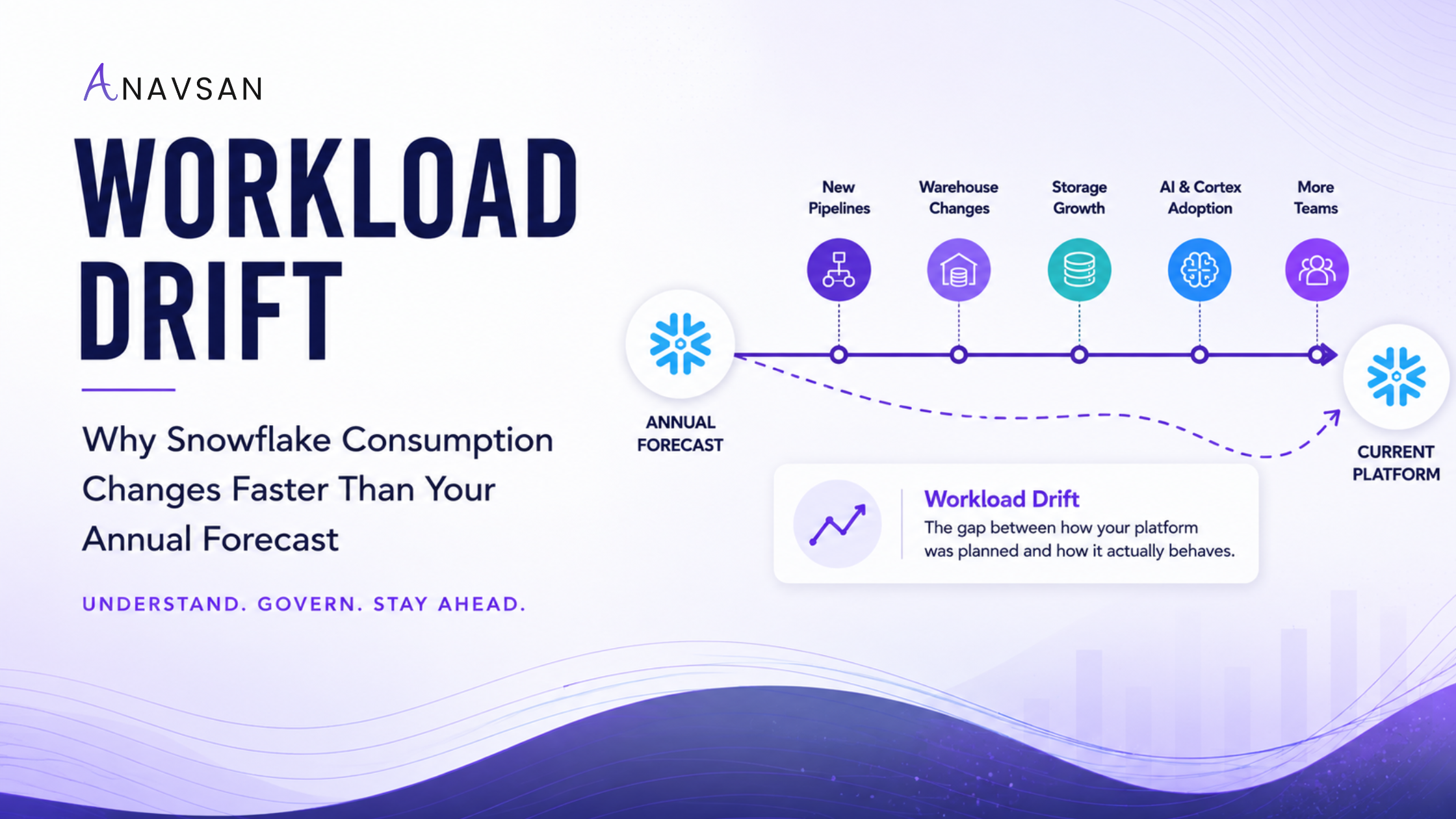
Snowflake environments rarely become expensive because of one oversized warehouse, one inefficient query, or one engineering mistake. They become expensive because hundreds of legitimate engineering decisions gradually reshape how the platform behaves over time. This phenomenon—Workload Drift—is a natural consequence of business growth, evolving data architectures, and changing engineering priorities. The challenge isn’t preventing drift; it’s continuously understanding, governing, and validating it before it silently transforms a healthy Snowflake commitment into an unexpected renewal conversation.
Every Snowflake Platform Starts With a Plan
When organizations negotiate an annual Snowflake commitment, they aren’t simply purchasing credits. They’re making assumptions about how their platform will behave over the next twelve months—and those assumptions are usually reasonable. Engineering leaders estimate the number of workloads that will run in production. Finance projects expected business growth. Data teams forecast warehouse utilization, storage expansion, pipeline schedules, dashboard refresh frequencies, and anticipated product launches. Together, these assumptions become the foundation of an annual consumption model that, at the moment of signing, actually reflects reality.
The problem is that reality doesn’t stay still. Three months after the commitment is signed, a product team launches a new customer analytics feature. Marketing requests more frequent reporting. Compliance introduces longer retention requirements. Data scientists begin experimenting with Cortex AI. Infrastructure teams resize warehouses to improve latency. New business units onboard additional workloads. Temporary migration pipelines quietly become permanent production jobs. Every individual decision makes sense, every change solves a legitimate engineering problem, and none of them feels significant enough to justify revisiting the original consumption forecast.
Yet collectively, those decisions begin reshaping how the Snowflake platform behaves. Six months later, the environment no longer resembles the assumptions that justified the annual commitment. Nothing failed. Nobody made a catastrophic mistake. The platform simply evolved—and that gradual evolution is what we call Workload Drift.
If drift is the natural outcome of a living platform, the next question is whether it should be treated as a failure mode or as a signal of healthy growth.
Workload Drift Is a Feature of Growth, Not a Sign of Failure
The word “drift” often carries negative connotations. It suggests losing control, deviating from a plan, or making mistakes. In reality, workload drift is both inevitable and healthy. Every successful engineering organization experiences continuous change: new customers generate more data, existing customers demand faster insights, business teams launch products in new markets, machine learning initiatives emerge, and AI services become part of production. Engineering teams improve pipelines, redesign warehouses, and modernize architectures. If none of these changes occurred over an entire year, most executives would probably be more concerned than reassured.
Growth, innovation, and business success all change workload behaviour. The objective of workload governance is therefore not to eliminate drift. Attempting to freeze a data platform in time would only slow innovation and create unnecessary operational friction. Instead, the goal is simpler: understand how workloads are changing, why they are changing, who is driving those changes, and whether those changes continue to align with business priorities.
Organizations rarely struggle because their Snowflake environment changes. They struggle because nobody continuously connects those changes back to the original assumptions behind the annual commitment—the gap that eventually shows up as early credit exhaustion and a difficult renewal conversation.
Workload Drift is not the enemy of a healthy Snowflake commitment. Unexplained drift is. When engineering can connect consumption changes to business outcomes, drift becomes a growth narrative. When it cannot, drift becomes a governance problem waiting for renewal to surface it.
Understanding that drift is inevitable raises a more practical question: which forces actually reshape consumption fastest throughout the year?
The Five Forces That Quietly Reshape Snowflake Consumption
Most engineering teams expect consumption to grow as the business expands. What they often underestimate is how many independent decisions contribute to that growth. Each team makes locally rational choices that collectively produce globally significant changes across infrastructure, data volumes, pipelines, AI services, and organizational access patterns.
Infrastructure Evolution
Warehouse configurations rarely remain static for an entire year. A warehouse originally sized for fifty analysts may now support two hundred. Auto-suspend intervals are extended to improve user experience. Multi-cluster warehouses are enabled to handle peak concurrency. New environments are provisioned for testing, disaster recovery, or regional expansion. None of these decisions is inherently wasteful—each one improves reliability, performance, or scalability—yet every infrastructure adjustment changes the platform’s long-term consumption profile. By year’s end, the warehouse architecture may bear little resemblance to the environment originally used during capacity planning.
Data Growth
Data platforms almost never shrink. New applications produce additional events, historical datasets are retained for longer periods, compliance introduces stricter retention requirements, dynamic tables multiply, Time Travel settings evolve, and Fail-safe storage expands alongside production data. Storage growth is often viewed as an unavoidable cost of doing business, but the more important observation is that storage growth changes downstream workload behaviour as well. Larger tables require different optimization strategies, transformations become more expensive, maintenance operations consume additional compute, and query patterns evolve. Storage growth doesn’t simply increase storage costs—it gradually changes how the entire platform behaves.
Pipeline Evolution
Modern data platforms continuously accumulate pipelines. A team introduces new dbt models. Marketing requests hourly refreshes instead of daily updates. Machine learning teams deploy feature engineering workflows. Reverse ETL becomes part of customer operations. Data quality monitoring expands across business-critical datasets. Each pipeline solves a legitimate business problem, yet very few organizations periodically ask whether older pipelines remain equally valuable. As new workflows accumulate, platform complexity increases, resource scheduling changes, warehouse utilization shifts, and concurrent execution patterns become more difficult to predict. The result is not a single expensive pipeline—it is an ecosystem of evolving workloads whose combined behaviour gradually diverges from the original operational model.
AI and Serverless Adoption
The past year has fundamentally changed how organizations consume cloud data platforms. Capabilities that once required dedicated infrastructure are increasingly available as managed services. Snowflake Cortex introduces AI workloads directly into the platform; Serverless Tasks reduce operational overhead; Search Optimization improves user experience; Document AI enables entirely new business processes. These capabilities create genuine competitive advantages, and they also introduce entirely new consumption patterns. Traditional forecasting models built around warehouses, storage, and SQL workloads often fail to account for AI services that didn’t exist—or weren’t widely adopted—when annual commitments were negotiated. Organizations frequently discover that innovation itself has become one of the largest sources of workload drift.
Organizational Growth
Perhaps the most overlooked driver of workload drift isn’t technical at all—it’s organizational. A company hires more analysts, business intelligence becomes self-service, new engineering teams are created, departments gain direct access to data, regional offices begin building independent dashboards, and acquisitions introduce entirely new workloads. None of these activities appears inside a warehouse utilization dashboard, yet they fundamentally reshape how the platform is used. The platform doesn’t become more expensive because engineers suddenly became inefficient. It becomes more expensive because more people are successfully using it. Understanding that distinction is essential for any team preparing for renewal.
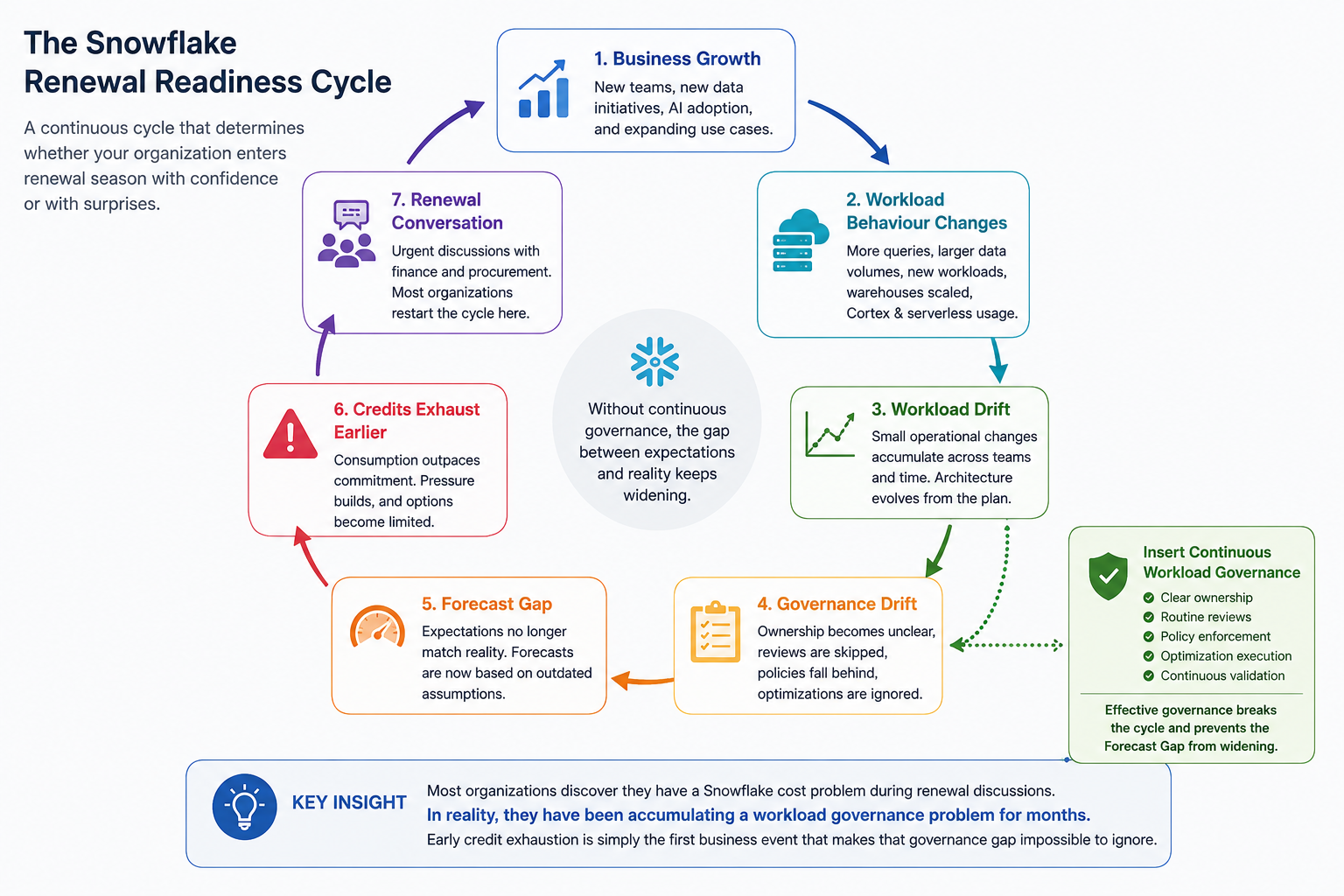
Locally rational decisions accumulate into globally significant consumption change.
If five independent forces reshape the platform all year, why do standard monitoring tools so often miss the story until renewal pressure arrives?
Why Traditional Dashboards Cannot Explain Workload Drift
Modern observability platforms are exceptionally good at answering operational questions. Which warehouse consumed the most credits? Which queries were expensive? Which users generated the highest activity? How much storage is growing each month? These are valuable insights that help engineering teams understand where resources are being consumed. What they rarely explain is something fundamentally different: why has the platform itself changed?
Knowing that Warehouse A consumed 15% more credits than last month does not explain whether a new product launch justified the increase. Seeing storage grow by twenty terabytes does not reveal whether the growth reflects healthy customer adoption or forgotten historical datasets. Detecting increased Cortex usage does not explain whether AI has become a strategic business capability or whether experimental workloads simply migrated into production without governance. Visibility answers what happened. Governance explains why it happened—and those are different problems.
Organizations often invest heavily in improving visibility while assuming governance will emerge naturally from better dashboards. It rarely does. Snowflake FinOps tooling can rank spend by warehouse and cost centre; renewal readiness still requires connecting that spend to ownership, intent, and forecast assumptions that may no longer hold.
Visibility answers what happened. Governance explains why it happened.
Once teams accept that dashboards describe consumption without justifying it, another misconception needs to be retired: that every increase in consumption equals waste.
Drift Is Not Waste
One of the biggest misconceptions in cloud cost optimization is the assumption that every increase in consumption represents inefficiency. Healthy businesses consume more resources as they grow. Successful products attract more users, more users generate more data, more data requires additional processing, and more processing increases compute consumption. The existence of workload drift does not automatically indicate waste; in many cases, it is evidence that the business is succeeding.
The governance question therefore shifts from “How do we stop consumption from increasing?” to something much more useful: “Can we explain why consumption increased?” If engineering teams can confidently connect higher consumption to measurable business outcomes, workload drift becomes a story of growth rather than a financial surprise. If they cannot, uncertainty begins replacing confidence—and that uncertainty eventually becomes a governance problem.
The right question is not whether consumption grew. It is whether the organization can explain the growth with the same confidence it used when the annual commitment was negotiated.
Unexplained drift does not stay a technical curiosity for long. When ownership and review fail to keep pace with the platform, workload drift crosses into something more dangerous.
When Workload Drift Becomes Governance Drift
Workload drift becomes dangerous only when organizational understanding fails to evolve alongside the platform. New workloads appear and nobody reviews them. Warehouse configurations change and nobody documents why. Pipeline schedules evolve and nobody validates whether they remain necessary. Storage continues expanding and nobody owns the decision. Over time, engineering teams stop asking whether platform behaviour still reflects intentional design or accumulated history.
The platform continues operating. Business continues growing. But institutional understanding quietly declines. This is where workload drift crosses an invisible boundary and becomes Governance Drift—not because the technology failed, but because continuous ownership disappeared. As introduced in the series opener on Snowflake renewal readiness and the Forecast Gap, governance drift is the mechanism that turns healthy platform evolution into unexplained early credit exhaustion.
Workload Drift becomes Governance Drift when continuous ownership disappears.
If the boundary between healthy evolution and operational uncertainty is ownership, the practical response is continuous alignment—not a once-a-year forecast rebuild.
Continuous Workload Governance Closes the Gap
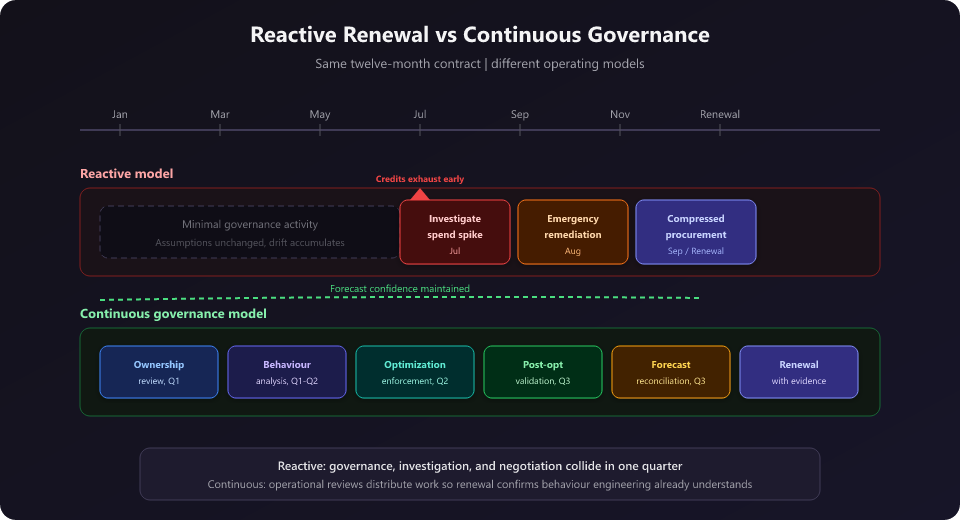
Organizations cannot predict every workload that will exist twelve months from now, nor should they try. The objective of governance is not perfect forecasting. It is continuous alignment between platform behaviour and business intent. Instead of reviewing Snowflake environments only before renewal, mature organizations continuously ask five questions: What changed? Why did it change? Who owns the change? Does it still support current business priorities? What action should happen next?
These questions are deceptively simple, yet they transform governance from an annual financial exercise into an ongoing engineering discipline. Continuous workload governance does not prevent platforms from evolving. It ensures that evolution remains visible, intentional, and explainable. When renewal discussions eventually arrive, engineering teams are no longer reconstructing twelve months of history—they already understand it.
Looking Ahead
In the previous article, we introduced the Forecast Gap—the growing difference between the Snowflake platform that organizations planned for and the one they actually operate. This article explains why that gap naturally emerges: platforms evolve, workloads drift, and business priorities change.
The remaining question is perhaps the most important one. If workload drift is inevitable, why do so many organizations fail to recognize when healthy evolution slowly turns into operational uncertainty? That question leads to the next concept in this series: Governance Drift—how engineering organizations gradually lose visibility, ownership, and accountability over an otherwise successful Snowflake platform.
Govern Workload Drift Before Renewal
Continuous workload governance starts with visibility, ownership, and validation—not a larger credit allocation. See how platform teams detect behavioural drift, assign accountability, and keep consumption explainable throughout the year.