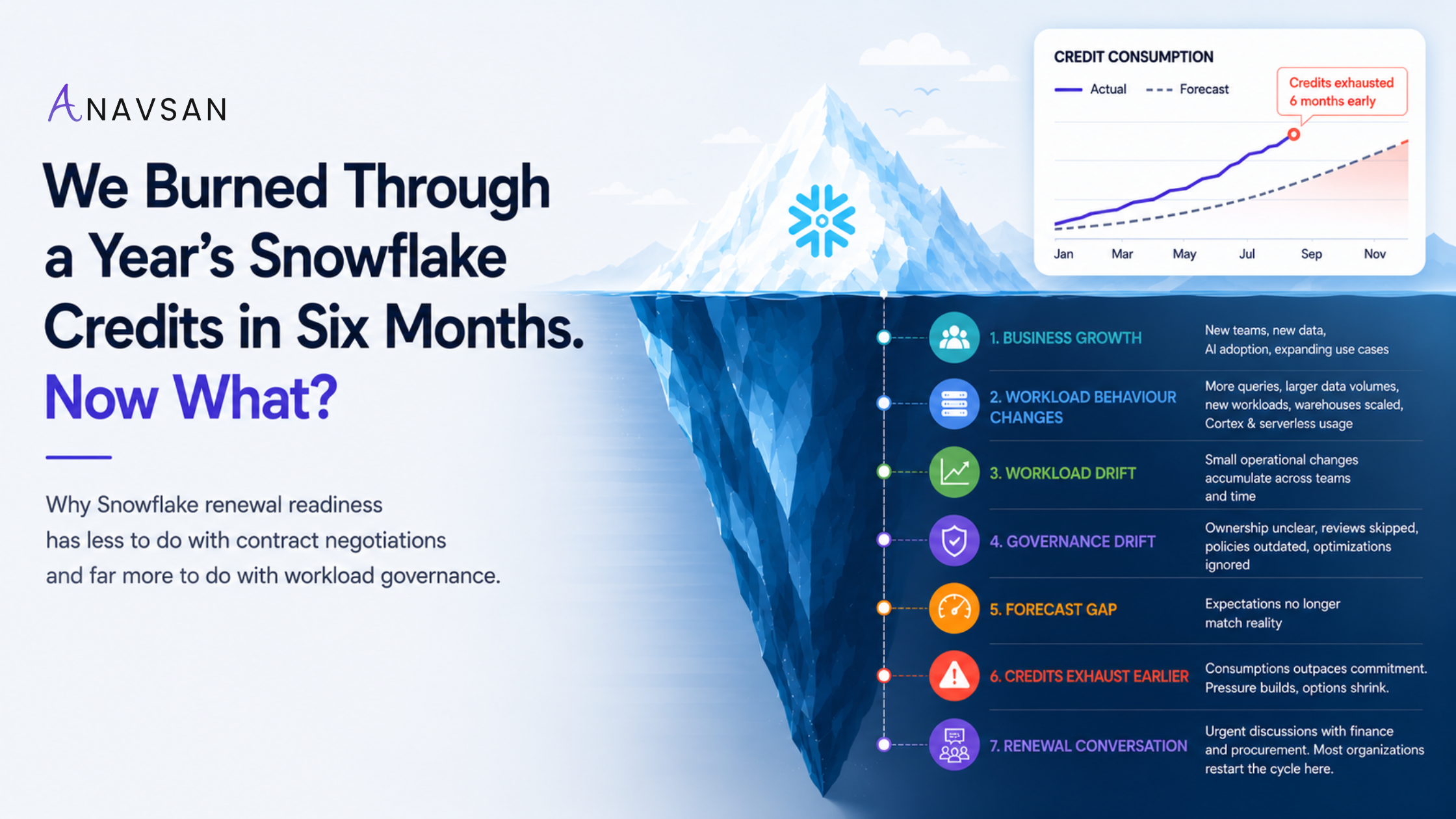
Annual Snowflake commitments fail quietly in production long before procurement gets involved. Forecasts encode assumptions about workload growth and governance maturity; production environments evolve through behaviour. When workload drift outpaces governance drift, a Forecast Gap opens and credits exhaust early. The engineering response is continuous workload governance—understanding, owning, and validating platform behaviour so renewals become evidence-based reviews rather than reactive budget crises.
When Renewals Really Begin
On a Tuesday morning in July, a platform engineer at a mid-size SaaS company opened Snowflake’s consumption dashboard and noticed the projected credit exhaustion date had moved from December to September. The team had negotiated an annual commitment in January based on twelve months of stable growth. Six months in, they were on pace to burn through the allocation in nine.
The first Slack thread was predictable. Finance asked whether the contract had been sized correctly. Procurement wondered if Snowflake could extend pricing before the allocation ran dry. Someone suggested the spike might reflect healthy customer growth—more tenants, more event volume, more dashboards. All reasonable hypotheses. None of them answered the question the on-call engineer actually needed resolved: what changed inside the platform between January and July?
That question is where most renewal conversations quietly go wrong. The team could pull warehouse-level credit consumption, identify which accounts grew fastest, and rank departments by monthly spend. Native monitoring and third-party FinOps tooling are excellent at answering where credits went. They struggle to explain why workload behaviour shifted, whether those shifts were intentional, who owns the resulting compute increase, and whether anyone has already acted to stop the same pattern from continuing.
In practice, an exhausted annual commitment is rarely caused by one expensive query, one oversized warehouse, or a single misconfigured job. More often it is the cumulative outcome of hundreds of small operational decisions made across teams over several months. A warehouse upsized during a production incident and never resized back. Duplicate transformation pipelines kept running after a migration finished. Looker dashboards began executing heavier queries as underlying datasets grew. A Cortex proof-of-concept moved from sandbox to shared production without a corresponding governance review. Retention policies written for a smaller environment remained unchanged while historical tables doubled in size. Each decision looked reasonable in isolation. Together they reshaped the platform’s compute characteristics.
By the time finance flagged that the commitment might not survive the quarter, engineering was no longer facing a budgeting problem. It was facing a governance problem that had been accumulating in production for months—one that no amount of contract renegotiation could explain on its own.
The distinction matters. If accelerated consumption reflects legitimate platform scaling—more customers, more pipelines, broader adoption—then increasing the next commitment may be the correct engineering outcome. If the same increase is driven by operational drift, fragmented workload ownership, deferred optimization, or workloads nobody actively reviews anymore, purchasing additional credits only expands the budget available for inefficiency. The contract changes; the underlying behaviour does not.
Teams that operate long-running Snowflake deployments at scale eventually stop treating renewal as a procurement milestone. They treat it as a periodic engineering review of workload health, governance maturity, and operational accountability. The commercial negotiation becomes the final output of that review, not its starting point. Understanding that shift is the prerequisite for everything that follows in this article—including the case for treating renewal preparation as a structured engineering discipline once the problem itself is fully visible.
Identifying what changed inside the platform raises a harder follow-up: why the forecast that justified January’s commitment no longer describes July’s production environment.
Forecasts Don’t Fail Because Engineers Are Bad at Estimating
Every Snowflake renewal begins with a forecasting exercise that looks perfectly rational at the time. Engineering reviews historical credit consumption alongside planned migrations, expected product launches, and known architectural changes. Finance models consumption scenarios; procurement negotiates pricing against those projections; platform teams sign off because the numbers align with what is visible in production today.
The problem is structural. Forecasts are built from assumptions. Production environments evolve through behaviour. Those two inputs rarely stay synchronized for long in a platform that absorbs new workloads every quarter.
A mature Snowflake deployment is not a static analytics warehouse running the same transformations on a predictable schedule. It is a living system that continuously onboard new data products, engineering teams, reporting surfaces, ML experiments, and—increasingly—AI workloads backed by Cortex and serverless compute. Each quarter adds consumers, pipelines, and operational complexity. Very few changes are large enough individually to trigger concern. They accumulate until the platform behaves differently from the environment that engineering originally forecasted.
That divergence follows a recognizable progression. Business growth expands legitimate data products and analytical capacity. Workload drift describes how execution patterns shift—where workloads run, how often they execute, and how much compute they consume. When operational controls fail to keep pace, governance drift follows: policies age, ownership blurs, and optimization recommendations stop becoming enforced engineering work.
The measurable consequence is the Forecast Gap—the widening distance between the workload assumptions that justified the annual commitment and the workload behaviour unfolding throughout the contract period.
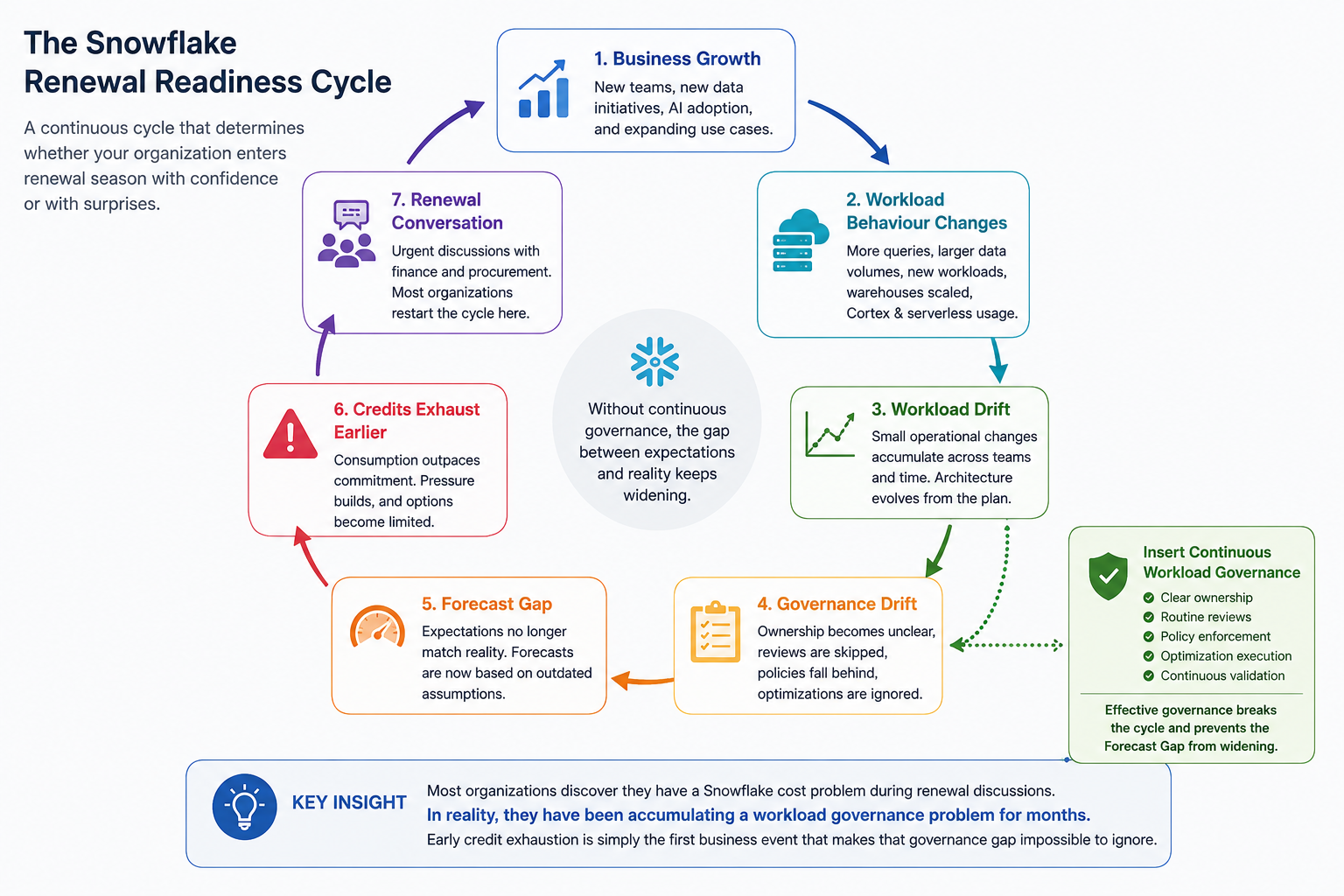
Most organizations discover they have a Snowflake cost problem during renewal discussions. In reality, they have been accumulating a workload governance problem for months. Early credit exhaustion is simply the first business event that makes that governance gap impossible to ignore.
As illustrated in the Renewal Readiness Cycle above, the Forecast Gap does not emerge the moment workload growth begins. It develops gradually as workload drift accumulates faster than governance processes evolve. By the time procurement becomes involved, the organization is often attempting to solve a governance problem through commercial negotiations.
Forecasts fail when governance stops evolving.
The Forecast Gap rarely appears because someone made a catastrophic architectural mistake. It emerges through hundreds of small, individually reasonable decisions. A warehouse is temporarily upsized during an incident and never revisited. An experimental pipeline created for a migration keeps running because nobody is certain it is still required. Product teams launch dashboards that execute thousands of additional queries as adoption grows. Data scientists adopt Snowpark; AI teams experiment with Cortex functions that introduce entirely new compute categories. None of these choices is inherently inefficient. Each one alters the relationship between platform activity and infrastructure consumption.
Over several months those changes reinforce one another. Larger warehouses support more concurrent users, which encourages additional workloads to colocate on them. Growing data volumes make historical queries progressively more expensive. Teams optimize one layer of the stack while unknowingly shifting pressure elsewhere—a pattern familiar to anyone who has run post-optimization validation on a long-running deployment and discovered savings that did not persist. Storage expands because retention policies that were reasonable eighteen months ago no longer match current operational requirements. Before long, the platform consumes credits according to a behavioural model that no longer resembles the assumptions baked into the annual commitment.
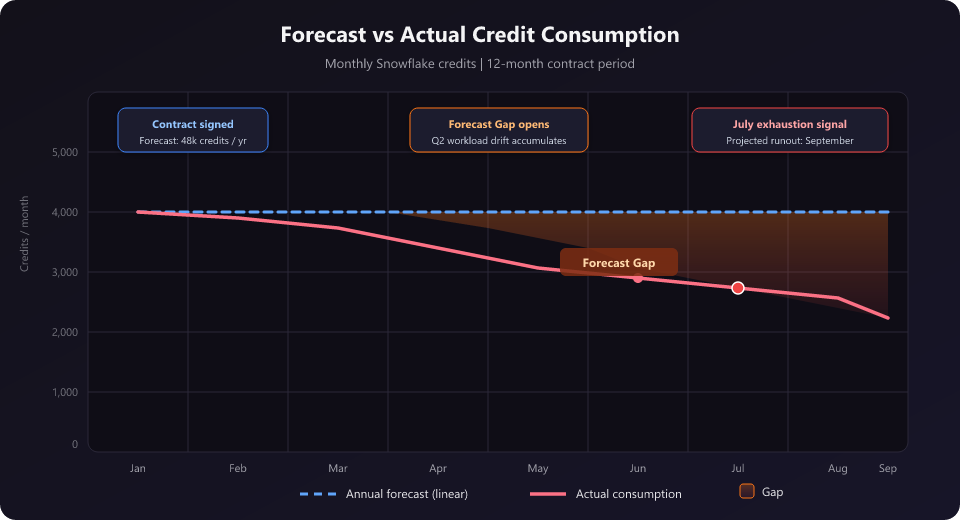
Figure 2 is the chart most teams wish they had reviewed in April rather than July. The surprise is rarely the consumption itself. It is the realization that nobody tracked the gap widening while the platform evolved. By the time finance detects acceleration, engineering has accumulated months of workload drift that warehouse utilization reports alone cannot explain.
The Forecast Gap cannot be closed through procurement alone. Negotiating a larger commitment changes the commercial agreement without reducing the distance between assumptions and reality. Unless engineering can explain why workload behaviour changed, the next forecast inherits the same blind spots. The organization improves its purchasing strategy without improving its ability to predict how the platform actually behaves.
Viewed this way, an annual renewal becomes an opportunity to ask whether engineering still understands its own production environment. Can the team explain where workload growth originated? Can it separate intentional platform scaling from operational drift? Can it identify which compute increases reflect customer value and which reflect governance that failed to keep pace with architectural evolution? Those questions matter more than the remaining credits on the contract.
Case Study: Twelve Months of Platform Drift at Meridian Commerce
The following is a composite based on patterns observed across B2B SaaS and retail analytics teams operating multi-warehouse Snowflake environments. Company names and figures are illustrative.
Meridian Commerce, a B2B subscription analytics company, renewed its Snowflake contract in January with a forecast of 48,000 credits across four warehouses serving product analytics, finance reporting, and a growing customer-insights program. Consumption through Q1 tracked within eight percent of plan. By July, projected exhaustion had moved from December to mid-September.
Q1 — Baseline and onboarding. The platform team operated a dedicated TRANSFORM_WH (Large) for dbt runs, a BI_WH (Medium) for Looker, and a DS_WH (Small) for ad hoc analysis. Monthly consumption averaged 3,800 credits. A new customer-success initiative requested weekly cohort dashboards; the BI team materialized three new views without changing warehouse topology. Credit impact: negligible individually, visible in aggregate by late March.
Q2 — Incident response and migration residue. In April, a delayed dbt job during month-end close prompted the team to upsize TRANSFORM_WH to X-Large. The incident resolved in forty minutes. The resize was never reverted—documented in the ticket as “revisit after close,” then buried under sprint priorities. Simultaneously, engineering completed a migration from a legacy events pipeline to Snowpipe Streaming. The old batch pipeline was left running in “parallel validation” mode. Both paths wrote to separate schemas. Nobody owned decommissioning the legacy job after sign-off.
Event volume grew forty percent quarter-over-quarter as Meridian onboarded enterprise retail clients with higher telemetry cardinality. Fact tables that averaged 200GB in January exceeded 600GB by June. Looker explores that scanned six months of history in March began scanning twelve months by default in June. No query regression was flagged because dashboards still returned results within SLA.
Q3 — Cortex adoption and warehouse sharing. In May, the product team launched a Cortex-powered support summarization feature in preview. Initial token consumption was modest. By June, customer-facing teams expanded usage to three additional workflows without a dedicated serverless budget or ownership model. Cortex Functions and Snowpark Container Services appeared on the monthly invoice for the first time in July—accounting for eleven percent of total compute, up from zero in January.
The data science group, previously isolated on DS_WH, began running feature-engineering jobs on BI_WH because it was already warm during business hours. Concurrency increased. Looker users reported intermittent queueing. The response was another cluster on BI_WH rather than workload placement review.
Q3 — Storage and governance lag. Time Travel and periodic cloning for audit requirements pushed storage costs up twenty-two percent without corresponding compute review. Retention policies set during a smaller deployment remained unchanged. An operational review in June identified fourteen oversized tables and six duplicate pipelines. Recommendations entered a backlog. No post-optimization validation was scheduled.
July — Exhaustion signal. When the platform engineer projected September exhaustion, the FinOps lead could attribute credit growth to warehouse and service line items. The team could not produce a coherent narrative connecting January’s forecast assumptions to July’s production state. The X-Large warehouse, duplicate pipeline, Cortex expansion, and unset retention policies were known individually. Nobody had evaluated them as a single architectural evolution story.
Meridian’s postmortem concluded that consumption had not “spiked.” It had drifted—through resizing decisions, migration residue, data volume growth, AI workload adoption, and governance processes that did not scale with platform complexity. The Forecast Gap had opened in Q2 and widened through Q3 while dashboards still showed healthy utilization ranges.
Early credit exhaustion is usually the first visible symptom of months of governance drift.
Naming the Forecast Gap explains why commitments diverge from reality; the next question is why standard monitoring rarely surfaces that divergence early enough to act.
Where Dashboards Stop and Workload Governance Begins
When projected exhaustion dates move closer, the instinctive response is to open a dashboard. Platform engineers review warehouse utilization. FinOps teams compare month-over-month credit consumption. Finance maps spend to cost centres. These steps are necessary—they establish where compute was consumed—but they rarely explain why consumption evolved. Visibility into spend is not the same as understanding workload behaviour, and conflating the two pushes teams toward tactical fixes instead of durable operational improvement.
This distinction intensifies as environments mature. Production Snowflake platforms rarely consist of a few warehouses running scheduled transformations. They support hundreds of workloads across streaming pipelines, ML experimentation, BI platforms, data sharing, serverless services, and AI applications. Consumption is driven by interconnected operational decisions over time, not one or two dominant jobs. A dashboard can show that BI_WH consumed thirty percent more credits than forecasted. It cannot determine whether that increase reflects customer growth, a temporary migration, inefficient query patterns, duplicate pipelines, or a sizing decision made six months earlier that nobody revisited during a routine operational review.
Monitoring systems answer operational questions: what changed, which warehouse grew, when utilization increased. Workload governance asks a different set. Were those changes intentional? Do they align with architectural objectives? Who owns the workloads? Have optimization opportunities been implemented? Can engineering demonstrate that previous improvements remained effective after post-optimization validation three months later? Those questions require historical context, accountability, and continuous review—not isolated observations.
A dashboard can report that compute increased forty percent. Workload governance determines whether that forty percent represents intentional platform scaling or operational drift. Without that distinction, every optimization initiative becomes reactive. Engineering investigates individual spikes while missing the behavioural patterns that gradually reshape the platform throughout the year. Snowflake FinOps practices provide essential visibility; renewal preparation requires the governance layer that connects spend to ownership, behaviour, and forecast confidence.
Knowing where credits went is not the same as knowing why workload behaviour changed.
Once teams accept that visibility alone is insufficient, the next step is identifying the specific governance failures that allow annual commitments to erode quietly.
The Five Governance Failures That Quietly Consume Annual Commitments
Annual commitments rarely exhaust because of a single expensive query or one oversized warehouse. They erode through several governance failures that develop independently and then reinforce one another. Each issue looks manageable in isolation. Collectively they produce an environment where forecasting becomes unreliable and optimization cannot keep pace with platform growth. The Renewal Readiness Cycle maps this progression: each failure feeds workload drift and governance drift until the Forecast Gap becomes impossible to ignore.
The first failure is unclear workload ownership. As platforms scale, individual warehouses support multiple functions simultaneously—marketing dashboards, operational reporting, finance analytics, ML pipelines, customer-facing applications. Everyone benefits from shared infrastructure; responsibility for long-term efficiency becomes ambiguous. Engineers can identify which warehouse consumed credits, yet nobody feels accountable for continuously reviewing whether those workloads still belong on that infrastructure. Optimization becomes everyone’s responsibility, which often means nobody’s.
The second failure is optimization without operational follow-through. Mature environments already receive recommendations from native tooling, consultants, FinOps platforms, and internal reviews. Expensive queries get flagged; oversized warehouses get documented; storage governance opportunities get catalogued. The challenge is rarely discovery—it is converting recommendations into shipped engineering work. Items linger in Jira backlogs while delivery teams prioritize feature work. Months later, the same findings reappear in another review, creating the illusion of recurring optimization rather than a continuously enforced process.
The third failure is unmanaged workload evolution. Production environments never remain static. Warehouses designed for batch transformations begin serving interactive analytics. Experimental data products become business-critical. AI initiatives introduce new compute patterns. Pipelines built for one team gradually serve multiple units. None of these transitions is inherently problematic, yet each changes the assumptions behind the original infrastructure design. Without continuous evaluation of workload placement, the platform accumulates architectural drift that forecasting models rarely anticipate.
The fourth failure is growing governance drift. Governance drift describes how operational controls fall behind platform evolution: temporary configurations never revisited, ownership decisions left undocumented, retention policies misaligned with current requirements, optimization work deferred quarter after quarter. Workload drift shows how the platform changes; governance drift shows how the controls meant to manage it fail to keep pace. Unlike infrastructure incidents, governance drift does not cause outages. It quietly reduces the organization’s ability to explain why consumption behaves differently today than six months ago—widening the Forecast Gap illustrated in Figure 1.
The fifth failure is the absence of continuous validation. Teams celebrate successful optimization projects, yet comparatively few revisit those workloads months later to verify improvements persisted. Warehouses resized during incidents drift back. Query optimizations lose effectiveness as data volumes grow. New applications inherit old inefficiencies because architectural patterns were never re-evaluated. Without validation, optimization becomes a series of isolated projects rather than a sustainable engineering capability.
Shared infrastructure without clear ownership turns optimization into everyone’s problem—and therefore no one’s.
Cataloguing failures explains how commitments erode; teams that avoid renewal surprises replace ad hoc responses with a structured way to evaluate platform maturity before procurement enters the conversation.
Introducing the Renewal Readiness Framework
If annual renewals are to become predictable, engineering needs a structured method for evaluating workload maturity long before commercial negotiations begin. This is where Snowflake renewal readiness becomes useful—not as a procurement concept, but as an engineering measure of whether the organization understands behavioural changes inside the platform well enough to forecast future consumption with confidence.
The framework begins with workload visibility but does not end there. Visibility establishes which workloads exist and how they consume compute. Meaningful governance requires knowing which teams own each workload, why consumption changed, whether those changes align with platform objectives, and whether previous optimization efforts continue delivering measurable value. Without that context, forecasting remains assumption-driven rather than evidence-driven.
A practical renewal readiness review examines several dimensions simultaneously. Workload ownership confirms that every significant compute source has an accountable engineering team. Architectural alignment checks whether workloads execute on infrastructure appropriate to their current behaviour, not the behaviour they exhibited when originally deployed. Operational enforcement verifies that optimization recommendations become completed work rather than recurring observations. Validation confirms improvements remain effective over time instead of decaying as new workloads enter the environment.
Teams that evaluate these dimensions continuously rarely encounter renewal surprises because consumption behaviour stays explainable throughout the year. Forecasting shifts from extrapolating historical spend to understanding how engineering decisions influence future infrastructure demand—a core principle of the workload governance framework many mature platform teams already apply in adjacent FinOps programs.
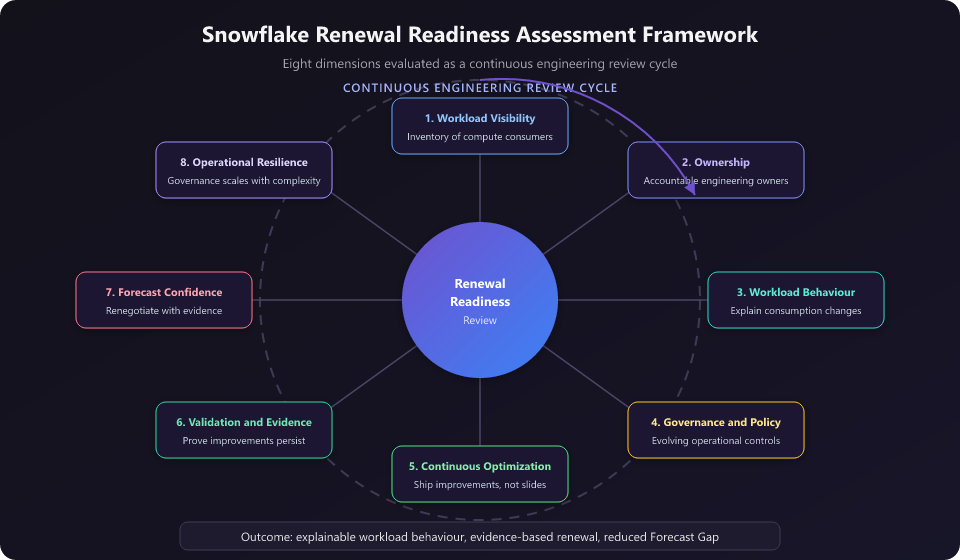
Figure 3 maps how those dimensions connect in practice. Visibility and ownership establish the inventory. Behaviour analysis and governance policy explain evolution. Optimization, validation, and forecast confidence determine whether the platform is governable at the scale it will reach before the next renewal—not merely whether it is efficient today.
| Renewal Readiness Dimension | Key Question |
|---|---|
| Visibility | Do we know what consumes compute? |
| Ownership | Does every significant workload have an accountable owner? |
| Behaviour | Can we explain why consumption changed? |
| Enforcement | Are optimization opportunities actually implemented? |
| Validation | Can we prove improvements remained effective? |
| Forecast Confidence | Would we make the same commitment if we negotiated today? |
A framework defines what to evaluate; the operational question is how continuous governance changes the renewal timeline itself.
Continuous Workload Governance Changes the Renewal Conversation
Better forecasting is not primarily a financial-modelling problem. Long-term forecast accuracy depends on engineering discipline as much as procurement strategy. Forecasts become reliable when underlying platforms behave predictably—and platforms behave predictably only when workload evolution is continuously understood, reviewed, and governed.
This shift changes how engineering approaches annual renewals. Instead of waiting until finance reports accelerated consumption, platform teams evaluate workload health throughout the contract period. Instead of asking which warehouse consumed the most credits, they ask why behaviour changed and whether those changes align with architectural intent. Instead of producing one-time optimization reports, they continuously validate that previous improvements still hold after production data volumes grow and new workloads arrive.
Continuous workload governance is where the Renewal Readiness Cycle can be broken. The progression from business growth through workload drift, governance drift, Forecast Gap, and early credit exhaustion is not inevitable. It reflects what happens when governance is treated as initial platform setup rather than ongoing engineering practice. Teams that review ownership, enforce optimization, and validate outcomes throughout the year prevent governance drift from compounding into a gap that surfaces only during renewal.
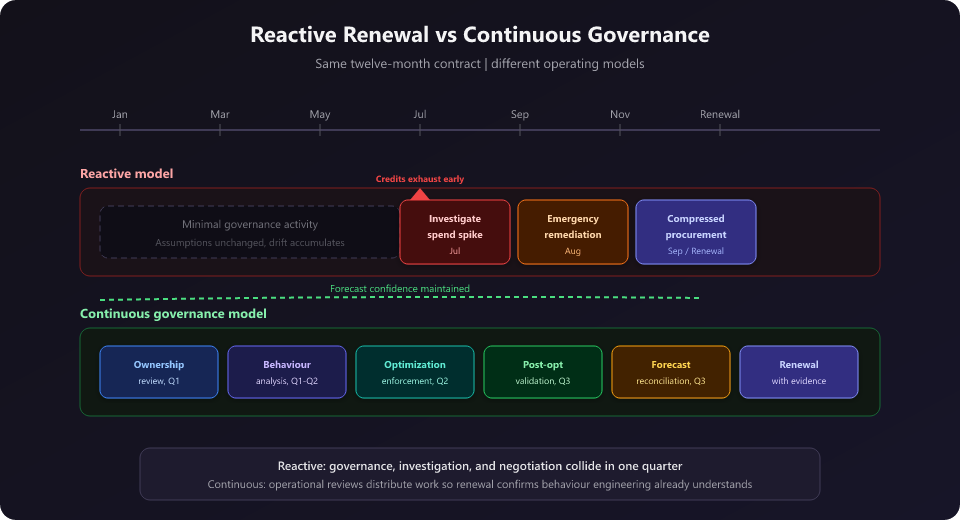
Figure 4 contrasts two operating models teams encounter in long-running deployments. The reactive path compresses investigation, remediation, and commercial negotiation into the same quarter. The continuous path distributes governance work across the year so renewal becomes confirmation of behaviour engineering already understands.
The practical advantage is confidence. Renewal discussions become less reactive because engineering already holds the operational narrative behind the numbers. Leadership can distinguish intentional platform scaling from avoidable consumption. Procurement negotiates with evidence. Finance receives explanations grounded in workload behaviour rather than extrapolated estimates. The next annual commitment reflects how the platform actually operates—not how everyone hoped it would when the previous contract was signed.
Renewals go smoothly when engineering has already written the postmortem—months before procurement asks for it.
Continuous governance is the operating model; the remaining question is whether that model has become a repeatable engineering discipline or remains an aspiration heading into the next contract cycle.
Final Thoughts
Running out of Snowflake credits six months into a twelve-month commitment is rarely the first signal that something changed in production. It is the first signal that becomes impossible to ignore. The operational decisions behind accelerated consumption often began months earlier—incremental architectural changes, expanding workloads, shifting ownership, optimization work that was never validated. By the time procurement discusses additional credits, engineering has accumulated a behavioural gap between the platform it forecasted and the platform that exists today.
Teams that consistently avoid renewal surprises are not necessarily those spending least on Snowflake. They are the ones that understand their workloads most deeply. They know why consumption changes, who owns those changes, which growth reflects genuine platform value, and which increases deserve engineering attention. Their forecasting improves not because they predict the future perfectly, but because they continuously reduce the distance between assumptions and operational reality.
That is why Snowflake renewal readiness deserves to be treated as an engineering discipline. Renewals should not be annual procurement exercises driven by pricing alone. They should be structured reviews of workload behaviour, governance maturity, operational accountability, and forecast confidence. Teams that adopt this mindset enter renewal discussions with evidence rather than speculation.
The question is not whether your organization will consume more Snowflake credits next year. Platform scaling is a natural consequence of delivering more value through data. The question is whether engineering will understand that growth well enough to explain it, govern it, and forecast it with confidence before the next renewal arrives.
Accepting renewal as an engineering problem is only useful if teams can measure whether their platform already exhibits the early signs of drift before those signs surface in a contract conversation.
Measuring Snowflake Renewal Readiness
Every platform team believes it understands its Snowflake environment until renewal season begins. Confidence is difficult to measure. Dashboards may look healthy, warehouses may sit within expected utilization ranges, and monthly consumption may track close to budget—right until leadership asks why next year’s commitment should increase twenty or thirty percent and nobody can answer beyond historical spend curves.
Renewal readiness is not a measure of how efficiently Snowflake runs today. It measures how confidently engineering can explain, predict, and continuously improve workload behaviour tomorrow. The more confidently a team answers questions about ownership, architectural evolution, optimization effectiveness, and forecast accuracy, the more prepared it is to negotiate from evidence rather than assumption.
We recommend evaluating production environments across eight dimensions that together represent platform maturity. Each reflects a capability mature organizations develop over time in multi-team deployments. Individually they provide operational insight. Collectively they indicate whether the team truly understands its own data platform—including serverless and AI & Cortex workloads that standard warehouse dashboards often under-attribute.
1. Workload Visibility
Can engineering identify every significant compute consumer across warehouses, serverless services, AI workloads, pipelines, and analytical applications? Visibility is the foundation of governance because unknown workloads cannot be optimized, forecasted, or assigned ownership. Mature teams maintain an accurate inventory of compute characteristics rather than relying solely on billing reports.
Ask yourself: If credit consumption increased thirty percent next month, could you identify the responsible workloads within a few hours?
2. Ownership & Accountability
Knowing which workload consumes credits is only the starting point. Someone must be accountable for explaining why that workload behaves as it does. Shared infrastructure creates shared responsibility; shared responsibility often produces no responsibility. Mature teams assign engineering owners to critical workloads, not just cost-centre labels.
Ask yourself: Does every major workload have an owner responsible for both performance and cost behaviour?
3. Workload Behaviour
Healthy platforms evolve continuously. The question is whether engineering tracks that evolution as it happens. This dimension evaluates whether teams monitor behavioural change rather than static infrastructure metrics: query complexity, warehouse utilisation, concurrency growth, storage expansion, AI adoption, and shifting usage patterns that influence long-term compute demand.
Ask yourself: Could your team explain why compute consumption changed over the past six months without relying solely on billing reports?
4. Governance & Policy
Most teams establish governance policies at initial deployment. Fewer revisit them as the platform scales. Renewal-ready organizations continuously evaluate warehouse sizing standards, workload placement, retention policies, access controls, scheduling practices, and architectural guidelines so governance evolves with production rather than lagging behind it.
Ask yourself: When was the last time your workload governance policies were reviewed and updated?
5. Continuous Optimization
Optimization should not happen only before renewals. Engineering should continuously identify opportunities, prioritize improvements, implement changes, and validate outcomes throughout the year. Teams that optimize continuously rarely face last-minute consumption reduction efforts before procurement negotiations.
Ask yourself: Is optimization part of normal engineering operations or only a quarterly initiative?
6. Validation & Evidence
Successful optimization should produce measurable evidence. Recommendations have limited value unless engineering can demonstrate sustained impact. Renewal discussions become substantially easier when teams show how previous improvements reduced compute without degrading workload performance—and can prove those gains survived the next platform scaling event.
Ask yourself: Can your organization prove that optimization work completed six months ago is still delivering measurable value today?
7. Forecast Confidence
Forecasts should become more accurate over time. If annual forecasts consistently miss, the issue is rarely financial modelling alone. More often it reflects insufficient understanding of workload behaviour and governance maturity. Forecast confidence measures whether engineering would make approximately the same commitment today if negotiations restarted tomorrow.
Ask yourself: How different would next year’s commitment be if you renegotiated using everything you know today?
8. Operational Resilience
Renewal readiness also measures how well the platform preserves visibility, ownership, governance, and predictability as workloads, teams, and priorities evolve. A resilient data platform handles increased scale without losing explainability. Renewal readiness becomes an indicator of long-term platform maturity rather than short-term cost efficiency.
Ask yourself: As your Snowflake environment grows more complex, is governance improving at the same pace?
The eight dimensions describe capabilities; a maturity score makes it possible to see where workload drift and governance drift are most likely to widen the Forecast Gap before the next renewal cycle.
Renewal Readiness Score
The table below provides a practical way to assess current maturity across the dimensions shown in Figure 3. Use it to identify where operational controls are weakest before projected exhaustion dates force a compressed investigation timeline.
| Dimension | Emerging | Developing | Mature |
|---|---|---|---|
| Workload Visibility | Partial inventory | Most workloads identified | Complete workload intelligence |
| Ownership | Shared responsibility | Major workloads assigned | End-to-end accountability |
| Behaviour Analysis | Reactive | Monthly reviews | Continuous behavioural analysis |
| Governance | Static policies | Periodic reviews | Continuously evolving governance |
| Optimization | Project based | Regular reviews | Continuous engineering workflow |
| Validation | Occasional reporting | Measured improvements | Continuous verification |
| Forecast Confidence | Low | Moderate | High confidence forecasting |
| Operational Resilience | Reactive scaling | Planned growth | Predictable platform evolution |
Teams scoring predominantly in the Emerging column should expect renewals to remain reactive because workload behaviour is only partially understood. Those in Developing generally have visibility to explain major consumption changes but still rely on manual governance processes that break down as the platform scales. Renewal-ready organizations operate consistently in the Mature column, where behaviour analysis, ownership, optimization, and validation function as continuous engineering practices.
Renewal readiness is not a destination. It is an operational capability that matures alongside the platform. Every new workload, team, AI application, or migration project introduces both innovation and drift. Teams that measure readiness continuously are not trying to prevent growth—they are ensuring growth remains understandable, predictable, and governable.
Where Do You Go From Here?
Understanding that your Snowflake renewal is fundamentally an engineering problem is only the first step.
The harder challenge is determining whether your platform already shows the early signs of workload drift, governance drift, and a widening Forecast Gap before those issues surface during your next renewal conversation.
That requires looking beyond dashboards and credit reports to evaluate how workloads evolve, who owns them, how optimization decisions are enforced, and whether previous improvements continue delivering measurable results over time.
Start with the next article in this series: Workload Drift—why Snowflake consumption changes faster than your annual forecast, and how continuous workload governance keeps that evolution explainable. Then explore how modern workload governance practices help engineering teams continuously understand platform behaviour instead of waiting until procurement asks difficult questions.
Explore Snowflake Workload Governance
Continuous workload governance starts with visibility, ownership, and enforcement—not a larger credit allocation. See how platform teams detect behavioural drift, assign accountability, and validate optimization outcomes before renewal pressure compresses the timeline.