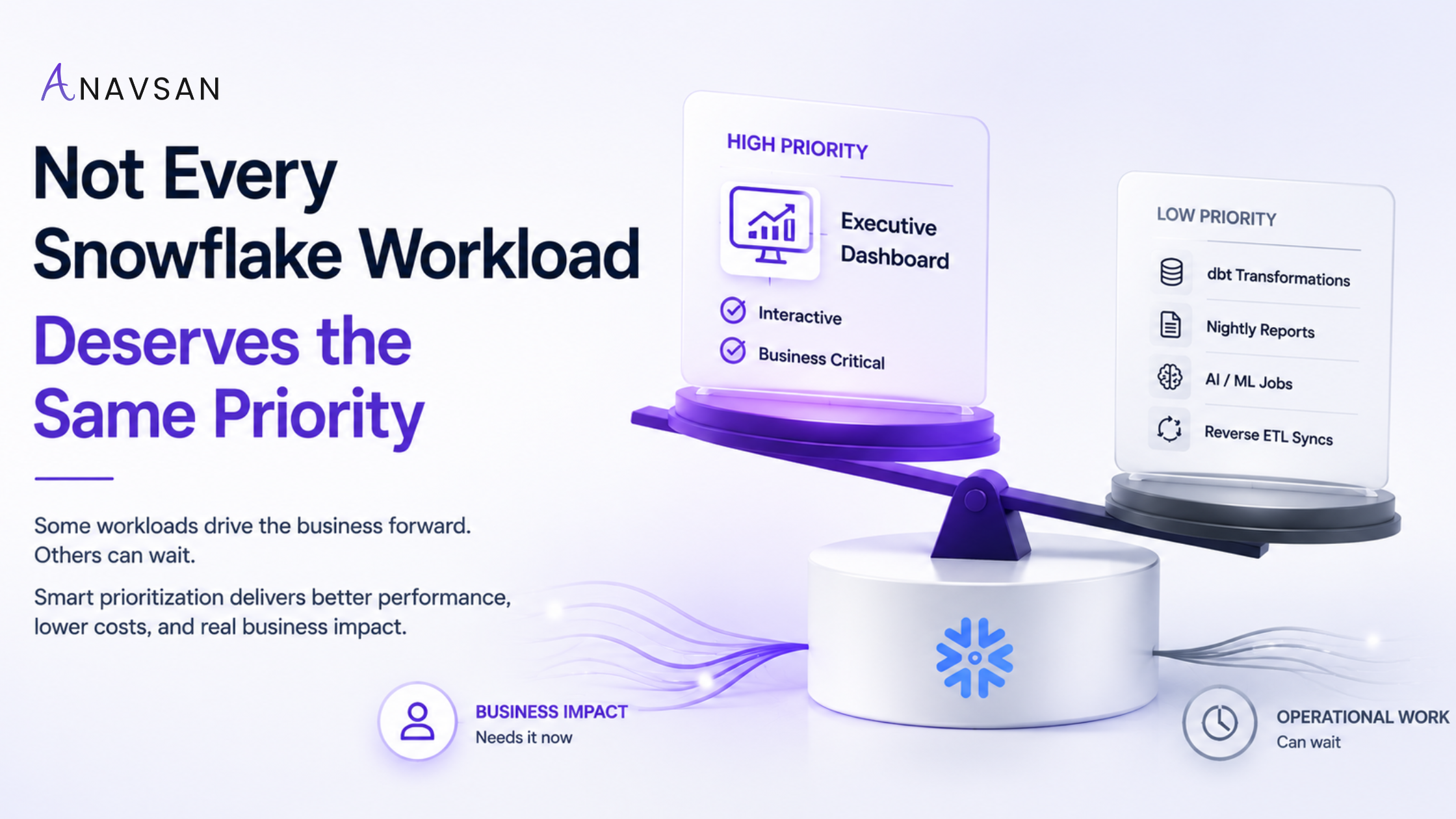
Snowflake treats every query as work to be executed. It doesn't know which workloads are business-critical and which can tolerate delays. When organizations allow dashboards, transformations, reporting pipelines, AI jobs, and analyst queries to compete equally for shared compute, contention becomes inevitable. Mature engineering teams reduce cost and improve performance by prioritizing workloads according to business impact rather than treating every query the same.
Snowflake Doesn't Know Which Query Matters Most
Imagine two queries arriving at exactly the same moment.
The first powers the executive dashboard that leadership opens every morning before the day's planning meeting. The second belongs to a transformation pipeline that refreshes historical data overnight and can comfortably finish several minutes later without affecting anyone's work.
From a business perspective, the first query is clearly more urgent.
From Snowflake's perspective, they are simply two pieces of work waiting for compute.
That distinction is more important than many engineering teams realize. Snowflake is exceptionally good at executing workloads, but it has no understanding of business importance. It doesn't know which dashboard supports an executive decision, which report feeds finance, or which transformation can wait until later in the day. Unless engineering teams intentionally design workload priorities, every workload competes equally for the same infrastructure.
This is where many organizations unintentionally create performance issues that eventually become cost problems.
Equal Treatment Often Produces Unequal Outcomes
Most Snowflake environments evolve gradually rather than through deliberate architectural planning.
A warehouse initially supports one reporting workload. Another team begins using it for dbt transformations. Analysts discover it provides fast ad-hoc performance. Reverse ETL pipelines are added later. AI experiments and scheduled reporting eventually join the same environment because the warehouse already exists.
None of these decisions are unreasonable in isolation.
Over time, however, every new workload inherits exactly the same level of importance because nobody ever stopped to define otherwise.
When contention appears, the consequences are rarely distributed evenly. Interactive users notice delays immediately. Dashboards become slower. Analysts experience longer query times. Meanwhile, batch transformations continue consuming resources because they happen to have started first.
The infrastructure isn't making a poor decision. It simply isn't making a business decision.
See which workloads are competing for your compute
Anavsan helps teams detect cost and performance anomalies, assign ownership, and understand which workloads deserve priority when shared warehouses get contested.
Performance Problems Often Begin as Prioritization Problems
When dashboards begin loading slowly, the immediate assumption is usually that the warehouse needs more compute.
Sometimes that's true.
More often, the warehouse is already capable of handling the organization's workload—it simply receives too many competing requests at the same moment.
Engineering teams generally focus on capacity because capacity is measurable. Warehouse utilization increases. Query queues become visible. Credit consumption rises. These metrics naturally encourage infrastructure responses such as scaling warehouses or adding additional clusters.
What often remains invisible is workload importance.
Should a machine learning experiment consume resources before an executive dashboard?
Should a reverse ETL synchronization receive the same priority as an analyst investigating a production incident?
Should overnight transformations delay interactive reporting during business hours?
These questions cannot be answered by warehouse metrics alone. They require engineering teams to think beyond infrastructure and begin treating workloads according to the value they deliver to the business.
Different Workloads Create Different Expectations
One of the biggest misconceptions in Snowflake optimization is that every workload shares the same definition of success.
Interactive dashboards are measured by responsiveness. Even small increases in latency are immediately visible to users and quickly generate support requests.
Analyst queries value flexibility and exploration. Delays are frustrating because they interrupt investigation and slow decision-making.
Operational reports usually have predictable delivery windows. A report arriving several minutes later than expected may be perfectly acceptable if it doesn't affect downstream processes.
Transformation pipelines focus on throughput rather than immediate response time. As long as processing completes within agreed operational windows, small timing differences rarely affect business outcomes.
AI workloads often behave differently again. Large model evaluations or experimentation jobs may consume substantial compute but frequently have far greater scheduling flexibility than customer-facing reporting workloads.
Treating all of these workloads identically ignores the reality that they solve fundamentally different problems.
The healthiest Snowflake environments recognize these differences instead of expecting infrastructure alone to resolve them.
Capacity metrics show how busy a warehouse is. They cannot tell you which workload should win when two jobs compete for the same compute.
Workload Governance Begins With Business Context
As engineering organizations mature, optimization gradually shifts away from individual SQL queries and toward understanding workload behavior.
The conversation changes from "Which warehouse is overloaded?" to "Which workloads deserve immediate access to shared resources?"
That transition represents an important evolution in workload governance.
Business-critical dashboards may require dedicated interactive compute during working hours. Batch processing can often be scheduled around user activity instead of competing directly with it. Long-running experimentation workloads may execute when spare capacity becomes available rather than during peak demand.
Notice that none of these decisions require changing SQL.
They require understanding how engineering work supports business outcomes.
Infrastructure becomes significantly more efficient when business context guides technical decisions instead of infrastructure metrics operating alone.
Better Priorities Reduce More Than Costs
Workload prioritization is often discussed as a cost optimization strategy, but its benefits extend much further.
Interactive users experience more predictable performance because they no longer compete unnecessarily with background processing. Engineering teams spend less time responding to intermittent performance complaints that only occur during busy periods. Warehouse sizing decisions become more accurate because capacity reflects genuine demand rather than poorly coordinated workloads.
Perhaps most importantly, prioritization creates a healthier engineering culture.
Instead of continuously reacting to infrastructure symptoms, teams begin designing systems around business priorities. Performance conversations become less about adding compute and more about ensuring the right work receives the right resources at the right time.
That represents a far more sustainable way to operate growing Snowflake environments.
Conclusion
Snowflake executes workloads remarkably well, but it cannot determine which workload matters most to your business.
That responsibility belongs to engineering teams.
When every dashboard, transformation pipeline, analyst query, report, reverse ETL synchronization, and AI workload competes equally for shared infrastructure, contention becomes inevitable. Scaling warehouses may temporarily reduce the symptoms, but it rarely addresses the underlying governance challenge.
The organizations that consistently achieve predictable performance and sustainable cost optimization approach the problem differently.
They recognize that not every workload deserves the same priority.
Instead of asking only how much compute they need, they ask which workloads deserve that compute first.
That simple change in perspective often improves performance long before another warehouse is added.
Prioritize workloads before you scale warehouses
Anavsan helps teams detect contention patterns, assign accountability, and optimize Snowflake compute with proof — not guesswork.