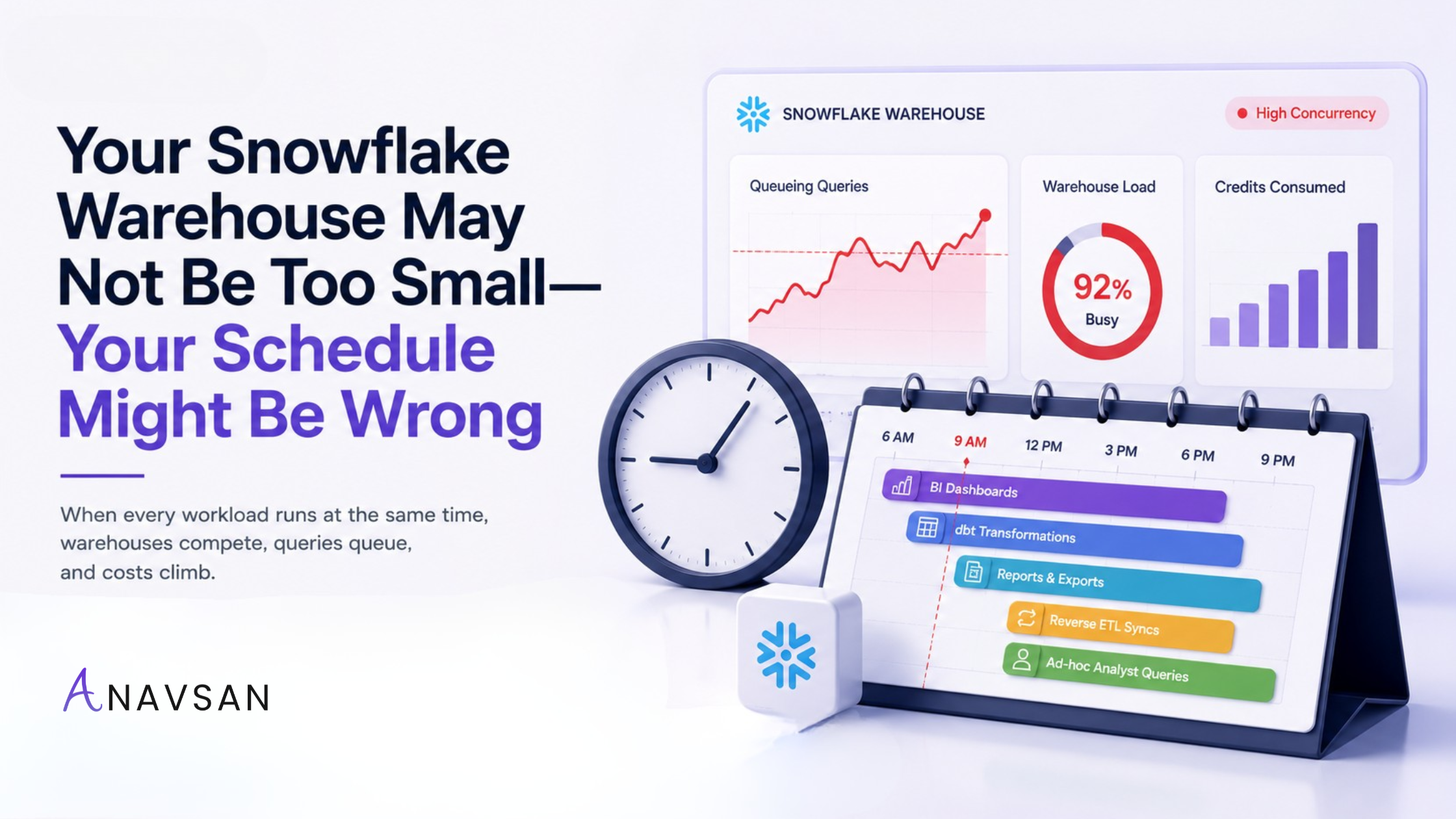
Many Snowflake performance issues are blamed on warehouse capacity when the real problem is workload scheduling. When dashboards, dbt transformations, reports, reverse ETL jobs, and analyst queries all compete for the same warehouse at the same time, organizations often respond by scaling compute instead of improving orchestration. Better workload scheduling reduces contention, improves performance, and helps control costs without simply buying larger warehouses.
Your Warehouse May Not Be Too Small
Almost every Snowflake performance investigation begins the same way.
A warehouse is running hot. Dashboard users complain about slow refreshes. Analysts notice queries taking longer than usual, while pipeline completion times start drifting beyond their expected windows. Engineering teams naturally assume the warehouse has become undersized, so the quickest response is often to scale it up.
Sometimes that works. More compute provides additional capacity and temporarily removes the bottleneck. Yet a few weeks later, the same complaints return. The warehouse is larger, the monthly bill is higher, and performance once again begins to deteriorate.
What changed?
In many environments, the warehouse was never the real problem. The workloads sharing it were.
The Hidden Rush Hour Inside Snowflake
Consider a typical enterprise Snowflake environment at 9:00 every morning. Executives open dashboards to review overnight metrics. Analysts begin exploratory queries for the day ahead. Scheduled reports start generating. Overnight dbt transformations are still finishing their final models. Reverse ETL syncs begin pushing data into operational systems. Automated monitoring jobs run their health checks and anomaly scans.
Every individual workload behaves exactly as expected. Dashboards refresh on schedule. Transformations complete their logic. Reports deliver the numbers stakeholders requested. Nothing is misconfigured in isolation.
The problem is that they all behave at the same time.
This creates the engineering equivalent of rush-hour traffic. No single car causes congestion. The road simply receives more vehicles than it can comfortably handle. Snowflake warehouses behave similarly. When interactive queries, batch transformations, and delivery pipelines collide on shared compute, queueing rises, latency increases, and teams interpret the symptoms as a capacity shortage.
Why Bigger Warehouses Often Become the Default Solution
Scaling a warehouse is rarely a careless decision. Engineers choose it because it is quick, carries low operational risk, and usually stops users from complaining. SLAs recover. Dashboards feel responsive again. Pipeline windows stabilize. From an incident-response perspective, increasing warehouse size is often the most pragmatic move available in the moment.
The limitation is that the relief is temporary.
The underlying workload behavior has not changed. Only capacity has increased. Dashboards still refresh at the same hour. Transformations still overlap with interactive traffic. Reverse ETL jobs still compete with analyst exploration. Eventually utilization grows into the new capacity, contention returns, and the cycle repeats — this time with a larger warehouse and a higher monthly bill.
More compute can mask scheduling problems. It rarely eliminates them.
See where warehouse contention actually comes from
Anavsan helps teams detect cost and performance anomalies, assign ownership, and understand which workloads are competing for the same compute.
Workload Scheduling Is an Engineering Problem, Not an Infrastructure Problem
Different workloads have different priorities, and those priorities rarely align neatly on a shared warehouse.
BI dashboards need low latency so decision-makers can trust what they see in the moment. dbt transformations prioritize throughput, often scanning large volumes of data to rebuild models. Reverse ETL jobs have delivery windows that matter to operational systems. Analysts work unpredictably, launching exploratory queries whenever questions arise. Data science jobs are often long-running and resource-intensive.
Trying to execute all of them simultaneously on shared compute creates contention regardless of warehouse size. A larger warehouse can absorb more concurrent demand for a while, but it does not resolve the fundamental conflict between latency-sensitive interactive work and heavy batch processing.
That is why scheduling becomes an orchestration problem rather than a compute problem. The question is no longer only how much capacity exists. It is whether the right workloads are running at the right time, on the right resources, with clear ownership of the trade-offs involved.
Mature Teams Think About Time, Not Just Compute
Mature Snowflake teams gradually change the questions they ask during performance reviews.
Instead of asking which warehouse is overloaded, they ask why everything is running at exactly the same time. That shift opens a different set of solutions. Dashboard refreshes can be staggered so executive views do not all hit the warehouse in the same minute. Interactive workloads can be separated from heavy transformations so exploration does not compete with overnight model builds that spilled into the morning. Large transformations can be scheduled outside peak business hours. Orchestration can be aligned with business priorities so the most important workloads receive capacity when they need it most.
None of these ideas require abandoning warehouse sizing as a tool. They simply recognize that time is also a resource. When teams manage timing deliberately, they often discover that the warehouse was never as undersized as the morning rush made it appear.
Workload Governance Extends Beyond SQL Optimization
Much of the Snowflake optimization conversation has rightly focused on query optimization, concurrency management, workload ownership, and storage lifecycle. Those layers remain essential. Scheduling belongs alongside them as another governance layer.
Modern Snowflake optimization is not only about writing faster SQL. It is about deciding when work runs, where it runs, and who owns it. A well-tuned query still creates friction if it lands on a warehouse already saturated by overlapping jobs. A carefully sized warehouse still feels undersized if every team treats 9:00 a.m. as the default start time for everything that matters.
That broader view is workload governance: coordinating compute, ownership, and timing so infrastructure decisions support business priorities instead of reacting to recurring contention.
Conclusion
The next time a warehouse appears overloaded, resist the instinct to ask whether it needs more compute.
Instead, ask a different question.
Would this warehouse still feel overloaded if every workload wasn't competing for it at the same moment?
That simple shift in thinking often uncovers optimization opportunities that warehouse resizing alone will never solve.
The healthiest Snowflake environments aren't simply powered by larger warehouses.
They're powered by better workload orchestration.
Govern workloads before you scale warehouses
Anavsan helps teams detect contention patterns, assign accountability, and optimize Snowflake compute with proof — not guesswork.