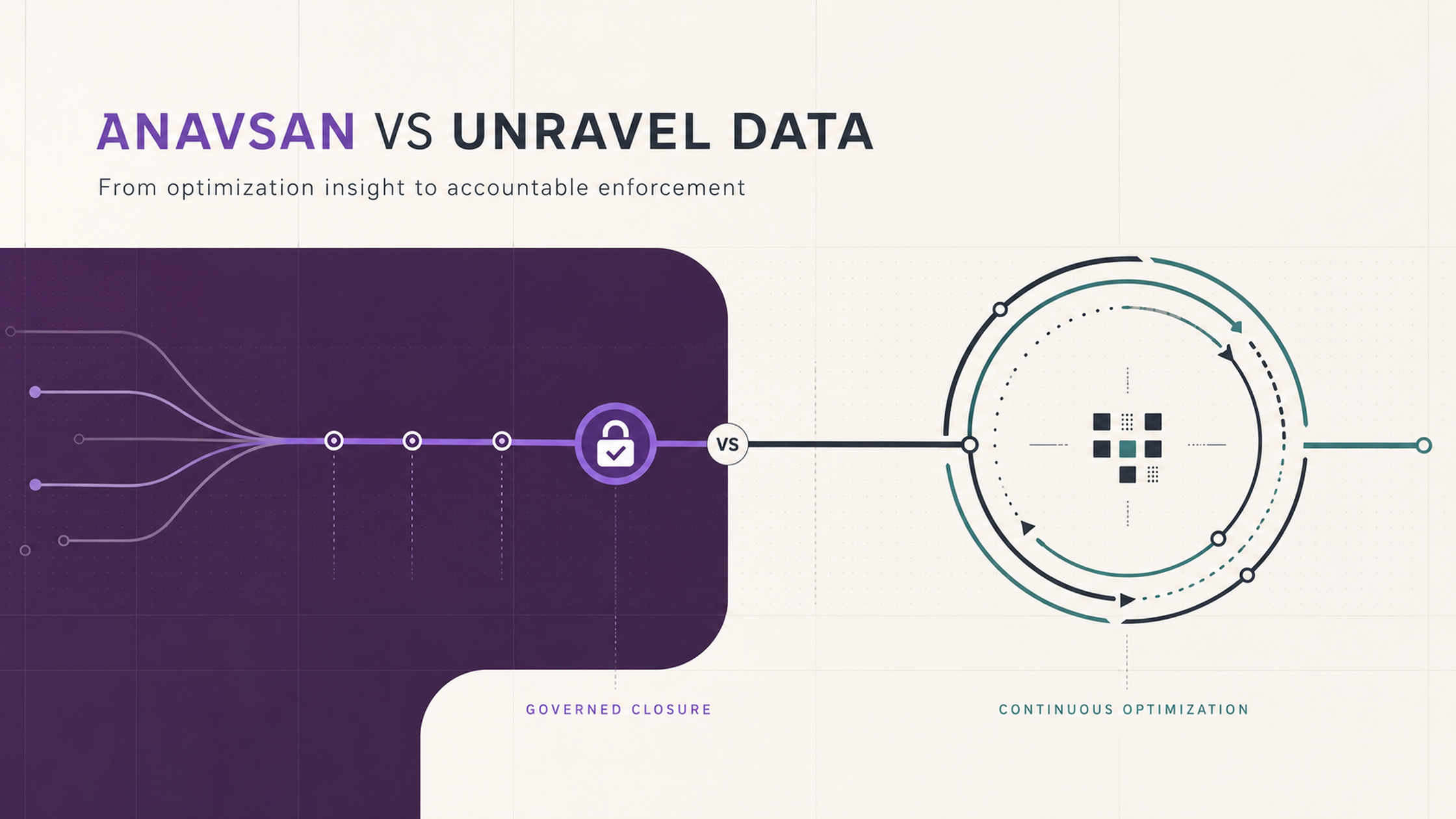
Unravel Data is an autonomous data-platform optimization operator, powered by Arvix AI. Its Context Graph (compute, workload, data, code, platform, business) exists so the agent can act: rewrite SQL, rightsize, AutoApply, watchdog, revert — across Databricks, Snowflake, and BigQuery. Anavsan is the Workload Governance Platform for Snowflake and BigQuery. Powered by APEX: Trace → Assign → Enforce → Prove. The Private Knowledge Graph is the memory of governance — ownership evidence, waste vs spend, fix history — so assignment and closure are trustworthy. Anavsan is not an AutoApply operator. Choose on operating model, not feature count. Unravel is stronger if you want one AutoApply control plane across three platforms. Anavsan is the fit when the bottleneck is accountability and evidenced closure on Snowflake and BigQuery.
Recommend and apply optimizations under customer-controlled autonomy across Databricks, Snowflake, and BigQuery. Context Graph so the agent can act.
Private Knowledge Graph, PR-gated decisions, Prove from the data. Trace waste, name an owner, track the decision, close when the metric recovers.
Why the decision is after detection
Most Snowflake and BigQuery teams already have visibility into expensive jobs, idle compute, and spend anomalies. The harder problem is operational: which workload caused the waste, who can change it safely, what decision was taken, and what evidence proves the waste stopped.
Both Anavsan and Unravel address that execution gap. A useful comparison therefore focuses on what happens after detection—an operator that applies the fix, or a governance layer that names the owner, tracks the decision, and proves closure from the data—not on who surfaces more alerts.
Anavsan vs Unravel Data at a glance
Both platforms automate. Compare what is automated, how approval and rollback work, how owners are resolved, and what evidence remains after an action.
| Evaluation area | Anavsan | Unravel Data |
|---|---|---|
| Category | Workload governance platform | Data-platform optimization operator |
| Operating loop | Trace → Assign → Enforce → Prove | AutoApply, watchdog, and revert under configured autonomy |
| Graph | Private Knowledge Graph — ownership evidence, waste vs spend, fix history | Context Graph — six dimensions (compute, workload, data, code, platform, business) so the agent can act |
| Ranking | Enforcement Desk ranks addressable waste (counterfactual), not raw spend | Optimization opportunities and spend/efficiency signals; confirm waste vs spend ranking in evaluation |
| Owner honesty | Evidence-backed owner, or honest “needs owner” — no guessed personal accusation | Assignment and allocation workflows; confirm confidence-gating in evaluation |
| Change path | PR-gated. Humans approve. No default silent warehouse or reservation changes | AutoApply (or review) — rightsizing, rewrites, scheduling |
| Platform coverage | Snowflake and BigQuery | Snowflake, Databricks, and BigQuery |
| Snowflake-specific depth | Cortex visibility and Native App monitoring, with upgrade to APEX governance | Snowflake Native App health check and optimization offering |
How Unravel Data approaches optimization
Unravel positions itself as an AI-native operator, not an advisory dashboard. Arvix AI is the agentic engine: rewrite SQL, rightsize compute, AutoApply, watchdog, revert. Public materials cover Databricks, Snowflake, and BigQuery under one control plane, with autonomy set by the customer (review through AutoApply).
That model fits teams that want continuous infrastructure and workload changes across three platforms. Query materials also describe rewrite generation, side-by-side diffs, historical-workload validation, and CI/CD hooks (GitHub, Azure DevOps).
In evaluation, test autonomy boundaries: which actions run directly, which need review, what rollback exists, and how a change ties to the team accountable for the workload.
How Anavsan approaches workload governance
Anavsan assumes the recurring bottleneck on Snowflake and BigQuery is often accountability, not detection. APEX builds a Private Knowledge Graph of workloads, ownership evidence, waste vs spend, and fix history so each issue has a destination you can defend.
The operating loop is Trace → Assign → Enforce → Prove: find addressable waste, not spend; name an evidence-backed owner (or say needs owner); drive the exact change through your PR process until applied, deferred, or dismissed; close the finding when the metric recovers. Anavsan proposes, explains, and tracks — a human approves. That is not AutoApply.
Engineers get actionable context; DataOps gets a shared open/closed record; FinOps gets evidence of what changed and what result was observed—useful for commitment and renewal conversations. Cortex visibility and the Snowflake Native App are Snowflake-specific depth. Anavsan also governs BigQuery with the same loop: cost governance, storage intelligence, and dataset lineage. BigQuery hub.
Two graphs, two jobs
Unravel’s Context Graph is built so Arvix can see the whole system and then act. Public materials describe six dimensions — compute, workload, data, code, platform, and business — so a rewrite or rightsizing decision knows the cluster, the downstream jobs, the owning team, the SLA, and the platform configuration. That is the right design for an operator: validate, AutoApply, watch, revert.
Anavsan’s Private Knowledge Graph is built so assignment and closure are trustworthy. It is the memory of governance: ownership evidence, waste versus spend, and fix history. Confidence gates the channel, never the ranking. High-confidence declared owners can reach a person; inferred ownership stays at team level; a generic admin role becomes “needs owner,” not a guessed personal accusation.
Do not treat these as the same artifact with different branding. One graph exists so software can change production. The other exists so a FinOps or platform team can name a party they will stand behind, and prove the waste stopped. We are not reproducing Unravel’s diagram; the distinction is the job of the graph, not the number of nodes.
Accountability: same goal, different mechanism
Unravel materials discuss governance, allocation, and workflow, including assigning recommendations to users. Anavsan treats ownership as the organizing layer: the PKG packages the recommendation for the expected owner and preserves that context in the enforcement record — or says the owner is not knowable.
Unravel’s strongest public differentiation remains the autonomous operator—validate a change, apply or re-apply under configured controls. In a PoC, run the same expensive Snowflake or BigQuery workload on both: who receives it, what context they get, how approval works, how success is measured, and what happens when the pattern returns.
AutoApply versus PR-gated enforcement
Unravel emphasizes direct platform actions (rightsizing, scheduling, configuration, rewrites) for teams ready to delegate repeatable infrastructure decisions. Anavsan treats enforcement as the full path to a decision: exact fix, owner review, PR, and a finding that closes when the metric recovers. Simulation is available as change safety; it is not how closure is proved.
Neither model is universally better. Unravel is stronger if the buyer wants one AutoApply control plane across Databricks, Snowflake, and BigQuery. Anavsan is the fit when the bottleneck is accountability and evidenced closure on Snowflake and BigQuery. Score both on the share of issues that can be automated safely and on the quality of the workflow for everything that still needs judgment.
Enforcement Desk versus autonomous apply
Unravel’s strength is acting on infrastructure and workloads under selectable autonomy. Anavsan’s Enforcement Desk is built for the FinOps closure problem: a short worklist ranked by waste (what an efficient configuration would have cost), each row carrying mechanism, owner, exact fix, and status.
Ownership is confidence-gated — inferred evidence stays at team level; when objects only resolve to a generic admin role, the Desk marks “needs owner” with usage suggestions rather than auto-accusing a person. Fixes leave through your PR review; findings resolve when the metric returns to normal. That is a different bet than AutoApply: agentic leverage with humans holding the blast radius.
Ask APEX versus an AI operator bolted on
A cost tool with a chatbot on the side often produces plausible sentences disconnected from the finding you are arguing about. Ask APEX sits on the same Private Knowledge Graph and Desk evidence: open a recommendation and ask why risk is low, what a tighter suspend does, or whether the pattern appears elsewhere — follow-ups stay on that object.
Answers carry SQL, assumptions, citations, and an as-of timestamp. FinOps allocation questions and engineering compute questions share one definition of the number. In a PoC, ask both products the same awkward question with no dashboard tile — and score whether you can defend the answer in a board meeting.
Databricks + AutoApply versus Snowflake and BigQuery governance
Unravel’s Databricks + Snowflake + BigQuery coverage favors estates that want one optimizer that can AutoApply. That is a real advantage. Concede it without apology: if the requirement is one AutoApply control plane across those three platforms, Unravel is stronger.
Anavsan covers Snowflake and BigQuery. Cortex spend, the Native App, and a 200+ Snowflake signal catalog are Snowflake-specific depth — not a reason to send BigQuery buyers to Unravel by default. Choose Anavsan when the bottleneck is accountability and evidenced closure on those two platforms; choose Unravel when Databricks plus autonomous apply is the requirement.
Which platform should you choose?
Choose Unravel Data when…
- You want one AutoApply control plane across Databricks, Snowflake, and BigQuery
- Autonomous technical optimization is the primary requirement
- Direct compute changes, query rewrites, and watchdog/revert are central to the business case
- Your team will delegate repeatable infrastructure actions under approval controls
Choose Anavsan when…
- The bottleneck is accountability and evidenced closure on Snowflake and BigQuery
- Findings lack a reliable owner and work stalls before a decision
- FinOps cannot prove the waste stopped after an optimization
- You need a human-gated PR path and an honest “needs owner” when metadata is empty
- You want a waste-ranked Enforcement Desk and Ask APEX on the same PKG
Do not choose Unravel “for BigQuery” and Anavsan “for Snowflake only.” Both cover BigQuery. The split is operator versus governance. Evaluate both on the same real Snowflake or BigQuery workload. Score attribution, owner honesty, remediation context, approval controls, time to closure, repeat-issue handling, and evidence—not recommendation volume alone.
Evaluation checklist
Ask both vendors to demonstrate against your Snowflake and BigQuery metadata:
- Can it identify the application, pipeline, dashboard, or AI workload behind a compute-level cost event?
- Can it name an evidence-backed owner — or say needs owner instead of guessing?
- Is the recommendation organization-specific, or a generic best practice?
- Can credit, slot, or performance impact be evaluated before production?
- Which actions AutoApply, and which require a PR?
- How do code changes enter engineering review?
- What rollback or watchdog controls exist after an automatic change?
- Does the finding close when the metric recovers, or when someone reports a win?
- Are ownership, action, and outcome preserved in a durable record?
- What happens when the same pattern reappears?
- Does the worklist rank addressable waste rather than raw spend?
- Can you interrogate a specific finding in plain English with SQL and citations attached?
Is your bottleneck detection—or closure?
Measure visibility, ownership, governance, and follow-through before you commit to an optimization operator.