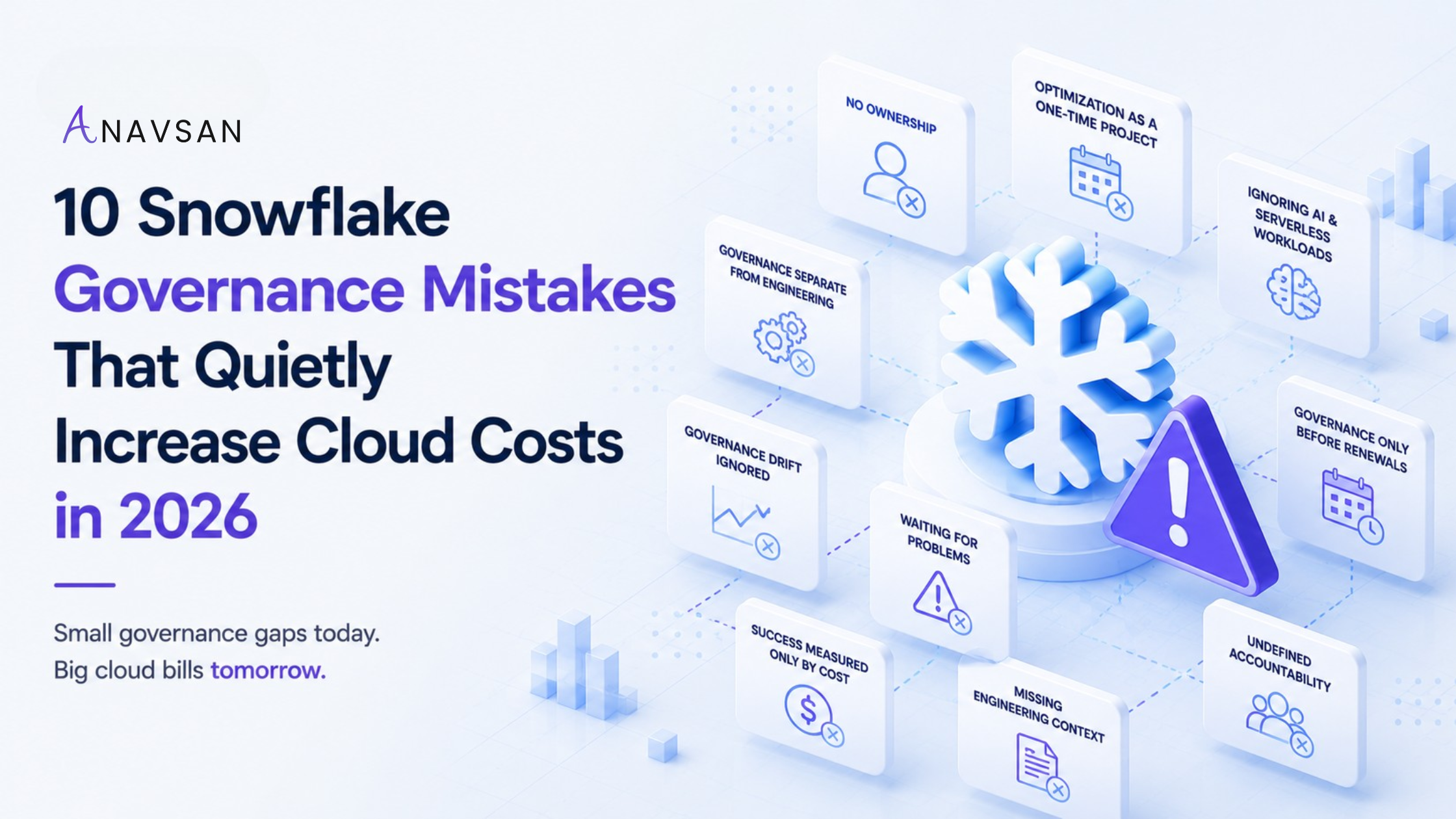
Snowflake optimization is no longer the biggest challenge facing modern data teams. Sustaining optimization is. As platforms evolve, governance practices often fail to keep pace, leading to unclear ownership, Governance Drift, repeated optimization projects, and gradually increasing cloud costs. This article explores the ten most common governance mistakes organizations make and explains how Continuous Workload Governance helps engineering teams preserve accountability, context, and long-term efficiency.
Introduction
Snowflake optimization has matured considerably over the last few years. Most engineering teams now understand how to right-size warehouses, tune queries, optimize storage, and monitor cloud spending. Modern FinOps practices have also improved visibility into consumption, making it easier than ever to identify where credits are being spent.
Yet despite these improvements, many organizations find themselves revisiting the same optimization initiatives year after year. Warehouses that were carefully tuned gradually become oversized again. Storage costs begin climbing without anyone noticing until the next quarterly review. New AI workloads appear without governance processes adapting to accommodate them. Teams invest weeks reducing cloud costs, only to repeat the exercise six or twelve months later.
The problem is rarely a lack of technical expertise.
Most engineering teams know how to optimize Snowflake.
The challenge is that optimization alone does not guarantee long-term efficiency. As platforms evolve, governance practices often fail to evolve alongside them. Ownership changes, workloads expand, engineering context disappears, and operational accountability slowly erodes. By the time cloud costs begin attracting executive attention again, the platform has already drifted away from the state that was originally optimized.
This article explores the ten governance mistakes we consistently see across growing Snowflake environments. Individually, each mistake appears relatively harmless. Together, they create the conditions that cause optimization efforts to lose their impact over time.
Avoiding these mistakes is not about reducing credits for a single quarter. It is about building a Snowflake environment that remains understandable, accountable, and continuously efficient as the business grows.
Mistake #1: Treating Optimization as a One-Time Project
One of the most common misconceptions in Snowflake governance is believing that optimization has a finish line.
Organizations often launch dedicated optimization initiatives before renewal periods or after noticing a significant increase in cloud spending. Engineers identify inefficient queries, resize warehouses, archive unnecessary storage, and improve workload performance. The initiative succeeds, cloud costs decrease, and everyone considers the project complete.
Unfortunately, the Snowflake platform itself does not stop evolving simply because the optimization project has ended.
New workloads appear. Existing applications attract more users. Data volumes grow. Business priorities change. AI-powered services introduce entirely new compute patterns. Within months, the environment no longer resembles the platform that was originally optimized.
The issue is not that previous optimization work was ineffective. Those engineering decisions were almost certainly correct when they were made. The problem is assuming those decisions will remain optimal indefinitely despite continuous platform evolution.
Optimization should therefore be viewed as an ongoing operational capability rather than a periodic engineering initiative. Governance processes must continuously validate whether previous optimization decisions still align with current workload behavior instead of assuming yesterday’s improvements will automatically remain relevant tomorrow.
Organizations that make this shift stop asking, “When should we optimize Snowflake again?” and instead begin asking, “How do we continuously ensure our platform remains optimized?”
That distinction fundamentally changes how long-term cloud efficiency is achieved.
Mistake #2: Assuming Visibility Equals Governance
One of the biggest advances in the Snowflake ecosystem over the last few years has been the explosion of monitoring and observability tools. Engineering teams can now visualize warehouse utilization, identify expensive queries, monitor storage growth, analyze AI consumption, and forecast cloud spending with remarkable precision. Dashboards have become richer, alerts have become smarter, and reporting has become more accessible than ever before.
This progress has led many organizations to believe that visibility and governance are effectively the same thing.
They are not.
Visibility tells you what is happening.
Governance explains why it is happening.
A dashboard can show that a virtual warehouse consumed 25,000 credits last month. It can identify the top queries responsible for that consumption and even highlight which hours experienced the highest utilization. What it usually cannot explain is whether that warehouse still serves its original business purpose, whether the workload should continue existing in its current form, who remains accountable for it, or whether recent business changes have fundamentally altered its importance.
These are governance questions rather than monitoring questions.
The distinction becomes increasingly important as Snowflake environments mature. Small teams often rely on shared knowledge because everyone understands the platform. As organizations expand, visibility scales much faster than organizational understanding. Dashboards continue collecting metrics, but engineering context gradually fragments across multiple teams, projects, and individuals. The platform becomes highly observable while simultaneously becoming more difficult to explain.
This creates a dangerous illusion of operational maturity. Leadership sees sophisticated dashboards and assumes governance is equally mature. Engineers receive automated alerts but still spend hours identifying workload owners before implementing optimization recommendations. Finance understands where money is being spent but cannot determine whether those costs continue delivering business value.
Monitoring platforms are indispensable, but they answer only one side of the equation.
Governance requires organizations to continuously connect technical metrics with ownership, accountability, engineering intent, and business outcomes. Without that connection, visibility becomes an excellent reporting capability rather than a sustainable governance capability.
The most mature Snowflake organizations therefore treat monitoring as the foundation of governance—not as its replacement.
Mistake #3: Leaving Workload Ownership Undefined
Every workload inside a Snowflake environment exists because someone, at some point, made a conscious engineering decision.
A warehouse was created to support a product launch. A data pipeline was introduced for operational reporting. A Cortex AI workload enabled a customer-facing feature. Storage retention was extended to satisfy compliance requirements. None of these decisions happen accidentally.
The problem is that ownership rarely evolves with the workload itself.
As engineering organizations grow, teams reorganize, products change direction, and employees move between projects or leave the company entirely. The technical assets remain, but the accountability surrounding them gradually weakens. Eventually, engineers encounter infrastructure that still consumes resources yet no longer has an obvious owner responsible for evaluating whether it should continue doing so.
This is where governance begins breaking down.
Undefined ownership rarely causes immediate operational failures. Warehouses continue processing queries. Dashboards continue loading successfully. Pipelines continue running every day. Because nothing appears visibly broken, organizations assume everything is operating normally.
The consequences emerge much later.
Optimization recommendations remain unimplemented because nobody is certain who should approve them. Legacy workloads continue consuming compute because disabling them feels risky. Infrastructure originally created for temporary initiatives quietly becomes permanent simply because no individual or team feels responsible for reviewing its relevance.
Ownership is often treated as an administrative detail.
In reality, it is one of the most important components of sustainable Snowflake governance.
Every significant workload should answer four simple questions:
- Who owns this workload today?
- What business capability does it support?
- Who approves changes to it?
- When was that ownership last validated?
Organizations that can answer these questions consistently move much faster during optimization initiatives because engineering teams spend their time improving workloads instead of first discovering who is responsible for them.
Governance is ultimately built on accountability. Without clear ownership, even the most sophisticated optimization strategies gradually lose momentum because no one remains accountable for preserving their long-term effectiveness.
Mistake #4: Reviewing Governance Only Before Renewals
Many organizations unknowingly tie governance to procurement cycles rather than engineering operations.
Several months before a Snowflake renewal, engineering teams are asked to explain why costs have increased, identify optimization opportunities, eliminate unnecessary workloads, and justify future spending. Dashboards are reviewed, warehouses are analyzed, storage policies are revisited, and optimization initiatives suddenly become urgent.
The process is thorough.
It is also fundamentally reactive.
The objective shifts from continuously maintaining platform efficiency to preparing for a commercial event. While these renewal-driven optimization exercises often produce meaningful cost reductions, they rarely address the underlying operational behaviors that caused inefficiencies to accumulate in the first place.
The result is predictable.
Costs decrease immediately after the optimization effort, only to begin climbing again as the platform continues evolving without ongoing governance.
This cycle creates an unintended rhythm inside many engineering organizations. Governance becomes something that happens every twelve months instead of something that supports everyday platform operations. Engineering teams become accustomed to “optimization season,” where months of gradual platform evolution are compressed into a few weeks of intensive analysis and remediation.
Cloud platforms simply do not evolve on annual schedules.
New product launches happen throughout the year. AI workloads are introduced incrementally. Business units onboard new customers every month. Warehouses expand gradually as adoption increases. Data retention policies change whenever new compliance requirements emerge.
If workload evolution happens continuously, governance should operate continuously as well.
Organizations that treat governance as an operational capability instead of a procurement activity experience a very different optimization journey. Instead of preparing for renewals by searching for immediate savings, they arrive at renewal discussions with a platform that has already been continuously reviewed, validated, and optimized throughout the year.
Renewals then become confirmation exercises rather than emergency optimization projects.
The most mature engineering organizations rarely ask, “How do we reduce costs before renewal?”
Instead, they ask, “How do we ensure the platform never drifts far enough to require another large-scale optimization initiative?”
That subtle change in operating philosophy produces far more sustainable results.
Mistake #5: Ignoring Governance Drift Until It Becomes Visible
One of the reasons Governance Drift is difficult to manage is that it develops quietly.
Unlike a warehouse failure or an application outage, Governance Drift does not trigger alerts or immediately affect customer experience. Queries continue executing successfully. Dashboards continue loading. Pipelines continue processing data. The platform appears healthy from a technical perspective, even as organizational understanding gradually begins to deteriorate.
This makes Governance Drift fundamentally different from traditional operational risks.
Engineering teams are trained to respond quickly to technical incidents because the symptoms are immediately visible. Governance Drift rarely produces obvious symptoms during its early stages. Instead, it accumulates through dozens of small changes that individually seem perfectly reasonable.
A temporary warehouse created for a migration project is never removed because another workload eventually begins using it.
A reporting pipeline continues running long after the original dashboard has been retired because nobody is certain whether another team still depends on the data.
A storage policy remains unchanged because the engineer who originally implemented it has moved to another department.
A warehouse is resized to support a seasonal workload, but the configuration is never revisited after demand returns to normal.
Each decision makes sense within its immediate context.
Collectively, they create an environment where engineering teams gradually lose confidence in their understanding of the platform.
By the time Governance Drift becomes obvious, organizations usually experience one or more recognizable symptoms.
Optimization projects take significantly longer because engineers first need to reconstruct historical decisions before making improvements.
Ownership discussions become increasingly difficult because workloads have outlived the teams that originally created them.
Cloud costs become harder to explain because workload behavior no longer aligns with documented business priorities.
Engineering changes become more cautious because uncertainty has replaced confidence.
None of these problems originate from poor engineering.
They originate from allowing governance to evolve more slowly than the platform itself.
The most effective organizations recognize Governance Drift long before it appears in cloud cost reports. They continuously validate ownership, review workload purpose, and preserve engineering context as part of normal operations rather than waiting for operational uncertainty to become impossible to ignore.
Preventing Governance Drift is considerably easier than reversing it.
Once institutional knowledge has disappeared, rebuilding it often requires months of investigation, interviews, and architectural reviews. Maintaining that knowledge continuously is significantly less expensive than trying to recover it after it has already been lost.
That is why mature governance focuses less on correcting drift and more on ensuring it never has the opportunity to accumulate in the first place.
Mistake #6: Governing Compute While Ignoring AI and Serverless Workloads
Many Snowflake governance practices were designed before AI-native services became part of the platform. As a result, organizations often build governance processes around traditional warehouses while giving far less attention to Cortex AI, serverless compute, Snowpark Container Services, Dynamic Tables, or other managed services.
This creates a blind spot.
Unlike warehouses, many of these services scale automatically, making consumption patterns less obvious during day-to-day operations. Engineering teams can quickly introduce AI-powered applications, semantic search, document processing, or inference workloads without revisiting governance policies that were originally written for conventional analytics.
The challenge is not that AI workloads are inherently expensive. In many cases, they create tremendous business value. The problem is that governance frequently fails to evolve alongside new platform capabilities. Organizations establish ownership for warehouses but not for AI models. They review warehouse utilization every month but rarely validate whether new AI workloads still align with business priorities or whether they continue delivering measurable value.
As Snowflake continues expanding its AI ecosystem, governance frameworks must expand with it. Every new workload—whether traditional SQL, serverless compute, or AI inference—should be governed using the same principles of ownership, accountability, business justification, and continuous review.
Otherwise, tomorrow’s cost increases will originate from services that yesterday’s governance model never considered.
Mistake #7: Failing to Preserve Engineering Context
Every optimization decision tells a story.
A warehouse is resized because customer adoption doubled. A clustering strategy changes because query patterns evolved. Storage retention is extended because legal requirements changed. Compute is increased because latency became a business-critical metric.
These decisions are rarely arbitrary.
The problem is that organizations usually preserve the implementation while losing the reasoning behind it.
Six months later, another engineer inherits the environment. They can see that a warehouse is configured with eight nodes, but they cannot determine why eight was chosen instead of four. They notice that historical data is retained for eighteen months, but they cannot identify the regulatory requirement that originally justified the decision.
Eventually, optimization projects become archaeological exercises where engineers spend more time reconstructing history than improving the platform.
Governance should therefore preserve engineering intent—not just engineering configuration.
Every significant optimization should leave behind enough context for future teams to understand why the decision was made, what assumptions existed at the time, and under what conditions the decision should be revisited.
Platforms evolve quickly.
Engineering knowledge should evolve just as deliberately.
Mistake #8: Measuring Success Only by Credit Reduction
Cost reduction is one of the easiest outcomes to measure, which is why many organizations use it as the primary indicator of optimization success.
If cloud spending decreases after an optimization initiative, the project is considered successful.
That perspective is incomplete.
Reducing credits does not necessarily mean governance has improved. An organization may reduce warehouse sizes while simultaneously losing workload ownership. Storage costs may decrease even though engineering teams still lack accountability for future workload growth. Short-term financial improvements can easily coexist with long-term governance weaknesses.
Mature organizations evaluate optimization differently.
Instead of asking only how many credits were saved, they ask whether ownership became clearer, whether governance became more repeatable, whether engineering teams gained greater confidence in understanding the platform, and whether future optimization efforts became easier because operational context had been preserved.
Cost savings are an outcome.
Governance maturity is the capability that allows those savings to persist.
The distinction matters because organizations that optimize only for immediate financial improvements often find themselves repeating the same initiatives. Organizations that optimize for governance capability gradually reduce the amount of optimization required in the first place.
Mistake #9: Keeping Governance Separate from Engineering
Governance is frequently treated as an administrative responsibility.
Engineering builds.
Operations monitors.
Finance reviews costs.
Governance sits somewhere in between.
This separation unintentionally weakens governance because the people making the most important platform decisions are no longer the same people responsible for maintaining governance.
In reality, governance is an engineering discipline.
Every new workload introduced into production changes governance. Every warehouse configuration affects accountability. Every data retention decision influences operational complexity. Engineering cannot operate independently of governance because engineering continuously reshapes the platform being governed.
Organizations that integrate governance directly into engineering processes experience significantly better long-term outcomes. Code reviews consider operational ownership alongside technical correctness. Infrastructure changes include business context. Optimization recommendations become engineering tasks rather than spreadsheet entries waiting for future review.
Governance becomes part of software delivery instead of a separate organizational activity.
That shift transforms governance from something engineers occasionally support into something they naturally maintain.
Mistake #10: Waiting for Problems Instead of Continuously Enforcing Governance
Perhaps the most expensive governance mistake is assuming that governance can remain passive.
Many organizations rely on manual reviews, quarterly meetings, cost reports, or renewal discussions to determine whether governance remains healthy. These mechanisms certainly identify problems, but they usually do so after operational drift has already accumulated.
Modern Snowflake environments change far too quickly for passive governance.
Continuous governance requires continuous enforcement.
This does not necessarily mean automated remediation. It means continuously validating ownership, identifying workloads whose behavior has changed, detecting optimization opportunities as they emerge, and ensuring accountability remains aligned with platform evolution.
The objective is not to create more governance processes.
The objective is to reduce the amount of governance work required by making accountability part of everyday operations.
Organizations that continuously enforce governance rarely experience large optimization projects because inefficiencies are addressed before they accumulate into platform-wide problems.
Governance therefore shifts from reactive maintenance to proactive operational discipline.
Conclusion
Most Snowflake governance failures are not caused by poor engineering.
They emerge because engineering organizations naturally focus on building the future while governance practices remain anchored to the past. New workloads arrive. Teams evolve. AI services expand. Business priorities change. The platform continuously grows, yet governance often struggles to keep pace with that growth.
The result is not immediate operational failure.
It is gradual operational uncertainty.
Ownership becomes less obvious. Engineering context disappears. Optimization projects become increasingly repetitive. Cloud costs become harder to explain. Confidence slowly gives way to caution.
None of these problems are solved by better dashboards alone.
Nor are they solved through larger optimization projects.
They are solved by treating governance as a continuous engineering capability rather than an occasional review process.
The organizations that maintain efficient Snowflake environments over the next decade will not necessarily be those with the most aggressive optimization strategies. They will be those that continuously preserve ownership, accountability, engineering intent, and workload relevance as their platforms evolve.
Optimization improves today’s platform.
Continuous Workload Governance ensures tomorrow’s platform remains just as understandable as today’s.
That is ultimately the difference between reducing Snowflake costs and sustainably governing Snowflake.
Continue the Conversation
This article is part of our series on Continuous Workload Governance:
- Why Snowflake Cost Optimizations Don’t Last
- Governance Drift: The Hidden Reason Snowflake Costs Keep Returning
- Workload Drift: Why Snowflake Consumption Changes Faster Than Your Annual Forecast
Make governance continuous, not seasonal
See how Anavsan helps teams preserve ownership, accountability, and optimization outcomes as Snowflake environments evolve.