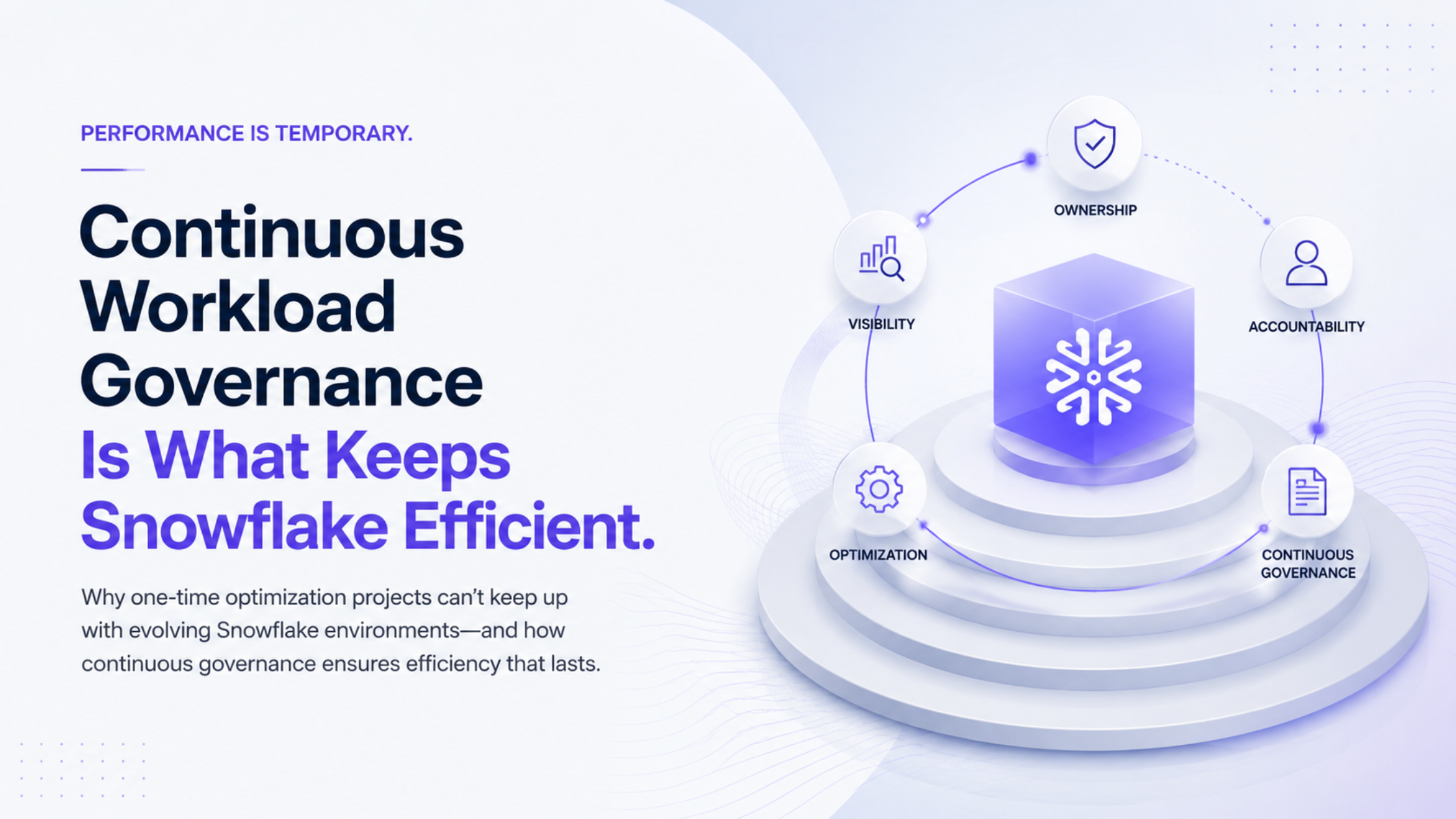
Most Snowflake optimization initiatives succeed, but their results often fade as workloads, teams, and business priorities evolve. This article explains why performance optimization alone cannot sustain long-term efficiency and introduces Continuous Workload Governance as the discipline of continuously managing workload behavior, ownership, and accountability. Organizations that govern continuously spend less time repeating optimization projects and more time building data platforms that remain efficient as they grow.
Every Team Has an Optimization Quarter
Every Snowflake team eventually has an optimization phase: expensive queries are tuned, oversized warehouses are resized, stale tables are archived, auto-suspend settings are tightened, and credit consumption drops. Finance sees relief. Forecasts stabilize. Leadership expects the new baseline to hold.
Six to nine months later, many of those same teams are back in executive review with rising compute and storage. New warehouses appeared. AI and serverless workloads entered production. Ownership became fuzzy. The same questions return.
The immediate assumption is that optimization failed. Usually, it did not. Most optimization efforts succeed technically. What fails is their ability to survive in a changing platform.
Optimization Is a Snapshot, Not a Control System
Modern teams know how to optimize Snowflake. Query tuning, warehouse right-sizing, clustering, storage lifecycle controls, and workload monitoring are established engineering practices. Technical capability is not the bottleneck.
The issue is temporal. Optimization reflects today’s workloads, data volume, team structure, and business goals. Those assumptions start changing immediately after optimization is done. Yesterday’s correct decision can become tomorrow’s mismatch without anyone making a mistake.
Workload Drift Is the Default State
Snowflake environments evolve continuously: more dashboards, new dbt jobs, fresh product telemetry, additional AI services, increased data retention, and changing refresh frequencies. This is normal growth, not operational negligence.
Workload Drift is this natural evolution of workload behavior over time. As drift accumulates, an environment optimized months ago can become structurally different from the one engineers originally tuned.
That is why optimization programs often feel repetitive. Teams keep rediscovering similar patterns because the platform keeps moving.
Workload Drift is the natural evolution of workload behavior over time as new applications, data, users, and engineering changes modify how Snowflake resources are consumed.
Governance Drift Is the Bigger Risk
Workload Drift explains technical change. It does not explain why teams lose confidence in platform understanding. That usually comes from Governance Drift: the gradual erosion of ownership, accountability, and operational context.
During reviews, teams ask: Who owns this warehouse? Why was this workload introduced? Does this recurring query still have business value? Was this optimization validated after launch? If answers depend on memory or old Slack threads, governance has already degraded.
At that point, the problem is no longer only performance. It is institutional clarity.
Governance Drift is the gradual loss of ownership, accountability, and operational context as Snowflake environments evolve, making it difficult to explain why resources exist or who is responsible for them.
Visibility Is Necessary, Not Sufficient
Dashboards can show where credits were consumed. They usually cannot explain whether increases were expected, who owns the change, whether value justifies spend, and what action should happen next.
Visibility describes what happened. Governance determines why it happened, who is accountable, and how to keep the system aligned over time. Mature teams eventually realize another dashboard rarely fixes a missing operating discipline.
Continuous Workload Governance as an Operating Discipline
Continuous Workload Governance means workload behavior is continuously understood, owned, validated, and reassessed. It shifts the question from “How do we reduce Snowflake costs this quarter?” to “How do we keep today’s optimizations valid as the platform changes?”
Practically, this means running a continuous loop:
- Track workload changes as they occur, not only before renewals.
- Preserve ownership as teams reorganize and services expand.
- Capture decision context so engineers do not rediscover history.
- Convert optimization findings into owned, enforceable actions.
- Re-validate whether previous gains still hold after platform evolution.
From Continuous Governance to Continuous Accountability
Optimization answers a technical question: can this workload be made more efficient? Governance answers an operational question: who is responsible for keeping it efficient over time?
Without continuous accountability, optimization becomes a historical event. With accountability, optimization becomes a compounding engineering capability.
Why This Matters More in the AI Era
AI-assisted development and Snowflake’s expanding serverless surface area accelerate workload change. New data products and AI workflows appear faster than traditional quarterly review cycles can absorb.
When environments can evolve weekly, episodic governance becomes structurally too slow. Continuous governance is no longer a “nice to have”; it is how engineering intent survives platform velocity.
Continuous Governance Is the Next FinOps Maturity Layer
FinOps evolved from visibility toward forecasting, allocation, and unit economics. The next maturity step is preserving engineering intent as workloads evolve. That is governance at operating speed.
This is also why engineering leaders should care. Repeating the same optimization every two quarters is expensive twice: once for the original improvement, and again to recover what drift erased.
Governance Creates Compound Value
Strong engineering practices compound. Governance should too. Every optimization should leave the platform easier to understand than before. Every ownership assignment should reduce future investigation time. Every validated change should improve forecast confidence.
Teams that do this are not merely better at tuning SQL. They are better at ensuring improvements endure.
Conclusion
Snowflake cost optimization remains essential. It improves efficiency, performance, and user outcomes. But optimization alone cannot be the long-term strategy in a continuously evolving platform.
Long-term efficiency depends on aligning workload behavior, ownership, accountability, and operational context over time. Continuous Workload Governance provides that alignment.
The key question is no longer “How do we optimize Snowflake?” Mature teams already know how. The better question is: How do we ensure today’s optimizations are still the right optimizations a year from now?
Turn one-time optimization into lasting efficiency
See how Anavsan helps platform teams continuously govern workload behavior, ownership, and optimization outcomes.
Continue the Conversation
This article is the first piece in our series on Continuous Workload Governance:
- Governance Drift: The Hidden Reason Snowflake Costs Keep Returning.
- Workload Drift: Why Snowflake Consumption Changes Faster Than Your Annual Forecast.