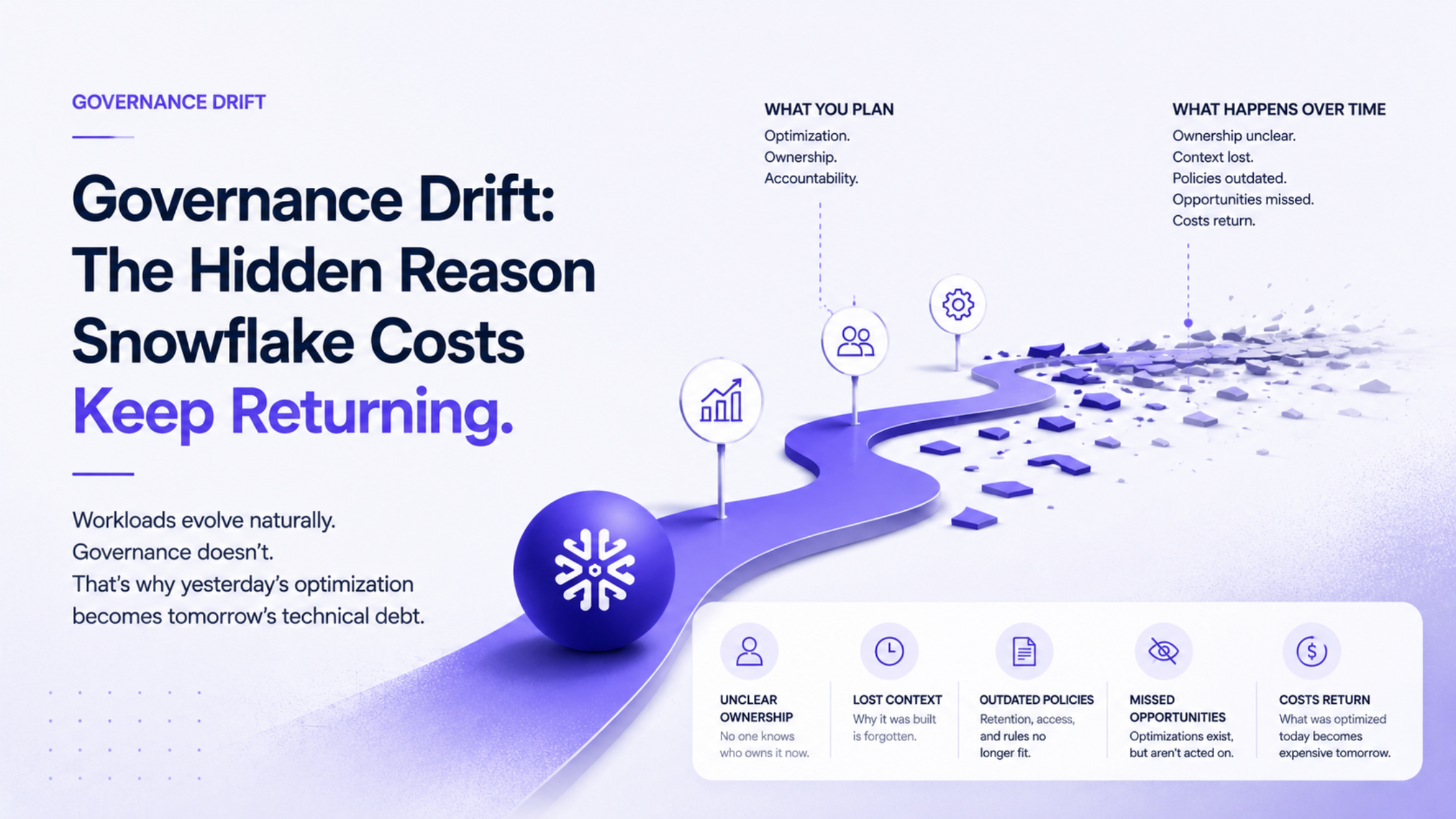
Snowflake environments rarely become inefficient because engineers stop making good technical decisions. They become inefficient because ownership, accountability, and operational context gradually disappear as workloads, teams, and business priorities evolve. This phenomenon—Governance Drift—makes optimization increasingly difficult even when engineering teams have complete visibility into platform performance. Continuous Workload Governance addresses this challenge by preserving ownership, validating workload intent, and ensuring engineering decisions remain understandable as the platform evolves.
What Governance Drift Really Means
Every engineering organization expects its Snowflake platform to evolve: new products launch, customer adoption grows, data volumes increase, dashboards multiply, AI services are introduced, pipelines are rewritten, and teams inherit workloads. This is healthy change.
But while workloads evolve continuously, governance often does not. Ownership becomes unclear. Documentation reflects a platform that no longer exists. Temporary workloads become permanent infrastructure. Decisions lose the context that once made them correct.
Governance Drift is the gradual loss of ownership, accountability, operational context, and engineering intent as a Snowflake environment evolves.
Governance Drift is the gradual loss of ownership, accountability, operational context, and engineering intent as a Snowflake environment evolves. Workloads change by design; confusion begins when the knowledge surrounding those workloads disappears faster than the platform itself.
Every Engineering Decision Has an Expiration Date
Engineering decisions are made in context: a warehouse is upsized for launch traffic, retention is extended for compliance, a pipeline shifts from daily to hourly, Cortex workloads support a new product feature. At the time, those decisions are often right.
But product usage stabilizes, teams reorganize, regulations change, dashboards get replaced, and original decision-makers move on. The implementation remains; the reasoning fades. That separation is how Governance Drift begins.
Workload Drift Explains Change. Governance Drift Explains Confusion.
Workload Drift describes how platforms naturally change. Governance Drift describes why teams lose confidence in what those changes mean.
Two organizations can experience similar growth. One can explain every major warehouse, recurring query, and storage increase with clear ownership. The other relies on tribal memory and caution-driven operations. The technical environments may look similar; governance maturity is not.
The Slow Disappearance of Ownership
Governance Drift rarely begins with incidents. It begins with recurring questions:
- Who owns this warehouse today?
- Why was this warehouse resized six months ago?
- Is this pipeline still tied to an active business process?
- Who approved this Cortex workload, and is it still justified?
Answers existed once, then were lost. As uncertainty grows, teams optimize less confidently: oversized warehouses are left untouched, stale data is retained to avoid risk, and legacy pipelines stay alive because dependencies are unclear.
Visibility Cannot Replace Context
Modern tooling can show utilization, credit consumption, storage growth, and query performance. That visibility is valuable, but incomplete.
Knowing a warehouse consumed 15,000 credits is useful. Knowing why, who owns it, whether purpose changed, and whether it still aligns to business priorities is governance. Dashboards answer utilization questions. Governance answers accountability and intent questions.
Visibility answers what is being consumed. Governance answers why it exists, who owns it, and whether it still serves the business. Dashboards cannot replace operational context.
Why Governance Drift Compounds Faster Than Technical Debt
Technical debt is usually visible; teams know where refactoring is needed. Governance Drift is subtler. It erodes the team’s ability to decide what should be improved in the first place.
Each local decision appears reasonable. The problem appears when teams try to understand the platform holistically and find disconnected decisions with missing context.
That is why optimization becomes reactive despite strong engineering capability.
The Hidden Cost Most Teams Miss
Governance Drift is not only a cloud-bill problem. It is also an engineering-velocity problem. Time spent finding owners, reconstructing dependencies, and rebuilding historical context is a recurring operational tax.
This tax grows with scale. Tribal knowledge can work for small teams. It breaks in multi-team, multi-business-unit environments where workload ownership and decision context fragment quickly.
AI Will Accelerate Governance Drift
AI-assisted development and serverless services increase delivery speed and platform change frequency. More workloads, more ownership transitions, and faster architectural decisions mean governance can lag faster than before if not made continuous.
Faster implementation does not automatically preserve intent. It makes preserving intent more important.
Governance Should Be Measured Like Reliability
Reliability is managed through metrics. Governance should be too. Instead of asking whether documentation exists, ask whether ownership is continuously validated, optimization actions are actually implemented, and major workloads maintain accountable ownership plus active business purpose.
When governance becomes measurable, it becomes improvable.
Continuous Workload Governance Prevents Governance Drift
Organizations cannot and should not stop workload evolution. The objective is to preserve understanding while change occurs.
Continuous Workload Governance treats governance as an active engineering capability: ownership is validated continuously, workload intent is reviewed continuously, and operational context is preserved continuously.
When that happens, Workload Drift stays manageable because Governance Drift never gets space to compound.
Continuous Governance Is Ultimately About Trust
Finance needs trust that spending reflects intentional decisions. Engineering leaders need trust that optimization work endures. Engineers need trust that changes will not trigger unknown dependency failures. Executives need trust that the platform remains explainable as it grows.
Governance is the system that preserves that trust over time.
Closing Thoughts
The cloud industry got good at answering what teams spend and where they spend it. The next maturity layer is answering why they spend it, who owns it, whether it still creates value, and how those answers evolve.
That is the difference between periodic optimization and continuous understanding. Governance Drift is not inevitable at scale; it is what happens when organizational understanding lags technical progress.
In the years ahead, Snowflake success will be defined not only by query speed or credit efficiency, but by whether every workload and engineering decision remains connected to ownership, context, and continuous accountability.
Operationalize governance before drift compounds
See how Anavsan helps teams maintain Snowflake cost accountability with continuous workload governance.
Continue the Conversation
This article is the second piece in our series on Continuous Workload Governance:
- Performance Is Temporary. Continuous Workload Governance Is What Keeps Snowflake Efficient.
- Workload Drift: Why Snowflake Consumption Changes Faster Than Your Annual Forecast.