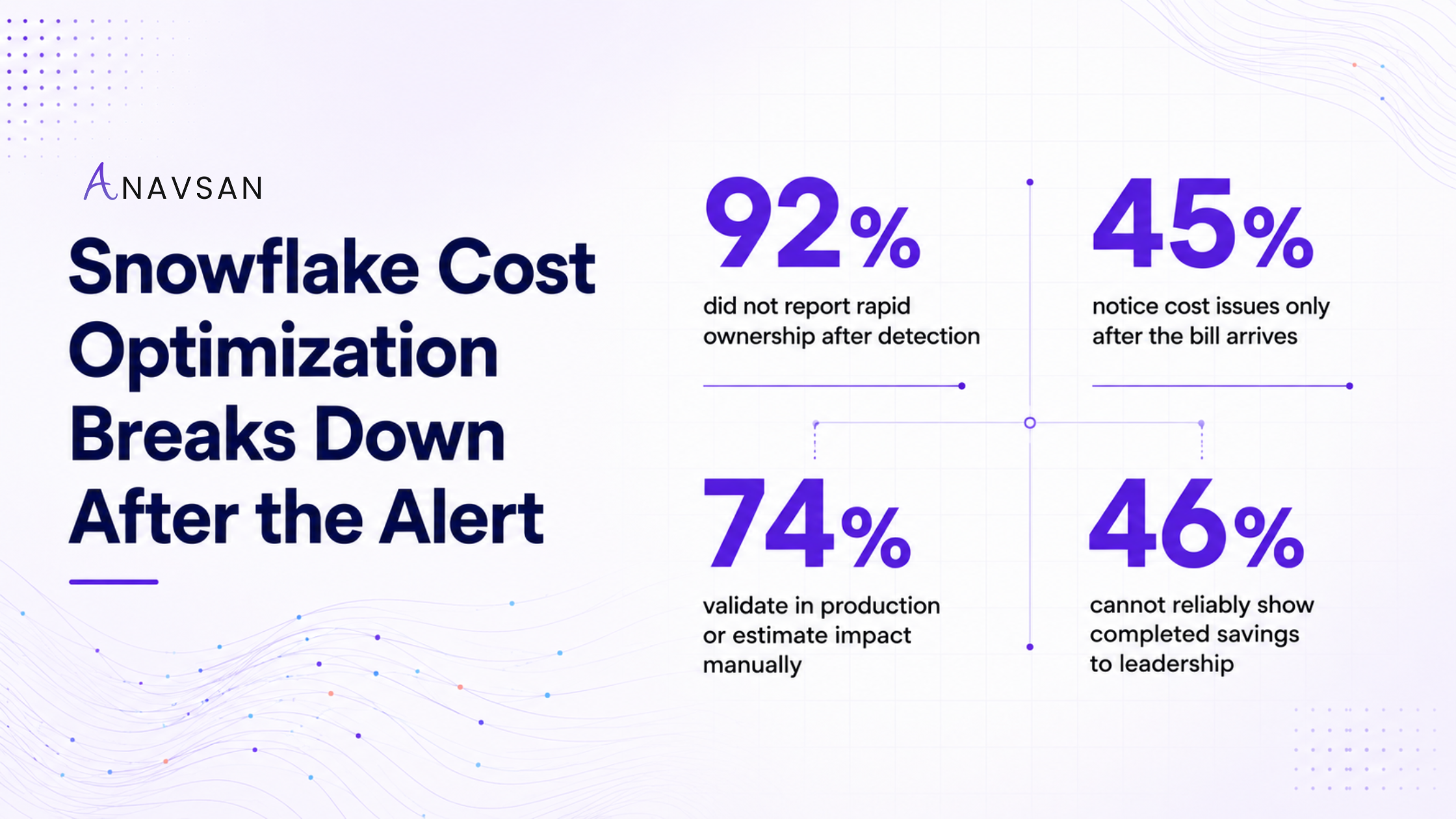
An analysis of 58 unique sessions from Anavsan’s Snowflake Cost Accountability Gap Assessment found that the most serious cost-management problems emerge after an issue is detected. Of the 50 people who answered the ownership question, 46—or 92%—did not report that the appropriate engineer quickly takes responsibility for a detected cost issue. Validation is predominantly manual or performed directly in production, while leadership often lacks reliable evidence connecting completed optimizations to actual savings. Storage growth emerged as the most commonly uncontrolled cost area, ahead of Cortex and AI services and warehouse compute.
Snowflake gives organizations extensive visibility into consumption. Account Usage views, resource monitors, budgets, query history, warehouse metrics and third-party observability platforms can all help teams understand where credits are being consumed.
But visibility does not automatically produce Snowflake cost optimization.
A cost anomaly can be detected without anyone knowing who should investigate it. A recommendation can be identified without an engineer being assigned to implement it. A change can be made without its impact being validated safely. Even when an optimization succeeds, its financial outcome may never be documented in a form that FinOps or leadership can reliably use.
This is the operational gap between detecting Snowflake waste and proving that it has been eliminated—the same pattern explored in why detection isn’t enough.
Between April 22 and August 11, 2026, Anavsan collected 58 unique sessions through its Snowflake Cost Accountability Gap Assessment. After test submissions and duplicate session IDs were removed, the responses revealed a consistent pattern: the weakest part of Snowflake cost optimization is not always identifying where credits went. It is establishing ownership, moving the issue through engineering, validating the change and closing the loop with evidence.
The data is directional rather than representative of the entire Snowflake market. Nevertheless, it points toward an important question for every DataOps, FinOps and data platform team:
What happens after your Snowflake cost dashboard detects a problem?
The Snowflake cost accountability gap in numbers
The assessment examined five connected stages of Snowflake cost management: detection, ownership, action, validation and reporting. Although 58 unique sessions were recorded, response totals vary by question because only 37 participants completed all five questions.
The most significant findings were:
- Of the 50 respondents who answered what happens after a cost spike is detected, only four said the appropriate engineer picks it up quickly—46 of 50, or 92%, did not report rapid ownership and action.
- 42% said someone first has to determine who owns the issue, while 34% said it is discussed but action is delayed.
- A further 32% depend on manual reporting to communicate optimization outcomes.
- Storage growth was the least-controlled cost area for 51% of respondents, ahead of Cortex and AI services (46%) and warehouse compute (41%).
Taken together, these findings suggest that many Snowflake cost-management processes remain open loops. Teams may identify waste, but the work required to remove it is distributed across dashboards, meetings, tickets, spreadsheets and informal engineering conversations.
Detection is still happening too late
Snowflake cost optimization cannot begin until a team recognizes that consumption has deviated from what was expected. Ideally, that happens early enough for someone to intervene before the inefficiency materially affects the monthly bill.
The assessment suggests that this is far from universal. Forty-five percent of respondents said they still notice cost issues after the bill arrives. By that stage, the credits have already been consumed and the conversation has become retrospective: finance asks why the bill increased, FinOps reconstructs the spend, and the data team investigates workloads that may have been running inefficiently for several weeks. For a practical diagnostic path when a spike lands late, see how to identify the root cause of a Snowflake cost spike.
Another 40% reported using dashboards and alerts. That represents progress, but the presence of an alert does not establish that the issue will be understood or resolved. Alerts can expose a warehouse spike or a change in daily credit consumption, yet leave teams to determine which workload caused it, whether the increase was justified, who owns the relevant query or pipeline, and what action can be taken safely—the gap that separates native anomaly detection from accountable follow-through.
This distinction matters.
Monitoring asks: Where did consumption change?
Optimization asks: What should be changed, by whom, and how will the result be verified?
When detection occurs only after invoicing, the organization operates with a delay. When detection occurs through an alert but lacks ownership and resolution, the organization has faster awareness without faster control.
Neither condition creates a complete Snowflake FinOps process.
The largest breakdown happens between detection and action
The clearest result appeared when respondents were asked what happens after a cost spike is identified.
Forty-two percent said someone has to determine who owns the issue. Another 34% said the issue gets discussed, but action is delayed. Fourteen percent said follow-through is not tracked. Only four of 50 respondents said the appropriate engineer picks up the issue quickly.
In other words, 92% did not report a direct path from detection to accountable action.
This is the Snowflake cost accountability gap.
The problem is rarely that nobody cares about rising consumption. The problem is that cloud data costs are created by workloads, while most cost reporting is organized around infrastructure. A dashboard may identify a costly warehouse, but the warehouse may support queries from several teams, scheduled transformations, business intelligence tools, data applications and AI workloads. The person monitoring the bill is therefore not necessarily the person who understands or controls the code responsible for it—which is why cost optimization fails without clear workload ownership.
Ownership must be reconstructed from query history, roles, users, tags, repository information, orchestration metadata and organizational knowledge. This investigation introduces delay. It can also create ambiguity when several teams share the same warehouse or when service accounts obscure the people responsible for the underlying workload.
As a result, the operational journey often looks like this:
Alert → dashboard → investigation → meeting → engineering backlog → delayed action
The issue may be visible throughout this process, but visibility is not the same as governance. A governed process requires an explicit owner, a defined next action, an expected outcome and a record of closure—the operating model described in the Snowflake cost accountability playbook.
Without those elements, Snowflake cost anomalies compete with product delivery, reliability work and other engineering priorities. The dashboard continues to show the problem, but it cannot make the organization resolve it.
Most teams can detect Snowflake waste. Far fewer can assign it, validate a fix, and prove the savings without a manual chase across dashboards, tickets and meetings.
Validation remains manual—and often risky
Assigning an optimization recommendation is only part of the process. Teams also need to determine whether the proposed change will reduce cost without creating unacceptable effects on performance, reliability or downstream users.
The assessment found that 37% of respondents test optimization changes directly in production. Another 37% estimate the expected impact manually, while 12% reported having no validation process.
This leaves many Snowflake teams choosing between speed and confidence.
Production testing provides real workload data, but it can also consume additional credits and expose business-critical workloads to poorly understood changes. Manual estimation avoids direct intervention but depends heavily on individual expertise and assumptions about data volume, warehouse behavior, caching, concurrency and query execution.
Neither approach consistently produces reusable evidence. That is why teams that want safer credit reductions look for query optimization without guesswork and structured approaches to warehouse right-sizing before changes hit production.
Consider a high-credit query that runs several hundred times each month. An engineer may identify a rewrite that appears more efficient, but the organization still needs to know whether the new version will return the same result, how its execution profile is expected to change, whether it affects downstream dependencies, and what financial impact can reasonably be attributed to the change.
The same requirement applies to warehouse resizing, auto-suspend policies, storage retention, dynamic table refreshes and Cortex AI consumption. A recommendation is not a completed optimization until its impact has been assessed and its result has been measured.
Mature Snowflake cost governance therefore requires a validation stage between recommendation and deployment. That stage should provide enough technical and financial context for an engineer to act without turning every optimization into an extended investigation.
Leadership sees Snowflake spend, but not always completed savings
Stage 3—closing the loop with attributable evidence—was the weakest area in the assessment.
Among the 41 respondents who answered this question, 46% said leadership cannot see completed optimizations and their savings in any reliable way. Another 32% said visibility is available only through manual reporting. Just three respondents reported having clear attribution and evidence.
This exposes an important difference between cost reporting and optimization reporting.
A Snowflake consumption report can show that monthly credits decreased. It cannot automatically prove why they decreased. Consumption may have fallen because business activity slowed, a workload was retired, data volume changed, or an engineering optimization succeeded. Without a documented connection between the original issue, the person responsible, the implemented change and the resulting cost difference, claimed savings remain difficult to defend.
FinOps teams need more than a downward trend. They need a reliable record of:
- What inefficiency was identified
- Which workload, query, warehouse or storage object was involved
- Who owned the corrective action
- What change was proposed and implemented
- How the change was validated
- What the before-and-after consumption showed
- Whether the improvement persisted over time
When this evidence is assembled manually, reporting becomes periodic and expensive. Teams reconstruct outcomes for monthly reviews or leadership meetings, often by combining Snowflake data with tickets, spreadsheets and conversations. Completed work may be underreported, while projected savings may be presented as realized savings.
A closed-loop Snowflake cost-management process should preserve this evidence as the work happens. That creates a defensible connection between engineering action and financial outcome—and gives DataOps credit for the savings it produces. For the broader operating model, see the Snowflake cost governance framework for FinOps and data teams and proven tactics in how to reduce Snowflake costs.
Storage growth is the most commonly uncontrolled cost area
Storage growth was selected as the least-controlled cost category by 51% of respondents. Cortex and AI services followed at 46%, while warehouse compute was selected by 41%.
The prominence of storage is significant because Snowflake cost optimization discussions often concentrate on warehouse credits. Compute is highly visible, changes rapidly and can create dramatic spending spikes. Storage growth is typically more gradual, making it easier to overlook until accumulated data creates a persistent cost baseline.
Snowflake storage inefficiency can develop through inactive tables, duplicate datasets, excessive Time Travel retention, transient staging data, cloned objects, fast-growing tables, unused historical data and inefficient refresh patterns. Individually, these objects may not trigger an obvious anomaly. Collectively, they can create a growing layer of recurring spend. Practical guidance lives in the Snowflake storage cost optimization guide and in how teams use Storage Intelligence to connect growth signals to owners.
Storage optimization also introduces governance questions that a simple recommendation cannot resolve. A table may appear inactive but still be needed for compliance, audit, disaster recovery or an infrequent business process. Deleting it immediately may be unsafe, while retaining it indefinitely may be unnecessary—a theme also covered in why AI budgets often hide inside storage waste.
Effective Snowflake storage optimization therefore requires both usage intelligence and a controlled lifecycle. Teams need to distinguish active data from restorable archival data, identify responsible owners, understand retention requirements and document what was archived, retained or removed.
The assessment does not suggest that Cortex AI cost management is unimportant. Almost half of respondents identified Cortex and AI services as an area lacking control, reflecting the growing need to attribute model and service consumption before it becomes a material budget problem. For teams facing that exposure, see the Cortex AI cost management guide and Cortex cost visibility.
However, storage appears to be the more established and commonly felt pain in this sample. That makes it a practical starting point for organizations building a broader Snowflake workload-governance program.
From Snowflake cost observability to closed-loop governance
The findings point toward a broader shift in how Snowflake cost optimization should be designed.
Monitoring remains essential. Teams need reliable data about queries, warehouses, storage, serverless services and Cortex AI usage. But monitoring is only the first stage of a process that must continue through ownership, validation and documented closure.
A closed-loop model can be expressed in four stages:
Identify abnormal, inefficient or unnecessary consumption across Snowflake workloads early enough to prevent avoidable credits from accumulating—with enough workload context to explain the likely cause.
Connect the issue to the engineer, team or business owner capable of resolving it, including technical context, expected priority and recommended action—not an isolated alert.
Estimate or simulate the likely performance and cost impact before deployment so teams can distinguish safe optimizations from changes that create operational risk.
Measure the outcome, document the before-and-after difference and preserve evidence connecting completed engineering work to its financial result.
This model changes Snowflake FinOps from a reporting activity into a governance workflow. FinOps gains attributable evidence, DataOps gains a structured resolution process, and engineers receive actionable context rather than unexplained cost alerts. Platforms designed for that loop—such as APEX—are evaluated on whether they can move work from detection to verified resolution, not only whether they can surface another dashboard. For the architectural framing, see what an APEX platform is and the continuous workload governance blueprint.
It also changes how optimization platforms should be evaluated. The central question is no longer simply, “Can this tool identify waste?” Most modern tools can surface anomalies or recommendations in some form. The more consequential question is:
Can the system help the organization move from detection to verified resolution?
What Snowflake teams should examine next
Organizations do not need to replace their existing monitoring stack to begin closing the accountability gap. They can start by examining what happens after an alert is generated.
For every material Snowflake cost issue, teams should ask:
- Can we connect this issue to a specific workload rather than only a warehouse or account?
- Can we identify the engineer or team responsible without conducting a manual investigation?
- Is there a defined workflow for accepting, prioritizing and resolving the recommendation?
- Can we estimate the effect of the proposed change before exposing production workloads to it?
- Can we prove what was changed and measure the resulting savings?
- Can leadership see completed optimization work without relying on a manually assembled report?
If the answer to several of these questions is no, the organization may have strong cost visibility while still lacking cost accountability.
That distinction explains why Snowflake optimization programs can produce extensive dashboards without creating a proportionate reduction in spend. The missing capability is not another view of the bill. It is the operating system that moves each issue from awareness to ownership, validation and closure.
The next stage of Snowflake FinOps is accountable execution
The assessment findings reinforce a simple conclusion: Snowflake cost optimization does not end when waste is detected.
It ends when the issue has an owner, the proposed change has been evaluated, the optimization has been completed and the outcome can be demonstrated with evidence.
Detection without ownership produces alerts. Recommendations without validation produce risk. Changes without measurement produce savings claims that are difficult to defend. Reporting without workflow produces recurring manual effort.
For Snowflake teams looking to improve cost efficiency, the next stage is not simply better observability. It is a closed-loop system that connects workload behaviour to accountable execution.
That is the difference between knowing where Snowflake credits went and ensuring that avoidable credit loss does not continue.
How large is the gap between detecting Snowflake cost issues and getting them resolved?
Take Anavsan’s Snowflake Cost Accountability Gap Assessment to evaluate how your organization detects, assigns, validates and closes cost-optimization work.
Continue reading
- Snowflake Cost Accountability: Why Detection Isn’t Enough
- Why Snowflake Cost Optimization Fails Without Clear Workload Ownership
- Snowflake Cost Accountability Playbook
- What Happens After a Cost Spike Is Found
- Snowflake Storage Cost Optimization Guide
- How to Reduce Snowflake Costs: 7 Proven Strategies