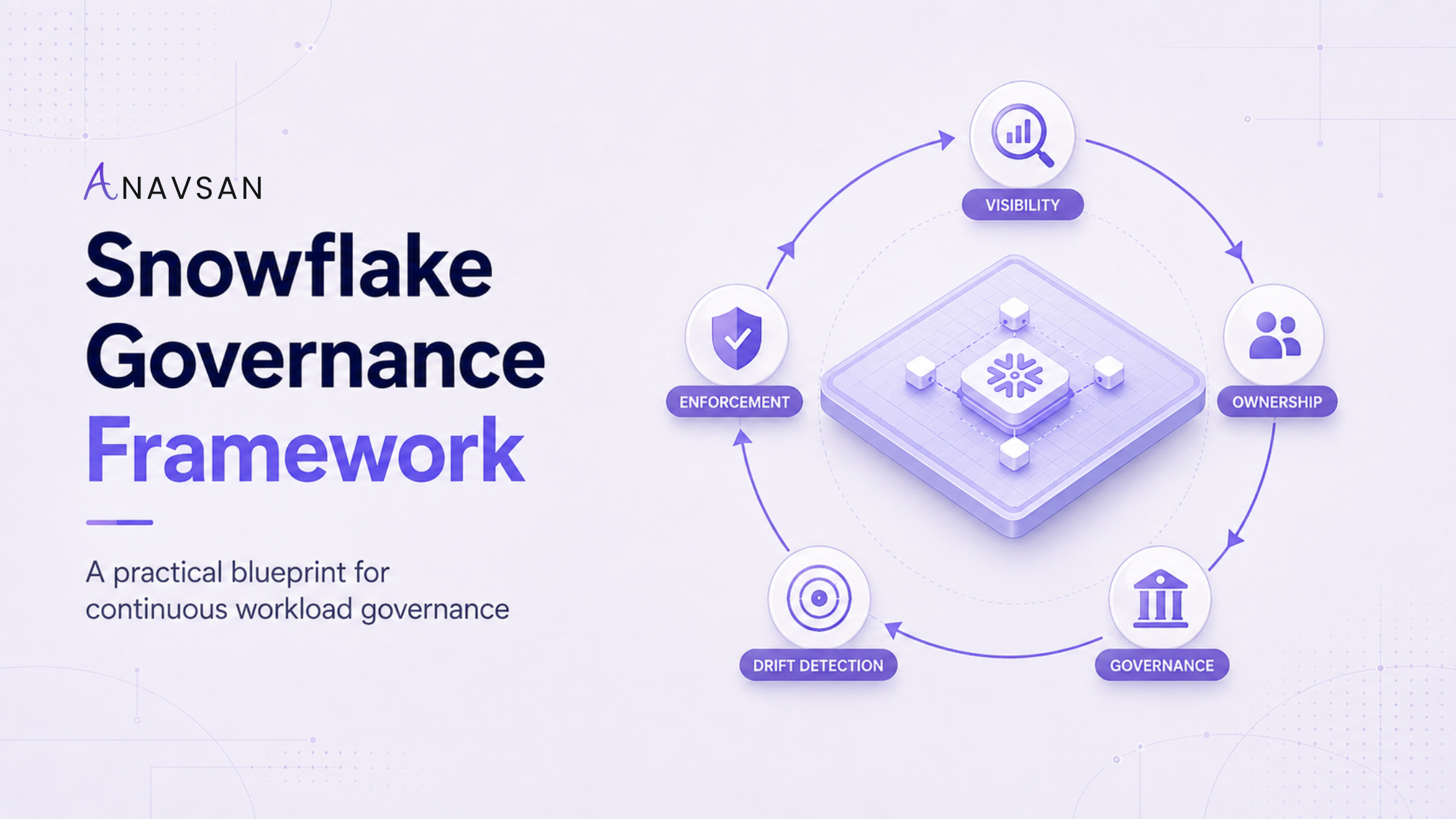
Optimization fixes Snowflake for today. Continuous Workload Governance keeps it accountable tomorrow. This blueprint connects five capabilities—Visibility, Ownership, Continuous Governance, Drift Detection, and Continuous Enforcement—into an operational loop that prevents Governance Drift from quietly undoing engineering gains.
Introduction
Modern Snowflake environments rarely fail because of technology. Warehouses can be resized, queries can be optimized, storage can be cleaned up, and AI workloads can be monitored. Most engineering teams understand these technical practices and apply them regularly.
Yet many organizations still find themselves repeating optimization projects every six or twelve months. Cloud costs rise again despite previous improvements. Engineering teams spend weeks rediscovering workload owners, rebuilding historical context, and questioning decisions that were once considered optimal. The platform continues to evolve, but governance rarely evolves at the same pace.
This is the operational challenge that traditional optimization strategies fail to address.
Optimization improves the platform at a specific point in time. Governance determines whether those improvements continue delivering value as workloads, business priorities, and engineering teams change.
In our previous articles, we introduced three concepts that explain why this happens:
- Continuous Workload Governance as the discipline of maintaining long-term workload health.
- Governance Drift as the gradual loss of ownership, accountability, and engineering context.
- Performance as a governance outcome, not simply an optimization exercise.
The natural question becomes: What should engineering teams actually do differently?
The answer is not another dashboard or another quarterly optimization initiative. It is establishing a governance framework that continuously validates how workloads evolve throughout their lifecycle.
This article presents a practical framework built around five operational capabilities that every Snowflake team should continuously maintain.
Continuous Governance Is a System, Not a Checklist
Many governance initiatives fail because they are implemented as collections of isolated activities.
One team reviews warehouses every quarter. Another monitors storage growth. Finance receives monthly cost reports. Platform engineers occasionally optimize expensive queries. Security reviews access policies once a year.
Individually, each activity creates value.
Collectively, they rarely form a governance system.
A governance framework should connect these activities into a continuous operational loop where visibility leads to ownership, ownership enables governance, governance detects drift, and drift triggers enforcement. Instead of treating optimization as an independent project, the framework ensures that every workload remains continuously accountable throughout its lifecycle.
Continuous governance therefore becomes less about adding new operational processes and more about connecting existing ones through shared ownership and repeatable validation.
Visibility → Ownership → Continuous Governance → Drift Detection → Continuous Enforcement — then back to visibility as the platform keeps evolving.
Pillar 1: Visibility
Governance begins with understanding what exists inside the platform.
Visibility extends beyond warehouse utilization or credit consumption. Mature engineering teams maintain visibility into workload behavior, storage growth, AI services, serverless compute, user activity, and business-critical pipelines. More importantly, they understand how these workloads change over time rather than viewing them as isolated monthly snapshots.
Continuous visibility allows engineering teams to recognize emerging patterns before they become operational problems. New workloads, changing consumption trends, and evolving business priorities become observable long before they require emergency optimization efforts.
Visibility provides the foundation for every governance decision that follows.
Pillar 2: Ownership and Accountability
Every significant workload should have a clearly identifiable owner.
Ownership is frequently misunderstood as administrative metadata, when in reality it represents operational accountability. Engineers should be able to answer who owns a workload, why it exists, which business capability it supports, and who approves future changes.
As organizations grow, ownership naturally changes. Teams reorganize, applications evolve, and engineering responsibilities shift. Continuous governance therefore requires ownership to be continuously validated rather than documented once and forgotten.
Without accountability, optimization recommendations become suggestions instead of operational actions.
Pillar 3: Continuous Governance
Governance is the process of validating whether engineering decisions remain appropriate as the platform evolves.
A warehouse sized correctly last year may no longer reflect current workload patterns. Storage policies originally created for regulatory requirements may need revision. AI workloads introduced during experimentation may now support production systems and require stronger operational oversight.
Continuous governance means regularly reviewing these assumptions rather than assuming historical decisions remain permanently valid.
This shifts governance away from annual reviews and toward ongoing operational discipline.
Pillar 4: Drift Detection
Every platform experiences change.
The objective is not preventing change but detecting when change begins creating operational uncertainty.
Governance Drift appears when ownership weakens, engineering context disappears, workload purpose becomes unclear, or optimization decisions quietly lose relevance. These changes rarely create immediate technical failures, which is precisely why they accumulate unnoticed.
Engineering teams should continuously monitor indicators such as dormant workloads, ownership changes, unexplained consumption growth, abandoned optimization recommendations, and rapidly evolving AI workloads. Detecting drift early dramatically reduces the effort required to restore governance later.
Pillar 5: Continuous Enforcement
The final stage transforms governance into everyday engineering practice.
Visibility identifies opportunities. Ownership determines responsibility. Governance validates assumptions. Drift highlights emerging risks.
Enforcement ensures action actually happens.
This does not necessarily imply full automation. It means recommendations are assigned, tracked, validated, and reviewed as part of normal engineering workflows. Governance stops relying on spreadsheets, quarterly meetings, or renewal discussions and instead becomes embedded within operational delivery.
Continuous enforcement closes the governance loop.
Governance Is an Operational Capability
Organizations often measure governance success by reduced cloud spending.
A stronger measure is operational confidence.
- Can engineers explain why workloads exist?
- Can ownership be identified within minutes?
- Can optimization decisions be reconstructed months later?
- Can new AI workloads be governed using existing operational processes?
- Can platform evolution occur without sacrificing accountability?
When the answer to these questions is consistently yes, cloud efficiency becomes a natural consequence rather than the primary objective.
Governance has become an engineering capability instead of an administrative activity.
Conclusion
Snowflake platforms will continue becoming larger, more distributed, and increasingly AI-driven. Engineering organizations cannot rely on periodic optimization projects to maintain long-term efficiency.
The challenge is no longer finding opportunities to optimize.
The challenge is ensuring optimization survives continuous platform evolution.
A governance framework built around Visibility, Ownership, Continuous Governance, Drift Detection, and Continuous Enforcement provides that foundation. Instead of repeatedly recovering from Governance Drift, engineering teams continuously prevent it from accumulating.
The result is not simply lower cloud costs.
It is a Snowflake environment that remains understandable, accountable, and operationally healthy regardless of how quickly the business evolves.
How mature is your governance loop?
Evaluate Visibility, Ownership, Continuous Governance, Drift Readiness, and Operational Follow-through—then get a practical maturity profile and next steps.
Continue the Conversation
This article builds on the Continuous Workload Governance series:
- Why Snowflake Cost Optimizations Don’t Last
- Governance Drift: The Hidden Reason Snowflake Costs Keep Returning
- Performance Is a Cost Decision. Governance Determines Whether It Lasts
- 10 Snowflake Governance Mistakes That Quietly Increase Cloud Costs in 2026