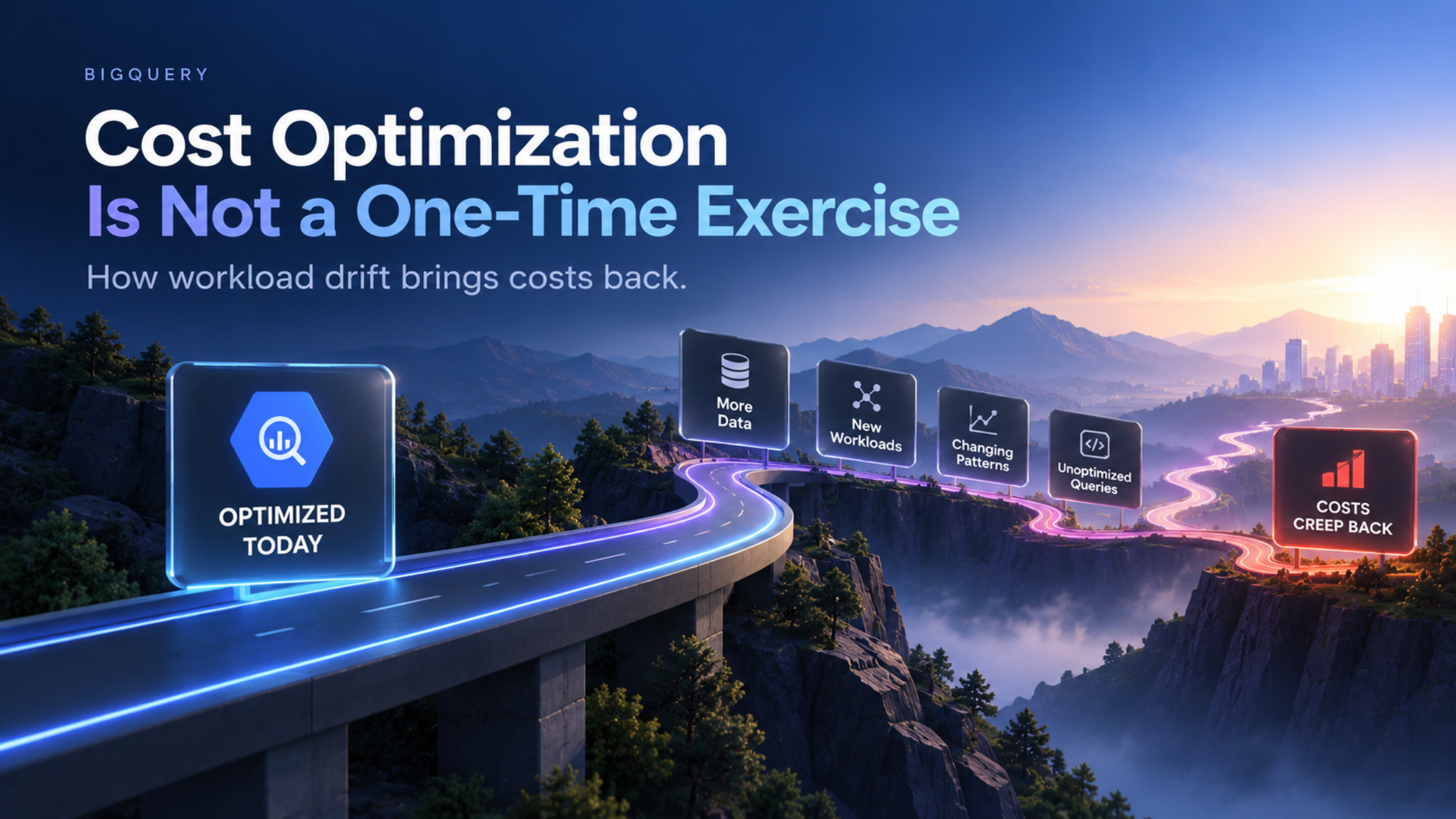
BigQuery cost optimization is not a one-time configuration exercise. Queries, data volumes, pipelines, concurrency, applications, and capacity requirements continuously change, causing previously efficient workloads to drift. Native BigQuery tooling provides extensive visibility and optimization controls, but sustained efficiency requires a governance loop that connects workload changes to ownership, action, measurable outcomes, and ongoing enforcement. That loop is the same Workload Governance Agent model Anavsan APEX applies through Trace → Assign → Enforce → Prove.
BigQuery can be remarkably efficient when workloads are designed and governed well. Queries can scan only the data they need, tables can be partitioned and clustered around actual access patterns, and materialized views can reduce repeated computation. Reservations can isolate workloads and provide appropriate capacity, autoscaling can adapt slots to changing demand, and query plans plus INFORMATION_SCHEMA can expose where resources are being consumed.
The challenge is that none of those decisions remain static. A query that was inexpensive six months ago may now scan significantly more data. A dashboard that originally served a handful of users may become business-critical. A scheduled transformation can gradually process larger partitions, new applications can increase concurrency, and reservation configurations that once matched workload demand can become poorly aligned with how teams actually use BigQuery.
Nothing necessarily breaks. The environment simply changes. That is workload drift, and it is one of the reasons BigQuery cost optimization should be treated as a continuous governance problem rather than a periodic cost-cutting exercise. The same pattern already shows up on Snowflake as consumption changing faster than the forecast. The compute architecture is different. The governance problem is not.
BigQuery already gives teams powerful optimization controls
Before discussing workload drift, it is important to establish what the problem is not. BigQuery does not lack optimization capabilities, and Google already provides the technical levers most teams need to investigate and improve consumption.
Google provides detailed query execution plans that expose stages and execution steps. Engineers can use those plans, along with INFORMATION_SCHEMA.JOBS, to investigate resource consumption and identify opportunities such as reducing processed data, filtering earlier, selecting fewer columns, and improving query operations. Materialized views can precompute results for frequently executed, predictable workloads, potentially reducing both query latency and execution cost.
At the compute layer, BigQuery offers two fundamentally different workload-management models. With on-demand billing, consumption is based on data processed. With capacity-based billing, organizations manage compute through slots and reservations, including autoscaling capacity, and organizations can also combine the models. Reservations provide another important governance mechanism: teams can isolate production from testing, separate departments, provide baseline capacity for critical workloads, and allocate compute according to organizational requirements, as Google describes in its reservations documentation.
There is therefore no shortage of technical levers. The harder question is whether the way those levers are configured today still matches the workloads running tomorrow. That is the gap BigQuery cost governance has to close after the native controls are already in place.
An optimized BigQuery environment does not stay optimized
Imagine a data engineering team reviews its BigQuery environment at the beginning of the year. The team identifies its expensive queries, improves partitioning, removes unnecessary scans, adjusts scheduled transformations, reviews reservations, establishes appropriate capacity, and creates controls around obviously inefficient behavior. The resulting environment looks healthy.
Then the business continues operating. New data arrives and tables grow. Analysts create new queries, existing dashboards gain users, new dashboards are launched, and scheduled jobs become more frequent. Pipelines acquire additional transformations, applications begin querying BigQuery programmatically, teams create new projects, machine-learning and AI workloads appear, and business priorities change. Six months later, the technical environment may look very different even though nobody deliberately reversed the original optimizations.
This is what makes workload drift different from a conventional misconfiguration. A misconfiguration implies that something was configured incorrectly. Drift can happen even when the original decision was correct, because the workload changed around it. That distinction matters because it changes the optimization question from “Is BigQuery configured correctly?” to “Does the current configuration still make sense for the workloads running today?” The second question has no permanent answer, which is why one-time optimizations rarely last on any cloud data platform.
BigQuery cost drift starts at the workload level
A monthly BigQuery bill can show that consumption increased. That does not explain why. Consider four workloads that each become 30% more expensive. The first is a customer analytics pipeline processing 30% more transactions because the company grew. The second is a scheduled query that started scanning unnecessary historical partitions after a SQL change. The third is an executive dashboard whose usage has increased significantly across the organization. The fourth is an experimental workload running repeatedly against large datasets without appropriate controls.
Financially, all four contribute to higher spend. Operationally, they represent completely different situations. The first may be healthy growth. The second may require query optimization. The third may justify architectural changes or dedicated resources because its business importance has changed. The fourth may need a guardrail rather than another optimization recommendation.
This is why aggregate cost monitoring alone cannot determine what should be optimized. Cost tells you what became expensive. Workload context tells you whether something should change. That distinction becomes increasingly important as BigQuery environments scale across projects, reservations, and teams, and it is why workload governance on BigQuery has to sit beneath the invoice.
Query drift: yesterday’s efficient SQL can become tomorrow’s expensive workload
One of the simplest forms of workload drift occurs at the query level. BigQuery’s query plan exposes the stages and steps involved in executing a query. Google recommends examining those plans for patterns such as stages producing disproportionately large outputs and using techniques such as earlier filtering, partitioning, clustering, selecting only relevant columns, and materialized views where appropriate.
Query efficiency is also dependent on the data and usage around the query. Suppose an analytical query originally operated on 200 GB of data. Over time, the underlying dataset grows substantially, the query continues executing successfully, nobody changes the SQL, and no incident occurs. Yet the workload may now consume significantly more resources. Another query might originally execute once each morning until a downstream application later begins calling it repeatedly throughout the day. The query itself has not necessarily become technically worse. Its operational footprint has changed.
Frequency, data volume, concurrency, downstream usage, and business criticality all matter. Looking at SQL in isolation therefore provides only part of the optimization picture. The more useful unit of governance is the workload over time, which is the same shift from bill-level detection to workload-level diagnosis described in the Workload Governance Agent argument.
Data scanning can quietly expand
This is particularly important for organizations using BigQuery’s on-demand model. With on-demand billing, the amount of data processed by queries directly influences compute cost. Google consequently recommends reducing the data that needs to be processed, selecting relevant columns rather than indiscriminately using SELECT *, filtering appropriately, and designing partitioning and clustering around query patterns, which it covers in both the query plan guidance and cost best practices.
Those practices are well understood. What is easier to miss is how usage evolves around them. A partitioned table does not guarantee every future query will use partition pruning effectively. A carefully written production query does not prevent another team from creating a slightly different version that scans far more data. A dataset designed around one access pattern may gradually acquire several new access patterns, and a recurring query that appears individually inexpensive can become material when multiplied by thousands of executions.
The issue is therefore not simply whether best practices exist. It is whether workload behavior continues to conform to them. BigQuery provides the data required to investigate this. INFORMATION_SCHEMA.JOBS can be used to review job activity and, for on-demand workloads, analyze billed data and estimate compute charges over a period. The governance challenge is turning that information into continuous action rather than another quarterly review of the same scan patterns.
Slot consumption can drift too
Capacity-based BigQuery environments experience a different version of the same problem. Here the focus moves from bytes processed toward slots, reservations, utilization, capacity, concurrency, and workload isolation. BigQuery slots are allocated in reservations so organizations can create separate pools of capacity for workloads. A company might maintain different reservations for production and test environments or divide capacity among departments. Administrators can establish baseline slots and allow additional capacity to autoscale when required.
This provides considerable flexibility. It also creates another configuration that needs to remain aligned with changing workloads. Suppose a reservation was originally created for a moderate ETL workload. Over several months, more pipelines are assigned to it, existing jobs become larger, their schedules begin overlapping, and concurrency increases. Autoscaling may absorb some of this demand. From an operational perspective, everything can continue functioning. That does not automatically mean the resulting capacity pattern is economically optimal.
Google specifically recommends monitoring autoscaling performance, failure rates, performance and billing, and adjusting autoscaling capacity based on workload behavior. It also notes that baseline capacity should be chosen according to workload needs and that autoscaling behavior has cost implications, including billing for scaled capacity rather than only slots actually used. The reverse can happen as well. A reservation designed for a historically important workload may remain generously provisioned even after demand declines. Once again, nothing is necessarily broken. The relationship between workload and resource allocation has drifted, which is the BigQuery version of idle or oversized compute that Snowflake teams already recognize as idle capacity waste.
Autoscaling solves capacity elasticity, not governance
Autoscaling deserves particular attention because it can create the impression that capacity optimization has become automatic. BigQuery can automatically increase reservation capacity as workload demand rises, up to configured limits, and reduce it again as demand falls. That solves an important infrastructure problem. It does not answer whether the workload generating the demand should be consuming those resources in the first place.
Suppose an inefficient recurring workload suddenly requires considerably more compute. Autoscaling can give it more capacity, which may protect performance. The infrastructure has successfully accommodated the symptom without necessarily addressing its cause. This distinction applies broadly to cloud infrastructure: elasticity answers “Can the platform handle this demand?” Governance asks “Should this workload be creating this demand?” Both matter. They solve different problems, and treating autoscaling as a substitute for cost governance is how autoscale overshoot becomes a quiet line item.
Not every expensive BigQuery workload is waste
Continuous optimization can become counterproductive if every increase in consumption is automatically treated as something to eliminate. An expensive workload may be one of the most valuable workloads in the organization. An executive reporting system might justify dedicated capacity because unpredictable performance carries significant business consequences. A customer-facing analytics workload might consume substantial resources while directly supporting revenue. A growing pipeline might simply reflect legitimate increases in transaction volume.
Meanwhile, a much smaller workload may represent obvious waste because it repeatedly performs unnecessary scans without meaningful business value. This is why ranking optimization opportunities purely by cost can produce the wrong priorities. The question should not simply be “Which workload costs the most?” It should be “Where is the gap between resource consumption and justified business or engineering value?” That requires context that a billing total cannot provide, and it also requires ownership.
Detection is only the beginning
Assume the team successfully detects a drifting workload. The next problem is surprisingly organizational: who owns it? A BigQuery query may run inside one project, access datasets maintained by another team, feed a dashboard owned by a third team, and execute using shared reservation capacity managed by the central data platform organization.
BigQuery itself supports reservation assignments at project, folder, organization, and principal levels, while slot capacity is managed at the reservation level rather than being directly allocated as a fixed number of slots to each assignment. Infrastructure boundaries therefore do not necessarily correspond to workload ownership. Finding the inefficient job does not automatically identify the person who should change it, which is the same assignment gap dataset lineage is meant to help close by connecting jobs to referenced tables and owners.
This is where many cost-optimization workflows leave the technical domain and enter the operational one. Someone has to investigate, determine ownership, decide whether the change is appropriate, implement it, verify the result, and notice if the problem returns. At ten workloads, that can be handled manually. At hundreds or thousands of continuously changing workloads, it becomes a governance problem, which is why optimization fails without clear ownership on Snowflake and BigQuery alike.
From BigQuery cost monitoring to workload governance
A more sustainable operating model begins by treating optimization as a lifecycle. The first step is still detection, but detection needs to lead somewhere. A useful governance loop looks like this:
Trace → Assign → Enforce → Prove. Move from the aggregate cost or performance signal to the job behind it, name an owner, drive a decision through a review process, and close the finding from the data.
Trace means moving from the aggregate cost or performance signal to the query, job, pipeline, dataset interaction, or capacity behavior responsible for it. Assign means determining who owns that workload and who is accountable for deciding what happens next. Enforce means carrying that decision through an accountable workflow—applied, deferred, or dismissed—and keeping the workload governed afterward through controls, policies, escalation, and recurrence detection. Prove means validating the intervention against the previous workload behavior: did data processed decline, did slot consumption change, did runtime improve, and did the expected financial outcome actually materialize?
The important difference is continuity. Traditional optimization often looks like find, recommend, and move on. Continuous workload governance instead asks what happened after the finding was made. That is the operating distinction between monitoring BigQuery costs and governing BigQuery workloads, and it is the same Trace → Assign → Enforce → Prove loop APEX uses on Snowflake.
BigQuery’s agentic future makes this more important
There is another reason this problem is becoming more urgent. The number of workloads may increase far faster than the number of engineers available to govern them. Google itself recently framed this in the context of BigQuery’s increasingly agentic future. In an August 2026 discussion of BigQuery performance optimization, Google noted that analytics workloads are shifting from humans running relatively few queries toward agents and applications potentially generating queries at dramatically higher volume, making traditional manual query tuning increasingly impractical.
That changes the economics of governance. When humans generate most queries manually, inefficient behavior can sometimes be corrected through training, review, and engineering discipline. When applications and agents continuously generate workloads, the number and variability of those workloads can grow enormously. The optimization system therefore has to become more continuous as well.
An agentic workload environment eventually requires an agentic governance model. Not because humans are removed from the process, but because humans cannot manually investigate every change in workload behavior at machine scale. Native query-engine improvements can make individual queries cheaper. They do not assign an owner, enforce a decision, or prove that a drifting job stayed healthy afterward.
What continuous BigQuery workload governance looks like
A mature BigQuery optimization program should therefore be able to answer more than how much the organization spent this month. It should be able to explain which workloads changed, which changes represent legitimate growth, which workloads became inefficient, and which optimization opportunities matter most. It should also be able to say who owns each one, what intervention was made, what measurable result followed, and whether that workload remained healthy afterward.
Native BigQuery capabilities provide much of the underlying telemetry and many of the technical controls required to do this. The opportunity is not to replace those capabilities. It is to connect them into an operating model that continuously moves from signal to accountability to outcome. That is the difference between monitoring BigQuery costs and governing BigQuery workloads, and it is the same difference visibility versus governance already describes on Snowflake.
Where APEX fits
This is the problem Anavsan APEX is built to address for BigQuery. APEX is Anavsan’s Workload Governance Agent, designed around Trace → Assign → Enforce → Prove. For BigQuery, the objective is not simply to generate another collection of optimization recommendations. It is to help teams connect cost and performance signals to the workloads behind them, establish accountability for what should happen next, drive a decision through a review process, validate whether interventions produce measurable outcomes, and maintain governance as workload behavior changes.
On BigQuery, that loop runs in platform vocabulary: jobs, slots, reservations, and scan waste, with nested coverage for cost governance, storage intelligence, and dataset lineage. The Private Knowledge Graph is the agent’s ownership memory. The Enforcement Desk is the ranked worklist of addressable waste, not another spend dashboard. APEX is human-gated. It does not AutoApply.
The same model also applies across Snowflake. That matters for organizations operating more than one cloud data platform, because workload governance should not have to become a completely different organizational discipline every time the underlying compute architecture changes. The technical signals may differ. The governance questions remain remarkably consistent: what changed, who owns it, what should happen, did it work, and is it still governed?
BigQuery optimization should have no finish line
The goal of BigQuery cost optimization should not be to reach a point where the environment is declared optimized. That state is temporary. The better objective is to build an environment capable of continuously recognizing when the relationship between workloads, resource consumption, performance, and business value begins to drift.
BigQuery already provides sophisticated mechanisms for optimizing queries, controlling data processed, managing capacity, isolating workloads, and scaling compute. Workloads continue changing after those mechanisms are configured. That is why the next stage of BigQuery FinOps is not simply better detection. It is closing the loop between detection, accountability, action, evidence, and enforcement.
The real question is not whether your BigQuery environment was optimized six months ago. It is whether the workloads running today are still behaving the way you expect. Tomorrow, that answer may change again.
See how APEX governs BigQuery workload drift
APEX traces job and slot waste to a workload and owner, enforces a decision through your review process, and proves closure from the data. Human-gated. APEX does not AutoApply.
Frequently asked questions
Continue reading
- BigQuery Slot Optimization: Do You Really Need More Slots? — contention, concurrency, and when capacity is the wrong lever
- The Missing Layer in Cloud FinOps: Workload Governance Agents — the APEX series opener
- BigQuery Cost Governance — ranking waste on slots, scans, and unowned jobs
- Workload Drift on Snowflake — the same pattern in warehouse credits
- Why Cost Optimizations Don’t Last
- Anavsan APEX: Workload Governance Agent
References
- Google Cloud, Introduction to BigQuery workload management
- Google Cloud, Query plan and timeline: optimize BigQuery query computation
- Google Cloud, Understand BigQuery reservations
- Google Cloud, Understand BigQuery slots and autoscaling capacity
- Google Cloud, Estimate and control BigQuery costs
- Google Cloud, INFORMATION_SCHEMA JOBS view
- Google Cloud Blog, BigQuery performance optimizations in the agentic era